
Soup and Stew Spices: Which Ones Survive a Long Simmer?
Which spices give up their flavor early, which need an hour, and what belongs at the end.
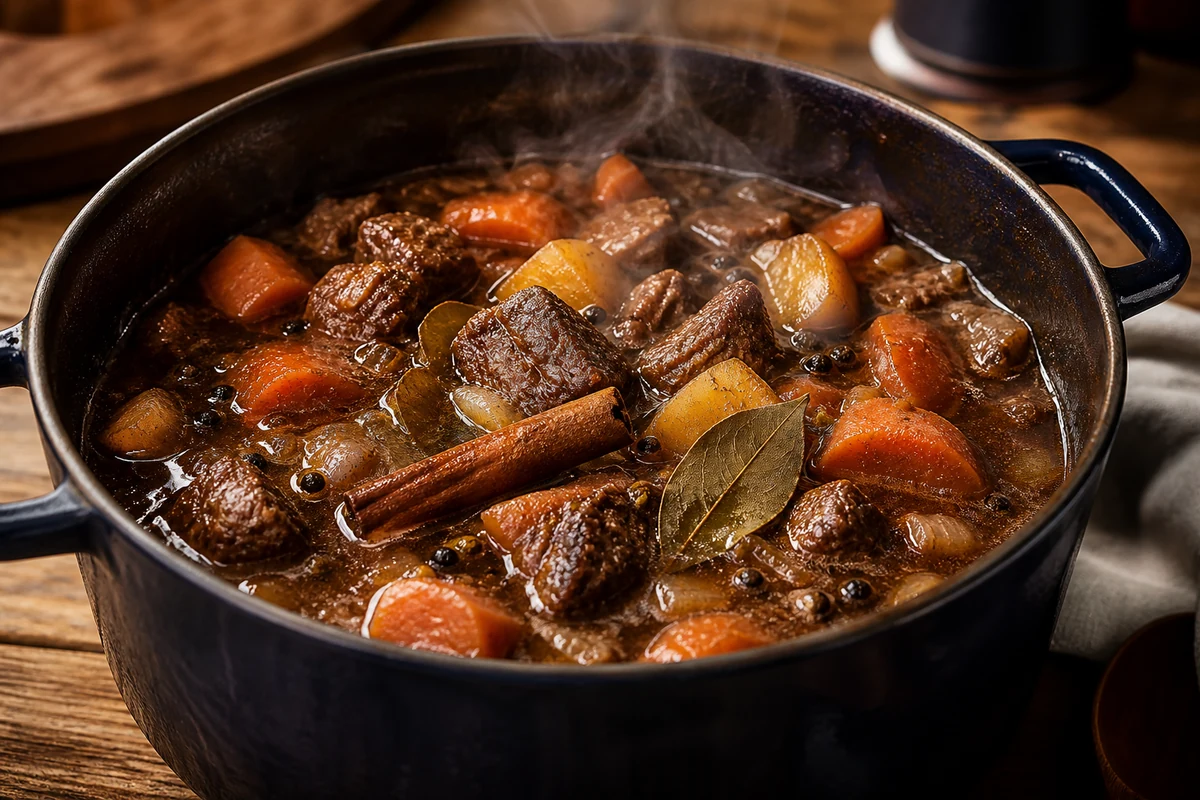
Nothing burns in a pot of liquid, so spices for soups and stews sort by time rather than heat. Ground spices give everything in the first ten minutes, whole spices need an hour before they say anything, and fresh herbs are finished within a minute of going in.
Why does a simmer change how spices behave?
Anything with liquid in it is held at boiling point until the liquid goes, which is around a hundred degrees Celsius.
That is far below the temperature at which spices scorch, so the whole question of which spices survive the heat simply does not arise here.
What replaces it is a question about time. Every spice in a pot is being extracted and, at the same time, losing its most volatile parts to the steam.
Those two clocks run at different speeds for different spices, and matching them is the entire skill.
| Spice form | Time to give up its flavor | Time before it fades |
|---|---|---|
| Ground spices | Minutes | Under an hour, and the top notes go first |
| Cracked or bruised whole | Twenty to forty minutes | Two hours or more |
| Whole hard spices | An hour or more | Survives the longest cook you will do |
| Fresh soft herbs | Seconds | Gone within minutes of going in |
| Dried leafy herbs | Twenty minutes | An hour or two |
| Bay | Thirty to sixty minutes | Improves for hours |
Read that table as a schedule rather than a ranking. Nothing in it is better than anything else, and each row simply belongs at a different point in the cook.
Should you bloom ground spices before adding broth?
The single step that changes a stew most is the one people skip when they are in a hurry.
Most of what we want from cumin, coriander, paprika and chile is fat-soluble rather than water-soluble. Stirred into a wet pot those compounds stay locked in the powder and the dish tastes dusty.
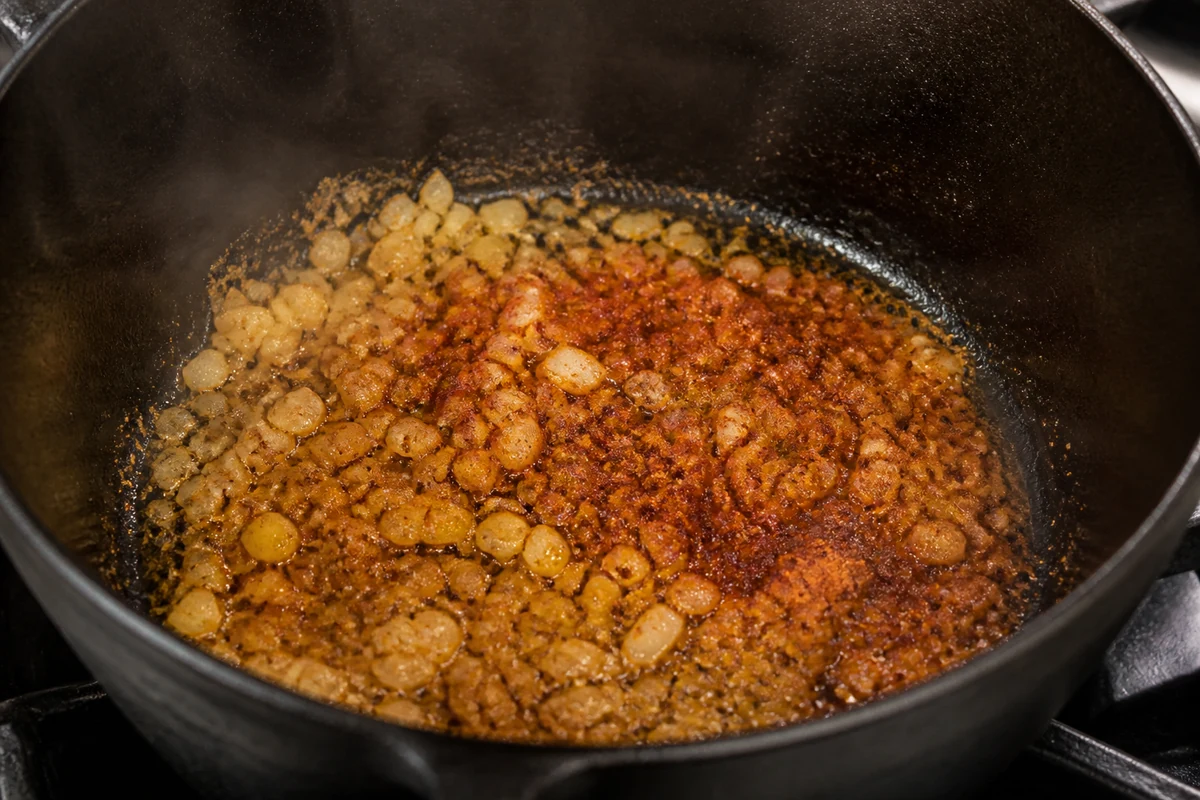
- When: After the onions soften, before any liquid goes in.
- How long: Thirty to sixty seconds, stirring constantly.
- The cue: The smell shifts from raw and dusty to round and toasted.
Thirty to sixty seconds in the hot fat at the start is enough. The powder darkens slightly, the smell turns from raw to round, and everything after that carries it.
Once liquid is in the pot, that door is closed. There is no way to bloom a spice in a simmering stew, which is why a spice added late to fix a bland dish never quite lands.
Which whole spices can stay through a long simmer?
A whole spice is a sealed package, and a long simmer is what opens it.
The hard aromatic spices belong here almost exclusively. Cinnamon stick, star anise, clove, cardamom pod, black peppercorn, coriander seed and cumin seed all release slowly and keep releasing for hours.
Ground versions of the same spices do the opposite. They give everything at once, and by hour two they contribute body and color but very little aroma.
| Spice | Whole in a long simmer | Ground in the same pot |
|---|---|---|
| Cinnamon | Warm background, builds over an hour | Strong at first, muddy and dull by the end |
| Coriander | Clean citrus note that lasts | Fades fastest of the common ground spices |
| Cumin | Deep and steady | Good early, thin later, and it clouds the liquid |
| Clove | Powerful, and two or three is plenty | Overwhelms almost immediately |
| Cardamom | Perfumed, released slowly from the pod | Loses its top note within twenty minutes |
| Black pepper | Aroma throughout, heat that stays | Heat stays, aroma disappears |
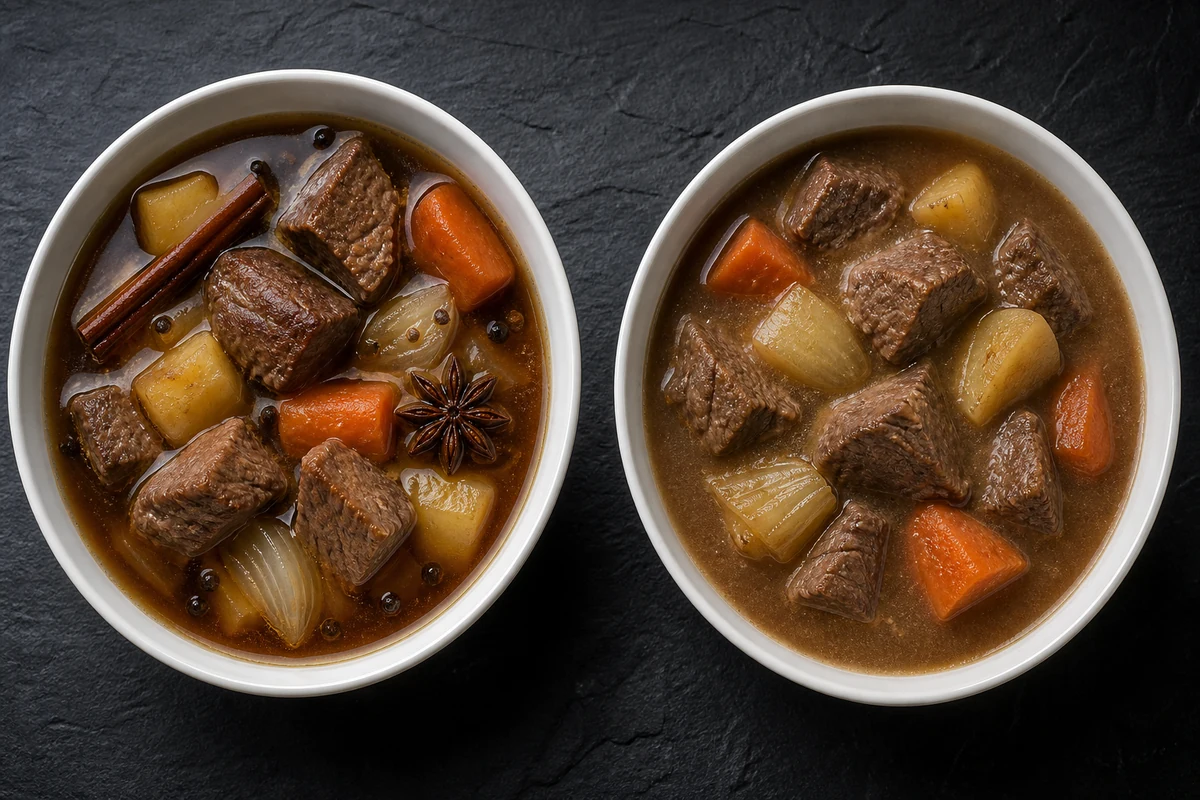
- Left: Clear liquid, whole spices intact and still releasing.
- Right: Cloudy and muddy, the ground spice already spent.
- At the table: The left still smells of spice, the right smells of stew.
The sensible arrangement uses both. Ground spice bloomed in fat at the start for depth, and whole spice dropped into the liquid for aroma that is still there at the end.
Whole spices in a finished stew are a genuine nuisance, and biting a clove is unpleasant enough to spoil a mouthful.
A muslin bag or a tea infuser solves it, and so does a bundle tied with string. The traditional bouquet garni is exactly this idea applied to herbs.
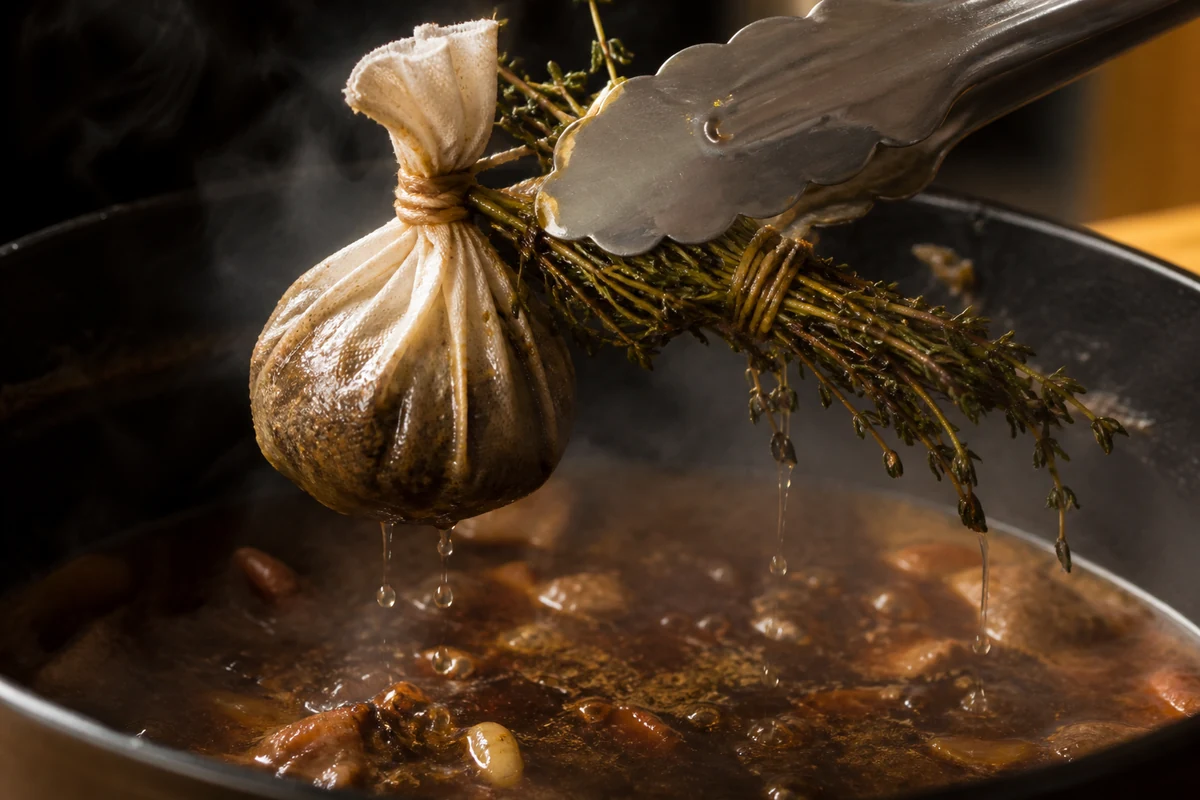
- In the bag: Cinnamon, clove, cardamom, peppercorns, anything hard.
- In the bundle: Parsley stems, thyme sprigs, bay.
- When it comes out: Once the flavor is there, usually before the final reduction.
Take it out when the dish tastes right rather than at a fixed time. Left in through a long reduction, cloves and bay keep giving and can tip a balanced pot into medicinal.
Parsley stems belong in that bundle rather than in the bin, which is covered under parsley.
Bay is the most misunderstood thing in the store cupboard, because a single leaf tasted on its own seems to do nothing.
It is not a top note and it never was. Its contribution is a background savoriness that only appears after half an hour in liquid, and it is far more obvious by its absence than its presence.
The test is worth doing once. Make the same stock twice, with and without bay, and taste them side by side.
Fresh bay is stronger than dried and needs about half as many leaves, which is the reverse of most herbs.
Check what you actually own before trusting either number. Bay sold cheaply is sometimes another laurel-like leaf altogether, and a jar that has sat open for three years is barely bay at all.
A leaf that still smells clearly of eucalyptus and pine when you crack it is worth using. One that smells of dust is taking up space in the pot.
Which spices and herbs should go in at the end?
The aromatics you actually smell at the table are the ones that went in last, because everything volatile has left the pot long before.
Fresh soft herbs are the clearest case. Parsley, coriander leaf, dill and basil are finished within a minute of hitting a simmer, so they go on off the heat.
- Bloom at the startGround spices in the fat with the onions.
- Drop in for the long cookWhole spices and bay, in a bag if you can.
- Check at the halfway pointTaste, and pull the bag if the spice is already there.
- Wake it up at the endA pinch of the same ground spice, off the heat.
- Add acid lastVinegar or lemon after the heat is off, a teaspoon at a time.
- Finish with freshChopped soft herbs on the plate rather than in the pot.
That fourth step is worth its own mention. A small pinch of the same ground spice stirred in at the end restores the top note that hours of simmering removed, and it costs nothing to try.
Black pepper deserves the same treatment for the same reason. Its heat survives a long cook while its aroma does not, so pepper added at the start and again at the end does two different jobs.
How much spice should you use for a two-liter pot?
Recipes are vague about spice quantity in a way they never are about salt, and a starting point helps.
These amounts assume a pot of about two litres serving four, and they are a floor rather than a target. A stew that tastes of one spice was usually built on a single large amount rather than several modest ones.
| Spice | Amount | Form and timing |
|---|---|---|
| Ground cumin or coriander | 2 tsp | Bloomed in fat at the start |
| Paprika | 1 to 2 tsp | Bloomed, and off the direct heat |
| Cinnamon | 1 stick | Whole, in with the liquid |
| Clove | 2 or 3 | Whole, and easy to overdo |
| Cardamom | 4 to 6 pods, bruised | Whole, in a bag |
| Black peppercorns | 1 tsp | Whole at the start, ground again at the end |
| Bay | 1 or 2 dried leaves | In from the start, out at the end |
| Dried chile | 1 or 2 whole | Whole, and removed once the heat is right |
Whole dried chiles are worth using instead of powder here. Dropped into the liquid they give fruit and warmth without the dusty heat of chile powder, and you can lift them out the moment the pot is hot enough.
How do pressure cookers and slow cookers change the timing?
Both of these break the assumption that aromatics escape with the steam, and they break it in opposite directions.
A pressure cooker is sealed, so nothing volatile leaves. Aromatics that would have boiled away are still in the pot when you open it, and the usual quantity of spice comes out noticeably stronger.
Cut the spice back by about a third in one, and expect whole spices to give up more than they would in the same time on the stove.
A slow cooker has the opposite problem. It rarely reaches a real simmer, so extraction from whole spices is slow and the pot can taste underspiced after eight hours.
Blooming matters most of all there. Since the slow cooker cannot brown anything, doing the onions and ground spices in a pan first is the difference between a flat result and a good one.
When should you salt a soup or stew that will reduce?
Salting a stew is not the same as salting anything else, because the liquid is leaving while the salt stays.
A pot seasoned correctly at the start is over-seasoned by the time it has reduced by a third. There is no way to take it back out.
- Season lightly at the start, enough to draw flavor out of the vegetables.
- Do not adjust again while the liquid is still visibly reducing.
- Taste once the reduction is finished and the dish is close to done.
- Bring it up to seasoning then, in small additions.
- Remember that salty things added late, such as soy or anchovy, count.
Acid follows the same logic and belongs even later. Vinegar and lemon juice lose their brightness to heat, so the spoonful that lifts a heavy stew goes in after the pot comes off.
Why do soups and stews taste better the next day?
Almost every spiced stew improves overnight, and there are two ordinary reasons rather than anything mysterious.
Extraction carries on in the cold. Whole spices, aromatics and connective tissue keep releasing into the liquid for hours after the heat is off.
The other reason is redistribution. A freshly cooked stew has its flavor unevenly spread through meat, vegetables and liquid, and a night in the fridge evens it out.
That is also why a stew you plan to keep should be under-finished. Leave the fresh herbs, the final pinch of spice and the acid until the reheat, and the second day tastes like the first day should have.
Reheat gently rather than at a boil. A hard reheat drives off what little aroma survived, which is covered under balancing flavors.