
What Is Nutmeg, and Why Grate Less Than You Think?
Grate whole nutmeg lightly, especially where cream, egg, butter, spinach, potato, or pastry carries the aroma.
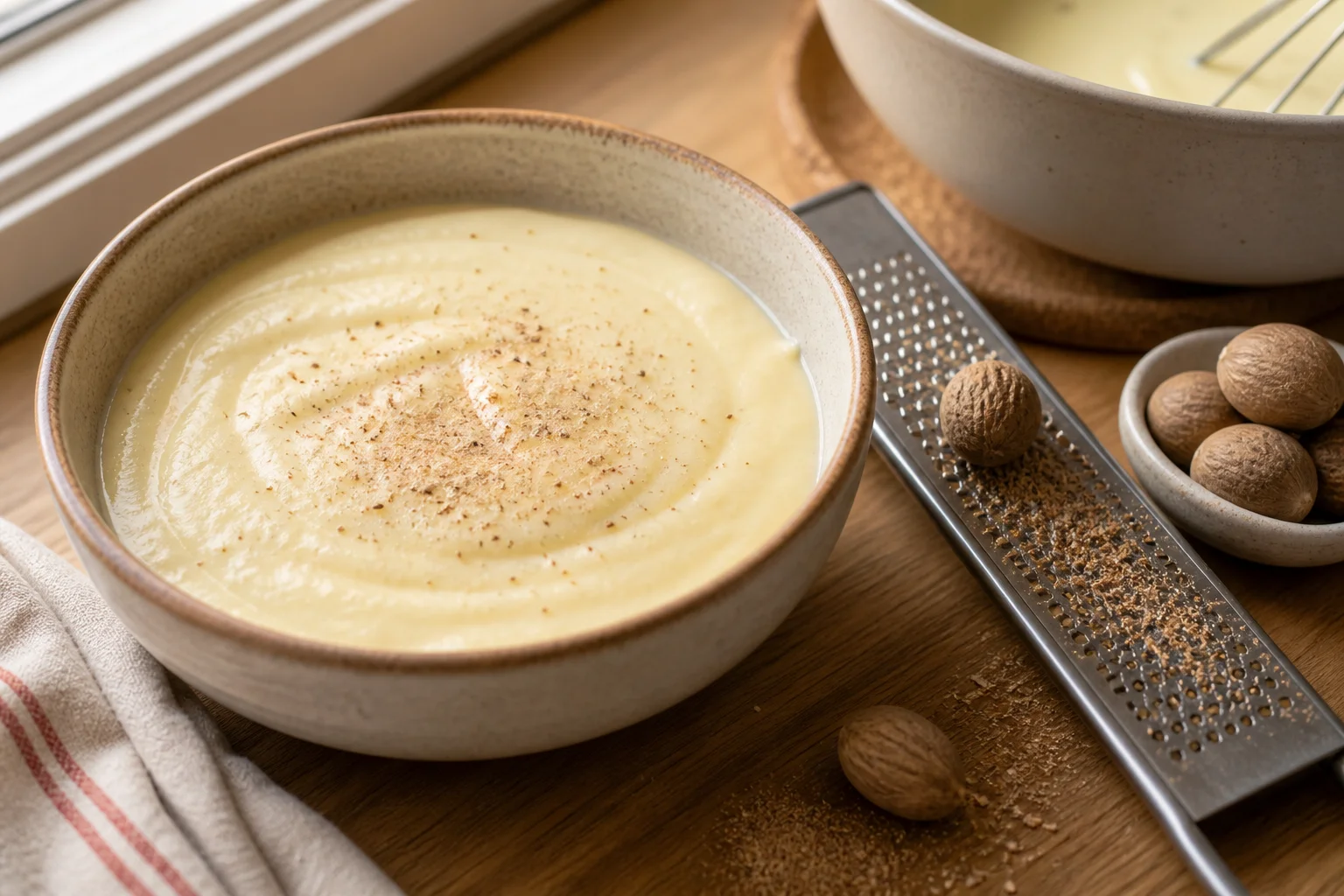
Nutmeg is the seed kernel of Myristica fragrans, used in very small amounts for warm, sweet, woody aroma. Fresh grated nutmeg tastes rounder than old ground powder because its volatile aroma fades quickly after grinding. Use it lightly in custard, cream sauce, potatoes, spinach, squash, baking, and spice blends.
Why fresh grated nutmeg tastes bigger but needs less
Nutmeg is the hard seed of Myristica fragrans, and freshly exposing its surface releases a warm, sweet, woody aroma that a long-open jar cannot match. A few fresh strokes can therefore season more clearly than a larger spoonful of tired powder.
Cream, egg, butter, potato, squash, and cooked greens catch that aroma in fat or starch. A lean broth exposes the resinous edge sooner because there is less body to soften it.
The same tree also produces mace, the lacy aril wrapped around the seed. Mace runs lighter and more floral, while nutmeg carries the deeper woody note.
Choose jar-ground nutmeg when the spice should disappear evenly inside cake batter, pumpkin bread, or cookies. Choose fresh grates when the aroma reaches the nose first, as it does in custard, bechamel, creamed spinach, or eggnog.
Whole nutmeg gives better dose control because two or three strokes are easier to stop than a tipped spoon of powder.
How much nutmeg should go into sweet and savory food?
Nutmeg should register as warmth, not announce itself as the main flavor. Start with a few grates.
In dairy, a tiny dose can taste larger after two minutes. Warm fat catches the aroma and spreads it through the sauce.
In baking, nutmeg has more room.
Flour, sugar, eggs, and cinnamon soften the seed note before it reaches the palate.
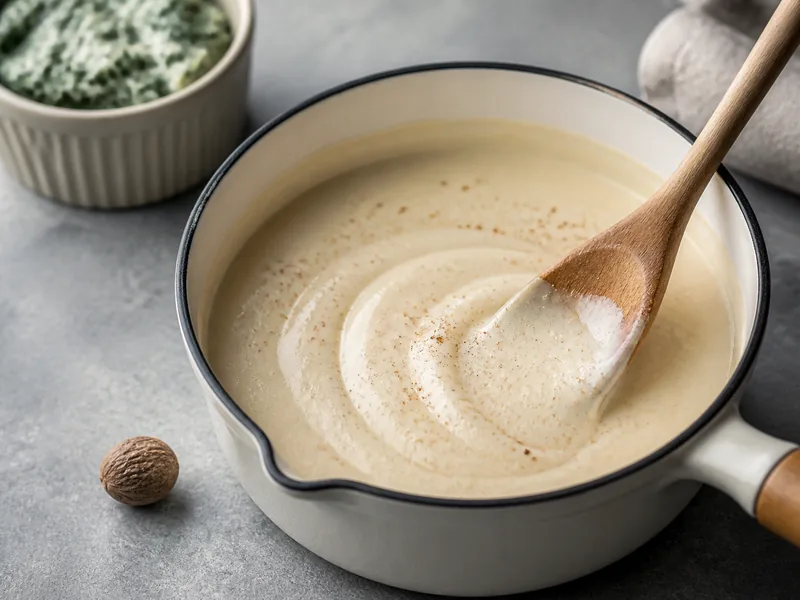
- Sparse dusting: Begin with a few fine flecks rather than a brown layer.
- Rich carrier: Butter and milk spread the aroma through the sauce.
- Savory check: The sauce should smell warmer without tasting like baking spice.
- Stop cue: If nutmeg is the first flavor you can name, do not add another scrape.
| Dish | Starting amount | Stop when |
|---|---|---|
| Custard or eggnog | 1/8 teaspoon per quart | Cream smells warm, not spicy |
| Creamed spinach | 2 to 4 fresh grates | Greens taste rounder |
| Mashed potatoes | A pinch per pound | Butter tastes deeper |
| Cake or quick bread | 1/4 teaspoon per loaf | Cinnamon still leads |
Taste before adding another scrape. Nutmeg often blooms after a few minutes in warm dairy or butter.
Fresh grating also changes measuring. Count strokes or pinches when the recipe only says a dash.
For a white sauce, stop when the steam smells faintly warm.
If the sauce smells like spice, you have gone too far.
For mashed potatoes, let butter and milk carry the aroma before adding more salt. Salt can sharpen a heavy nutmeg dose.
For custard, add nutmeg before chilling only if you want the spice woven through. Dust the top for clearer aroma.
What is nutmeg, and how is mace different?
Nutmeg and mace grow on the same tree, inside the same fruit.
Myristica fragrans produces an apricot-like fruit that splits open when ripe. Inside sits a single dark seed, and wrapped around that seed is a bright red lacy web.
The seed dried is nutmeg. The web dried is mace.
They are the only two spices in common use that come from one fruit, which is why their flavors run so close together.
Mace is the lighter of the two. It carries the same warm sweetness with more citrus and less of the resinous depth, so it suits pale sauces, custards, and clear soups where nutmeg would read as heavy.
Color is the practical difference in a kitchen.
Nutmeg speckles a white sauce brown while mace tints it a faint orange, and that alone decides which one a classic bechamel calls for.
Substituting one for the other works with an adjustment. Use slightly less nutmeg where a recipe asks for mace, because the resinous side arrives faster than the citrus side does.
| Nutmeg | Mace | |
|---|---|---|
| Part of the fruit | The seed | The lacy aril wrapping the seed |
| Color dried | Warm brown | Orange to rust red |
| Flavor | Warm, sweet, resinous, deeper | Warm, sweet, more citrus, lighter |
| Best in | Cream sauces, potato, sausage, baking | Pale sauces, custards, clear soups |
| In the jar | Whole seed or ground | Whole blades or ground |
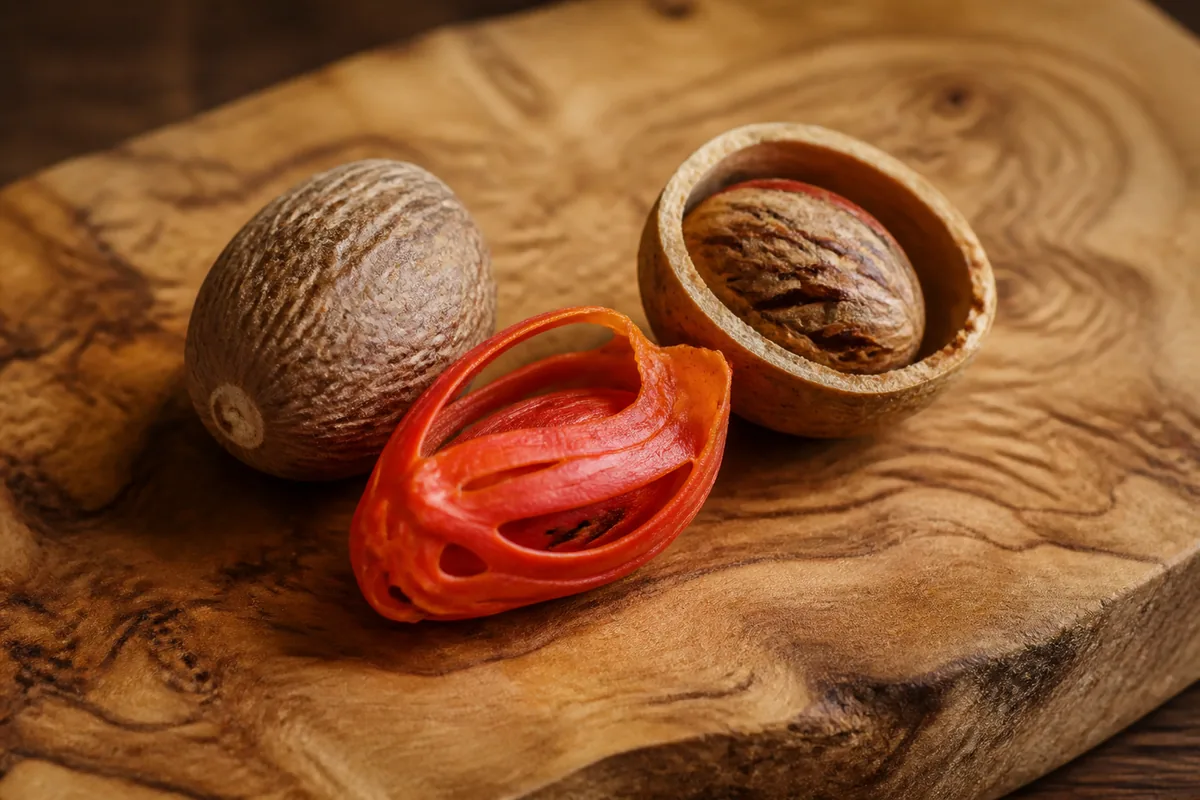
- The fruit: Apricot-like, splits open on the tree when ripe.
- The seed: Dried, this is nutmeg.
- The red web: Dried, this is mace.
- In a white sauce: Nutmeg speckles it brown, mace tints it faintly orange.
Where does nutmeg belong in savory cooking?
Nutmeg works in savory food when richness needs lift without chile heat or citrus acid.
Classic uses include béchamel, creamed spinach, potato gratin, pumpkin, squash, sausages, and some meat pies.
The pattern is fat plus softness. Nutmeg cuts through creamy weight without making the dish taste sour or spicy.
Spinach and chard show the effect quickly because their mineral bitterness can taste flat under cream. Nutmeg adds lift.
- Cream sauce: Add a tiny amount after the flour taste cooks out.
- Greens: Pair with butter, cream, or olive oil so bitterness stays controlled.
- Potatoes: Use a pinch with butter and milk before adding more salt.
- Squash: Pair with cinnamon, ginger, black pepper, or sage depending on sweetness.
Nutmeg should make savory food taste rounder.
If it tastes like dessert, the dose is too high.
In white sauces, add it after the roux cooks but before final salt. Salt can make the aroma feel sharper.
In meat dishes, use it as background warmth. It should support clove, pepper, or allspice, not replace them.
In sausages and meat pies, nutmeg should disappear into pepper, mace, or clove.
If you identify it first, reduce it.
In baking, nutmeg often sits behind cinnamon, ginger, and cloves. That balance keeps it warm instead of soapy.
Savory nutmeg needs less sweetness around it. Let butter, onion, cream, or potato carry the warmth instead.
This is why nutmeg fails in lean tomato sauce. Acid and water expose the woody edge before fat can soften it.
When does nutmeg belong in sweet baking?
Nutmeg belongs in sweet baking when the recipe needs warmth behind cinnamon, not a louder spice headline.
Pumpkin pie, custard pie, doughnuts, spice cake, apple filling, and eggnog all give nutmeg enough fat or starch.
Use it differently from cinnamon. Cinnamon can lead a blend, while nutmeg usually rounds the middle.
Clove and allspice can make nutmeg taste medicinal when all three run high. Keep one strong spice in charge.
Fresh nutmeg on top of eggnog or rice pudding behaves like a finishing aroma.
Ground nutmeg inside batter behaves like background warmth.
If a dessert already has vanilla, butter, and eggs, nutmeg can make those flavors taste deeper. It should not taste woody.
In the dish, vanilla and nutmeg work well together because vanilla softens the seed edge. The pairing suits custards and cream desserts.
For quick breads, measure ground nutmeg.
Fresh grating can clump on wet batter if you do not whisk the dry mix first.
For apple desserts, nutmeg should sit behind fruit acidity. Too much makes the filling taste brown before it tastes fresh.
For chocolate, use even less. Cocoa already brings bitterness, so nutmeg should only warm the background.
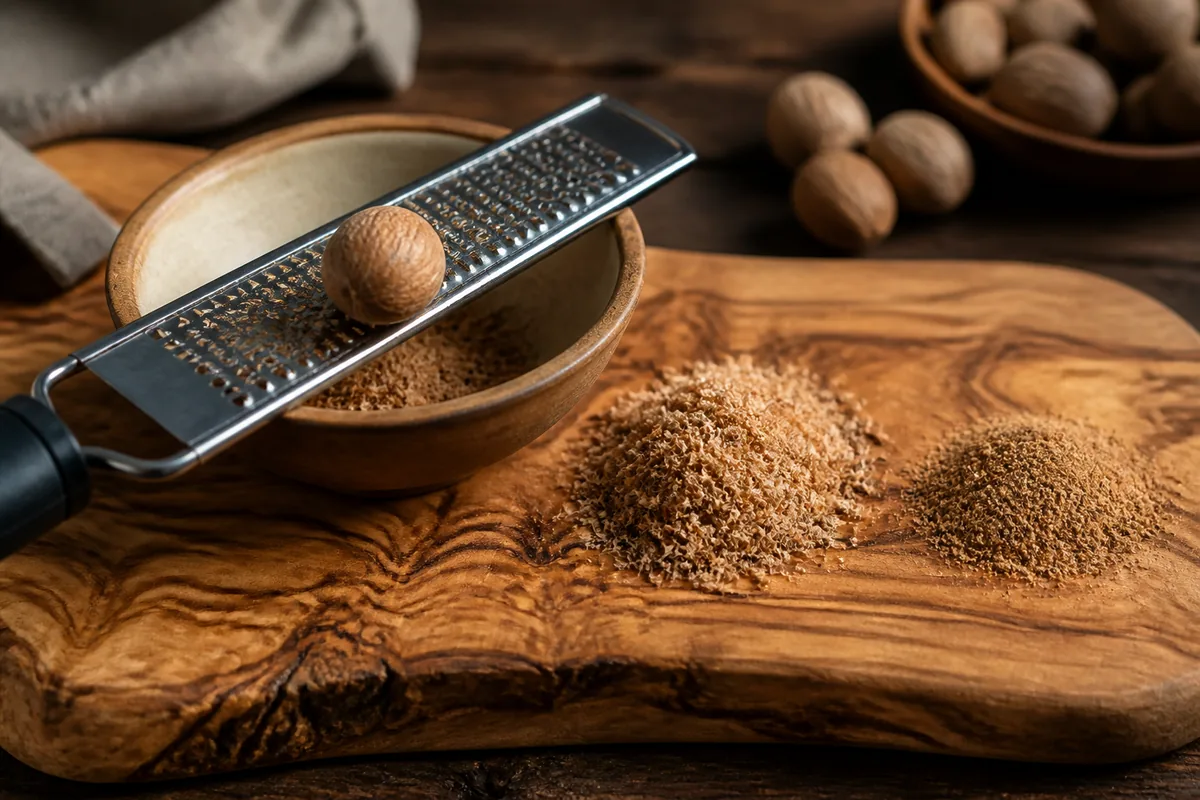
- Freshly grated: Pale, fluffy, and loud. A few passes is usually enough.
- Pre-ground: Darker, denser, and quieter within months of opening.
- The consequence: A recipe written for pre-ground will overshoot if you grate fresh.
- Storage: A whole seed keeps for years, ground nutmeg fades in a season.
Why old ground nutmeg tastes dusty
Whole nutmeg protects aroma until you grate it.
Ground nutmeg exposes much more surface area to air and light.
That is why whole spices last longer than ground spices. Nutmeg is one of the clearest pantry upgrades.
Old ground nutmeg does not simply become weak. It often leaves a dry sawdust note that pushes cooks to overuse it.
A whole seed can look unchanged while still fading.
Scratch it with a grater and smell the cut surface before trusting it.
| Form | Best use | Storage cue |
|---|---|---|
| Whole nutmeg | Finishing, dairy, baking, greens | Hard seed with strong aroma when scratched |
| Fresh grated | Visible aroma moments | Use immediately after grating |
| Ground jar | Baking where it blends with other spices | Replace when it smells like sawdust |
Buy whole nutmeg if you own a microplane or small grater. The seed lasts far longer than a jar of powder.
Keep ground nutmeg only if you bake often. Otherwise the jar will go quiet before you finish it.
Whole nutmeg also travels well in a baking drawer.
One seed can perfume many batches without occupying a full jar slot.
Scratch the seed before grating. If the aroma is faint, the seed is old or badly stored.
Do not store a whole seed beside the stove just because it feels durable. Heat still drives aroma loss.
A small grater changes the buying decision.
Once you own one, whole nutmeg becomes easier than replacing stale powder.
Should nutmeg go in before or after cooking?
Nutmeg is a finishing spice far more often than a cooking one.
Its aroma sits in volatile compounds that leave with steam, so a long simmer strips most of what you paid for. A sauce seasoned at the start tastes of very little by the time it is served.
Grate it in during the last few minutes.
A bechamel, a soup, or a pan of creamed spinach wants nutmeg once the cooking is essentially done and the pot is off a hard boil.
Baking is the exception, because the batter traps it.
A cake or a custard holds nutmeg inside a set structure rather than boiling it off, so it goes in with the dry ingredients like any other spice.
Anything grated at the table is finishing by definition.
Eggnog, a bowl of pasta, and a mug of hot milk all take their nutmeg last, which is why the little grater lives near the table rather than the stove.
- Sauces and soups: Grate in during the last few minutes, off a hard boil.
- Baking: In with the dry ingredients, because the batter holds it.
- At the table: Eggnog, pasta, hot milk. Grated last, over the bowl.
- Never at the start: A long simmer takes the aroma out with the steam.
What can replace nutmeg?
A nutmeg substitute should match warm sweetness, not the exact seed flavor. The right backup depends on the dish.
Mace is closest in cream and custard because it comes from the same fruit. It tastes lighter and less woody.
Allspice works better in darker sweets, squash, and meat pies.
It brings clove-like warmth, so use less.
| Nutmeg substitute | Ratio | Where it fits |
|---|---|---|
| Mace | 1:1 | Cream, custard, baking, light sauces |
| Allspice | 1:2 | Cakes, pies, meat pies, squash |
| Cinnamon plus clove | 2:1 blend, use half | Sweet baking |
| Garam masala | Tiny pinch | Savory Indian-style food only |
In the dish, allspice can replace part of the warmth in cakes, but it cannot copy fresh nutmeg aroma.
Do not replace nutmeg with equal clove. Cloves are stronger and turn medicinal faster.
In the dish, cardamom can help in custard or rice pudding, but it moves the flavor toward citrus and perfume.
In savory cream sauce, skip the substitute if none fits. Pepper, cheese, onion, or bay may serve the dish better.
In baking, keep the total spice level steady. Replacing nutmeg with several warm spices can crowd the crumb.
What do you do with the last stub of a nutmeg?
A nutmeg grates down to a nub that is too small to hold safely.
Most cooks lose a knuckle-worth of skin to that last centimeter, and the sensible answer is to stop grating rather than push on. The stub is not wasted.
Drop the nub whole into something wet and slow.
A pot of rice pudding, a simmering bechamel, or a jar of mulled wine syrup pulls flavor from an intact piece over time, and it comes out easily at the end.
A nutmeg grater with a hinged lid solves the problem differently.
The compartment holds the stub against the blade so your fingers never approach it, which is exactly what those small boxed graters were designed for.
How much nutmeg is genuinely too much?
Nutmeg belongs in pinches and light grates, and there is no useful home threshold for experimenting with a large dose. Normal recipe amounts are far below the quantities described in poisoning reports.
A 1998 toxicology review noted intoxications after roughly 5 grams of nutmeg. That figure is a report boundary, not a safe limit, because nutmeg composition, body size, medicines, and other exposures can change the outcome.
A 2014 review of Illinois Poison Center records found 32 reported nutmeg exposures over ten years. Intentional ingestion and cases involving other drugs required the clearest medical attention, while young children accounted for many unintentional exposures.
Poison Control lists nausea, vomiting, agitation, prolonged drowsiness, hallucinations, and coma among possible effects of swallowing too much. Symptoms may be delayed, so waiting for a person to look ill is a poor response to a known large ingestion.
This medical boundary does not make ordinary seasoning unsafe. It supports the same culinary rule the flavor does: grate a little, let the aroma spread, then decide whether the dish needs more.
How to fix too much nutmeg
Too much nutmeg tastes harsh, bitter, or soapy. Dilution works better than adding another strong spice.
In dairy dishes, add more plain base first.
Milk, cream, potato, pasta, or greens give the aroma more room.
In baking, the best fix happens before the pan. Add more batter if you can still scale the recipe.
- Dairy dishes: Add more milk, cream, potato, pasta, or greens before adding sugar.
- Baking batter: Increase plain batter if possible, or add cinnamon to redirect warmth.
- Soup: Add stock and fat, then correct salt after the aroma softens.
- Sauce: Strain if whole grated specks are concentrated in one spot.
Avoid chasing nutmeg with more clove, allspice, or ginger. That usually makes the warm-spice problem louder.
If the finished dish is only slightly heavy, serve it with something plain.
Bread, potatoes, rice, or greens can soften the bite.
If the dish tastes medicinal, stop adding warm spices. Rebuild body and salt instead.