
What Is Vanilla, and When Is Imitation Good Enough?
Use real vanilla where aroma stays visible; use imitation only where heat and browning hide the difference.
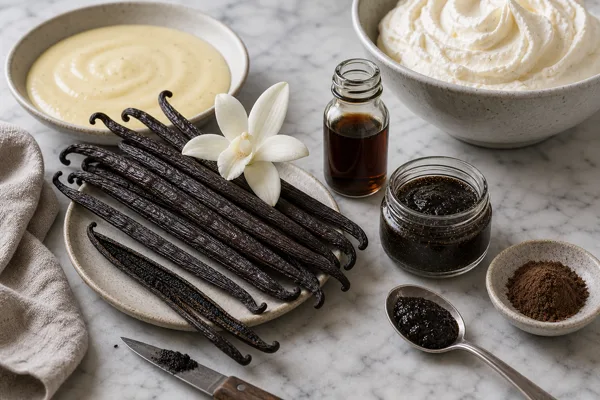
Imitation vanilla has 1 flavor compound while real vanilla has 250+, and the price reflects 12–15 months of hand-pollination and curing. Use Madagascar Bourbon for universal baking, Tahitian only for cold unheated applications, and Mexican for chocolate and mole, with vanilla paste the most practical daily format. Any product labeled only "natural flavors" or without a listed origin should be treated as suspect.
How vanilla became a synonym for boring
In the 20th century, "vanilla" stopped meaning one of the world's most complex flavors and started meaning "default", "nothing special," "plain."
This is a direct consequence of imitation vanilla extract.
Imitation extract is primarily vanillin, a single aromatic compound originally synthesized from lignin (wood pulp). It smells like vanilla the way a photograph smells like the place it depicts.
- Imitation: One dominant vanillin note gives sweetness but little depth.
- Real extract: Hundreds of compounds add floral, creamy, smoky, and woody edges.
- Best test: Taste both in cold custard or whipped cream, where heat cannot hide the difference.
Real vanilla contains over 250 flavor compounds. Vanillin is one of them, the loudest one, but the rest create the complexity, warmth, and almost creamy depth that makes real vanilla unmistakable.
When generations grew up eating imitation vanilla in mass-produced cookies and ice cream, the association of vanilla with flat sweetness became cultural. Real vanilla corrects that.
Why vanilla is so expensive
Vanilla is the only fruit-producing orchid genus. Outside its native Mexico, there is no natural pollinator, every flower must be hand-pollinated within 12 hours of opening.
The vanilla orchid's only native pollinator is a stingless bee (Melipona) found exclusively in Mexico's Totonac region, the origin of all commercial vanilla cultivation.
A vanilla plant flowers for one day. Plantation workers walk the rows every morning, identifying overnight blooms and pollinating each one by hand with a small stick.
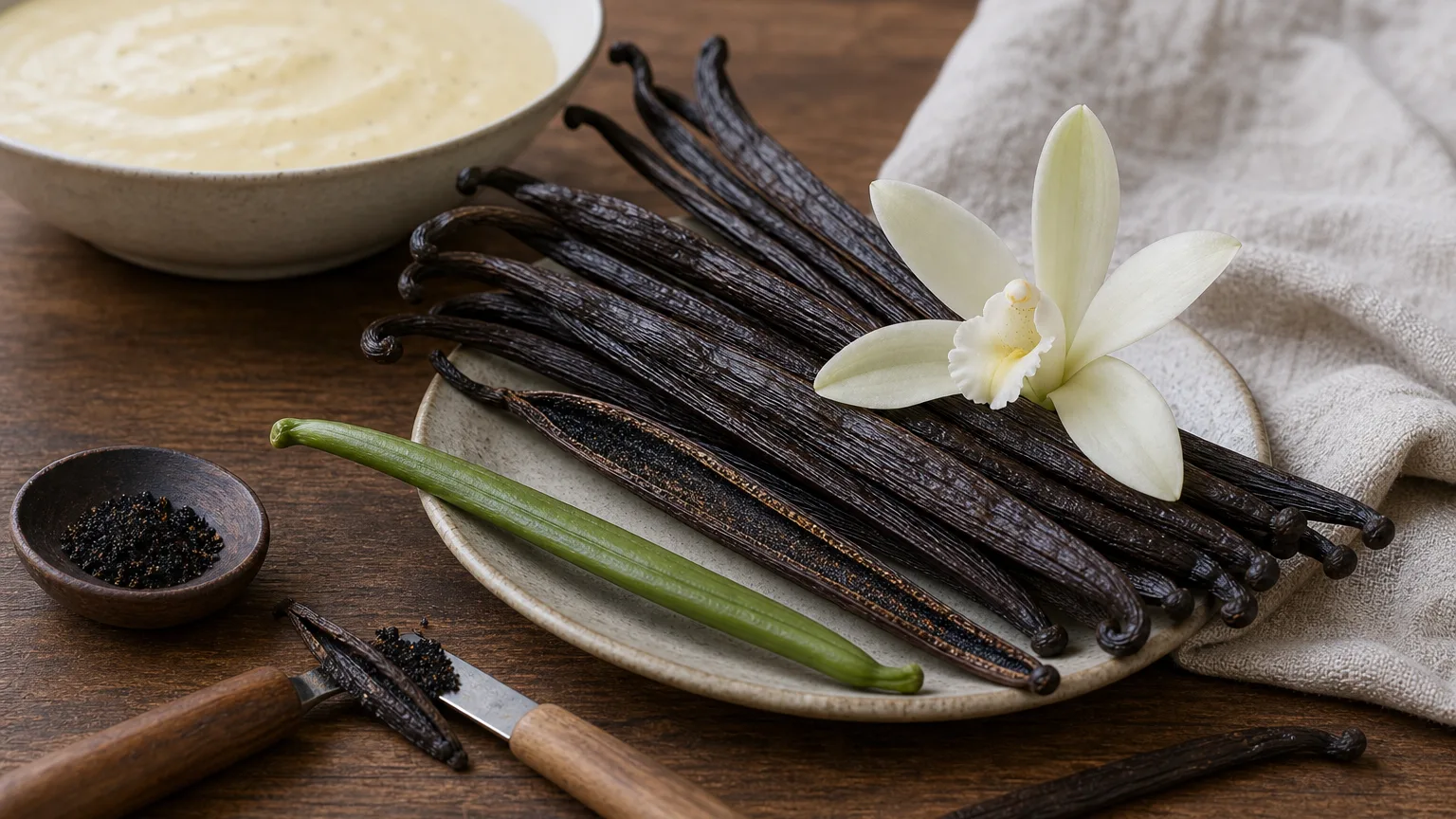
- Flower window: The bloom must be handled quickly after opening.
- Green pod: Flavor is not ready until the bean matures and cures.
- Cured beans: Drying and conditioning create the aroma bakers pay for.
- Custard test: Pale dairy exposes real vanilla more than browned cookies do.
After pollination, the bean takes 9 months to mature. After harvest, curing, drying, sweating, and conditioning, takes another 3–6 months before the bean is usable.
Only saffron rivals vanilla in labor intensity per unit weight, both require hand-harvesting steps that cannot be mechanized at any scale.
The 12–15 month cycle from flower to finished bean explains the price. Hand labor at every stage keeps real vanilla from behaving like a commodity.
Madagascar, Tahitian, and Mexican: three different ingredients
The origin determines the flavor. Madagascar Bourbon, Tahitian, and Mexican vanilla are not interchangeable, they have distinct flavor profiles suited to different applications.
| Madagascar (Bourbon) | Tahitian | Mexican | |
|---|---|---|---|
| Flavor | Creamy, sweet, full, classic | Floral, fruity, anise-like, delicate | Spicy, smoky, complex |
| Best for | Baking, custards, ice cream, universal | Delicate cold desserts, raw fruit prep | Chocolate dishes, mole, savory |
| Heat stability | Strong, holds up to baking | Delicate, loses character when baked | Strong and complex |
| Availability | Common | Rare, most expensive | Specialty stores |
Madagascar Bourbon vanilla ("Bourbon" refers to the island of Réunion, formerly Bourbon, not the whiskey) is the global standard. Over 80% of the world's vanilla comes from Madagascar and pairs naturally with cinnamon in warm custards and baked goods.
Tahitian vanilla (Vanilla tahitensis) is a different species. Its floral, cherry-like character works beautifully in cold applications with cardamom.
Those same delicate Tahitian compounds evaporate quickly in a hot oven, use Tahitian only in cold or room-temperature preparations where its subtlety survives.
Mexican vanilla is smokier and more complex. It pairs unusually well with chocolate and dried ancho chili in mole negro.
For everyday baking, Madagascar Bourbon is the correct default. Tahitian and Mexican are specialty ingredients used when their specific character is the point.
Bean, extract, paste, or powder, which to use
Whole vanilla beans deliver the full flavor spectrum: seeds, pod, and the infusion potential of both. They are the best format when vanilla is the central flavor.
Split lengthwise with a sharp knife. Scrape the seeds with the back of the blade and add to the recipe.
Add the spent pod to a jar of sugar alongside a clove or two, the aromatic compounds infuse into the sugar over several weeks.
Pure vanilla extract is beans macerated in alcohol over months. Look for extract listing "vanilla bean extractives" or a specific origin, not just "natural flavors," which can mean partial vanillin.
In traditional spice blends, vanilla pairs naturally with nutmeg in warm custard applications, both spices share a creamy-warm character that amplifies in fat-rich bases.
Vanilla paste is seeds suspended in thick syrup, the most practical daily format. You get visible seeds without splitting beans each time, and the intensity is close to a whole bean.
I switched my bakery to paste three years ago and never went back. The whole beans are for special applications where the pod itself matters. For everything else, paste gives you the seeds and the intensity without splitting individual beans every morning.
Claire MarchettiPastry chef, 12 years professional bakery
Vanilla powder (dried, ground beans) works well where liquid extract would affect texture. In dry spice blends alongside ginger for warm-spiced baking, powder distributes more evenly than extract in the dry ingredient mix.
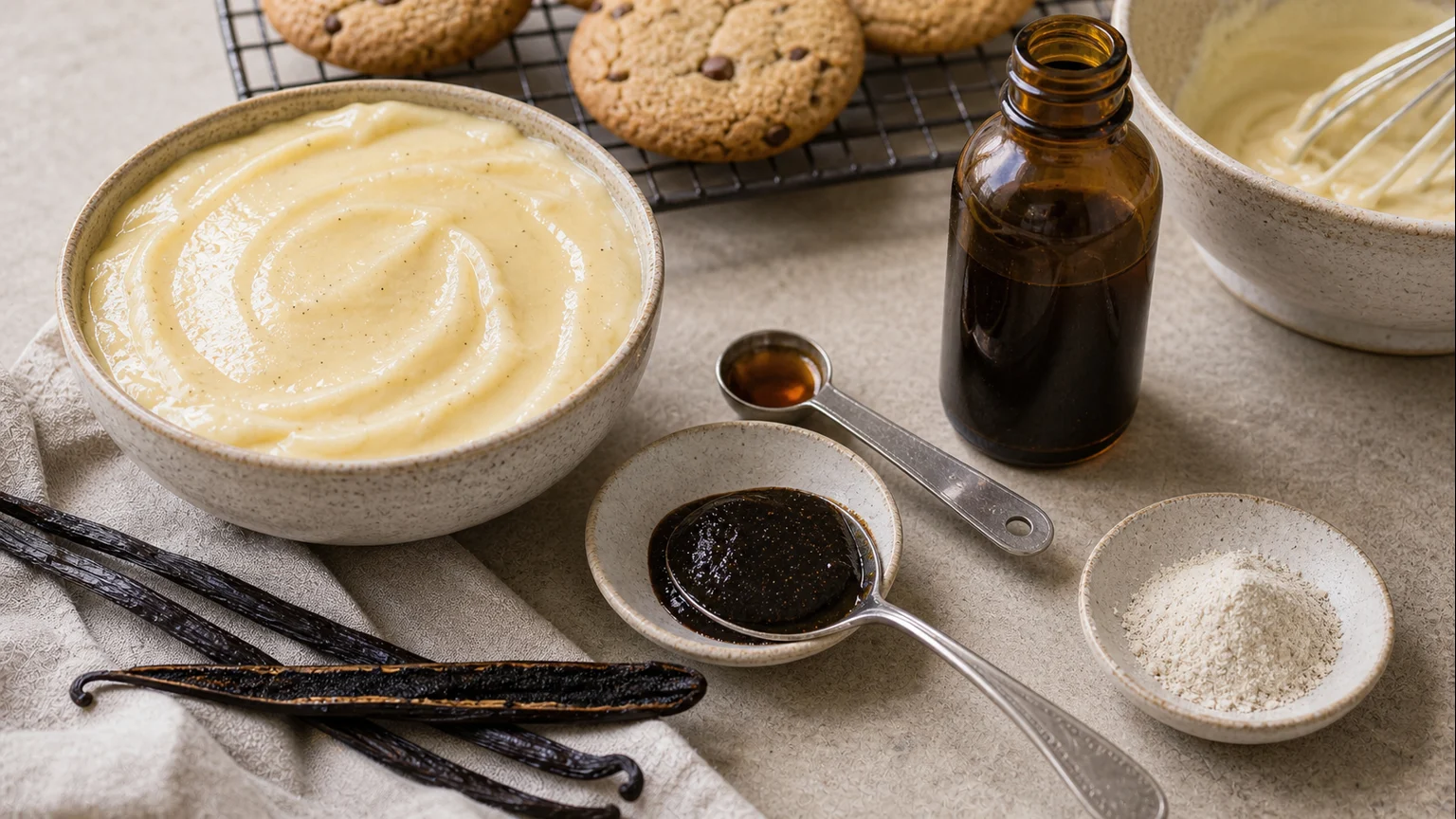
- Beans: Use when visible seeds and pod infusion are part of the dish.
- Extract: Use when liquid disappears into batter or syrup.
- Paste: Use when you want seeds without splitting a bean.
- Powder: Use when extra liquid would damage dough or dry mix texture.
How to substitute vanilla forms
Vanilla substitutions should preserve intensity and texture. A spoonful of extract does not behave like scraped seeds in every recipe.
Use extract when liquid can disappear into the batter. Use paste or beans when the vanilla is visible and central.
| If the recipe asks for | Use instead | Best context |
|---|---|---|
| 1 vanilla bean | 1 tablespoon paste or 2 teaspoons extract | Custards, cakes, ice cream bases |
| 1 teaspoon extract | 1 teaspoon paste | Cookies, frosting, whipped cream |
| 1 teaspoon paste | 1 teaspoon extract plus seeds if available | Most baking |
| Vanilla powder | Half the amount of extract | Dry mixes, spice blends, low-moisture doughs |
Imitation vanilla can work in high-heat cookies where sugar and browning dominate. It falls short in ice cream, custard, buttercream, and anything uncooked.
Storing vanilla without wasting it
Vanilla loses aroma through air exposure. The fix is a small bottle, tight cap, and dark cabinet, not a decorative jar near the stove.
Beans need flexibility, extract needs a tight cap, paste needs a clean rim, and powder needs dryness. Treating every form the same is how expensive vanilla becomes flat vanilla.
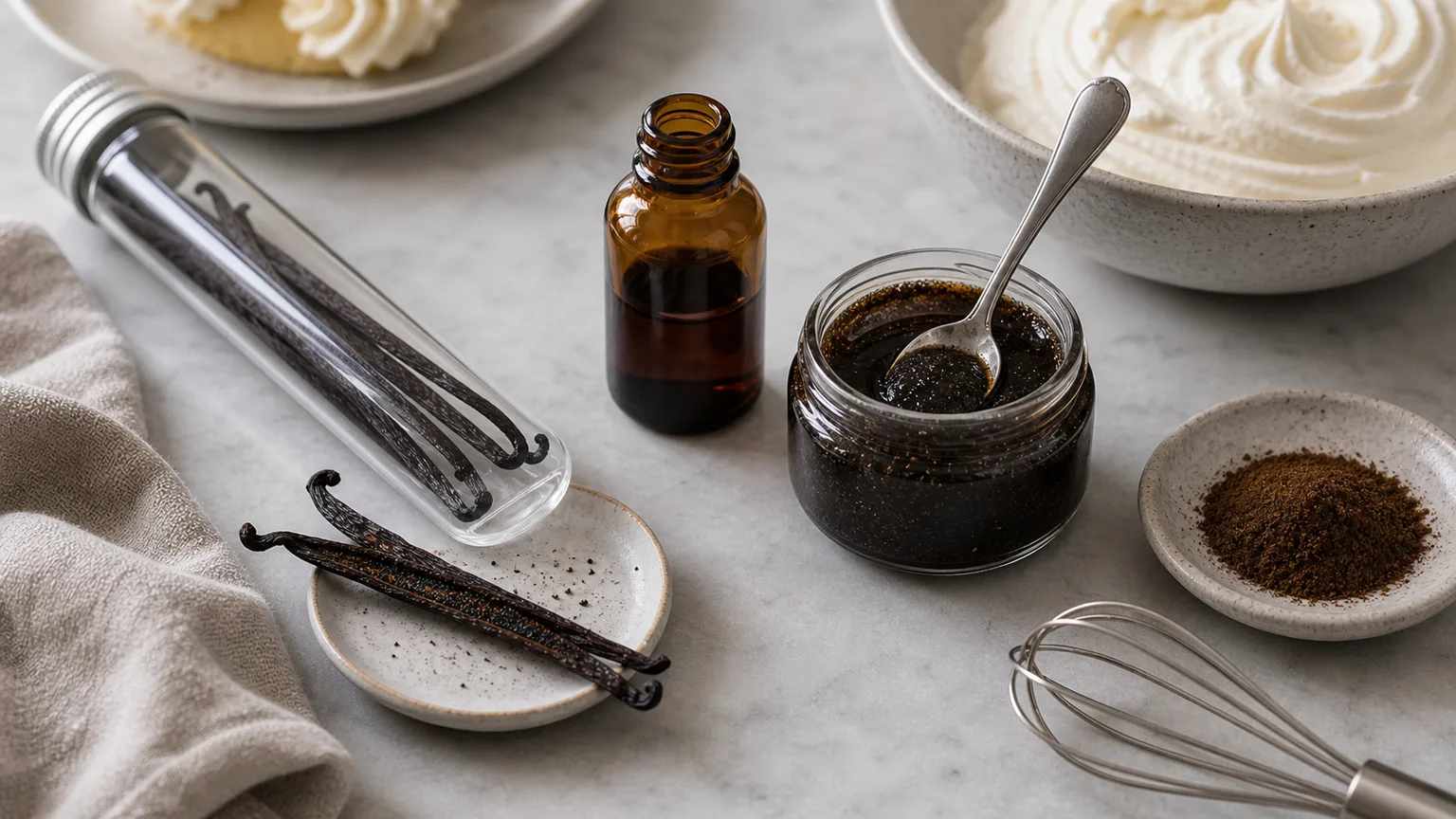
- Beans: Keep them flexible and sealed, not dry and cracked.
- Extract: Tight caps protect alcohol aroma after each use.
- Paste: Clean rims stop sugar crystals from breaking the seal.
- Powder: Dry storage matters because moisture clumps the ground bean.
- Beans: Keep them flexible in an airtight tube. If they dry out, steep them in warm milk or sugar syrup.
- Extract: Store sealed away from heat. Alcohol preserves it, but aroma still fades after repeated opening.
- Paste: Wipe the rim before closing. Sugar crystals on the lid break the seal over time.
- Powder: Treat it like ground spice. Keep it dry and use it within 6 months after opening.
If vanilla smells more like alcohol than beans, let it sit open for one minute before judging. If no bean aroma follows, replace it.
For expensive beans, split only what the recipe needs. Keep the unused pod sealed so the next custard still smells like vanilla, not dry wood.
When imitation vanilla is acceptable
Imitation vanilla is not always useless. It works when heat, browning, and sugar erase the quieter compounds in real extract.
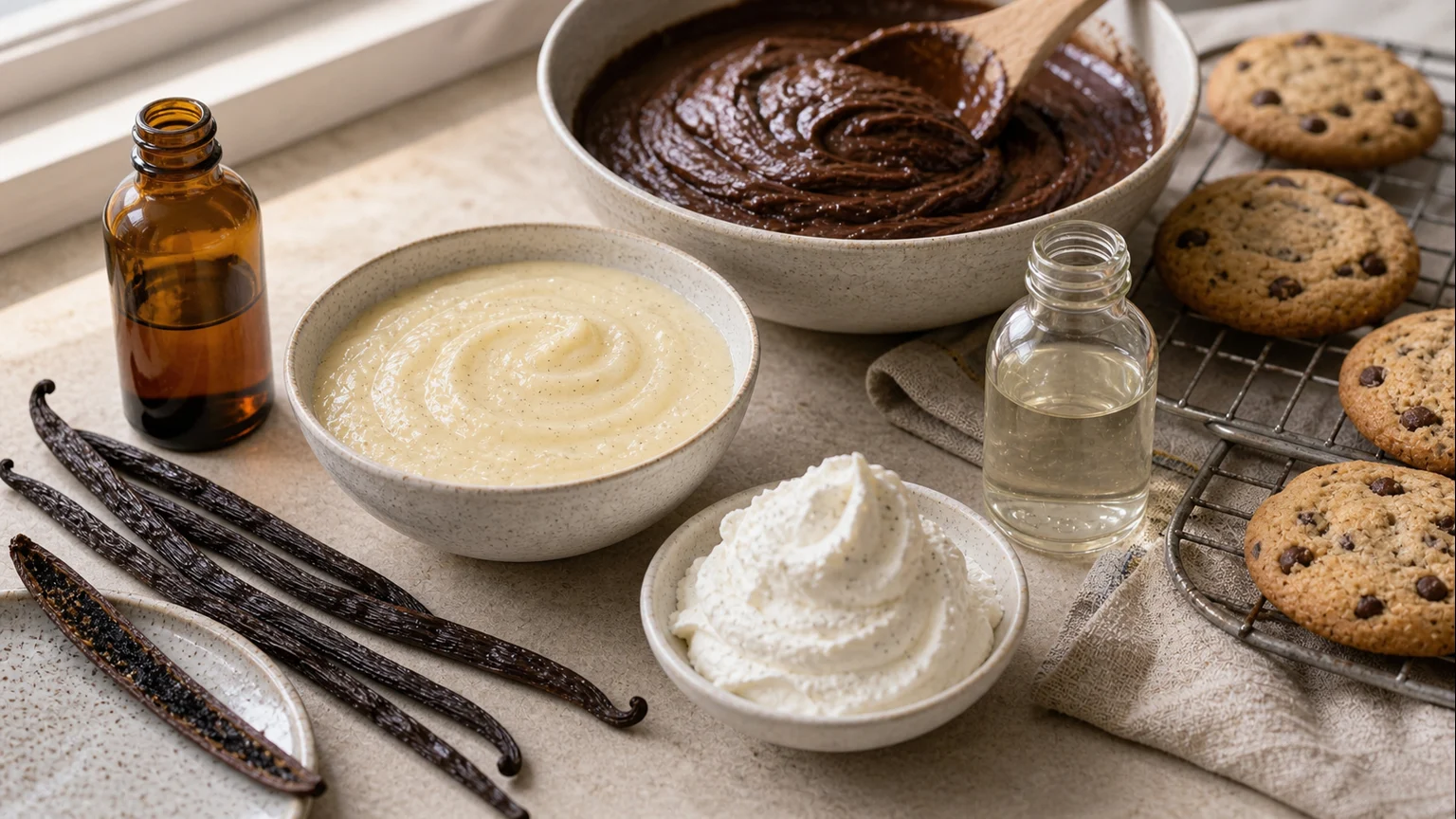
- Cold dairy: Custard, whipped cream, and ice cream expose imitation quickly.
- High heat: Cookies and spice cake hide some of the missing compounds.
- Chocolate: Dark batter can cover flat vanillin better than white cake.
- Main flavor: Any recipe named for vanilla deserves real extract, paste, or beans.
The money decision is not real versus fake in every recipe. It is whether vanilla is exposed enough for the missing floral and woody notes to matter.
- Acceptable: Chocolate chip cookies, spice cake, and browned-butter batters where Maillard flavor dominates.
- Not acceptable: Ice cream, pastry cream, whipped cream, buttercream, and uncooked frostings.
- Worth upgrading: Any recipe with vanilla in the title. If vanilla is the main flavor, use real extract, paste, or beans.
- Safe compromise: Use real vanilla for the filling and imitation in the crust or crumb topping.
- Chocolate rule: Imitation works better in dark chocolate than in white chocolate. Bitterness hides its flatness.
- Buttercream rule: Use real vanilla because there is no heat to hide rough edges.
- Custard rule: Use beans or paste when the custard is pale. The seeds signal real vanilla before the first bite.
- Spice cake rule: Imitation can survive here because cinnamon, cloves, and ginger carry the aroma.
The practical rule is simple: bake with imitation only when vanilla is background. Use real vanilla when it is the point.
That rule saves money without flattening the recipes where vanilla has to carry the whole dessert.
Spend on real vanilla where the flavor stays visible. Save the cheap bottle for background sweetness in recipes where browning or chocolate takes the lead.
Choose by recipe visibility: extract can disappear into a cake, while beans or paste should lead custards, ice cream, and buttercream.
Why vanilla prices swing wildly
Vanilla prices can vary by 10–15x within a single decade, not from gouging, but from a fragile supply chain concentrated in one cyclone-prone island.
Cyclone Enawo hit Madagascar in 2017 and destroyed a significant portion of the crop. Prices went from roughly $20/kg to over $600/kg in two years.
When prices spike, fraud increases. "Pure vanilla extract" gets adulterated with synthetic vanillin.
When prices collapse after overplanting, farmers lose income and sometimes abandon vanilla for more stable crops, setting up the next shortage cycle.
Buy from sources that list specific origin and harvest year. The further from "Madagascar Bourbon vanilla beans, 2024–2025 harvest" and toward "pure vanilla product," the less certain you can be about what you have.
Treat vanilla like a volatile pantry ingredient. Buy a one-year quantity, store it sealed, and replace it when aroma fades.
For most home bakers, pure extract from a named origin and a tube of paste cover daily use. Whole beans can stay special-occasion ingredients.