
What Is Saffron, and How Can You Tell If It Is Real?
Learn the thread cues, water test, blooming method, and dish-specific dose that make costly saffron worth using.
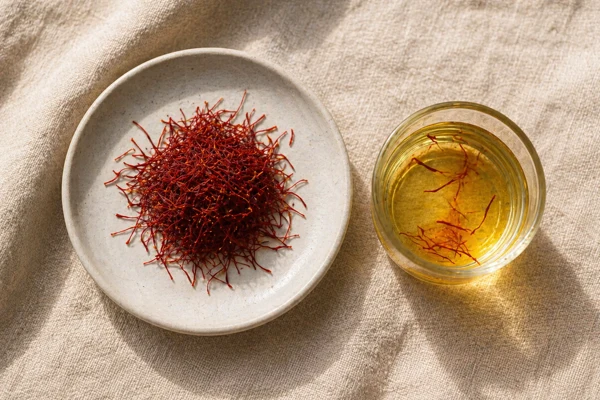
Real saffron releases golden color gradually while its red threads remain visible, and it needs a measured warm-liquid bloom before it enters the dish. Buy intact threads with traceable origin, test a few before cooking, and match the dose to rice, dairy, broth, or baking rather than trusting a vague pinch.
Why most saffron dishes taste like nothing
Most weak saffron dishes fail because the threads were not bloomed, the dose was too small, or the material had already lost aroma. Adulteration is another real possibility, but color alone cannot diagnose it.
Start by blooming a few threads in warm liquid for 15 to 20 minutes. If the liquid turns gradually golden yet carries little floral, hay-like aroma, freshness or dose is more likely at fault than the recipe.
A 2024 study in Genome examined 104 market samples collected across 16 countries and found 45 adulterated samples. That result describes the tested market set, not every jar on every shelf, but it explains why intact threads and traceable labels matter.
Among culinary spices, only vanilla rivals saffron in labor intensity per unit weight. Both depend on careful handwork at harvest.
Test authenticity, extraction, and dose in that order. Adding more threads blindly can turn good saffron bitter while doing nothing to repair stale or adulterated material.
What is saffron, exactly?
Saffron is the dried stigma of a crocus flower.
Each Crocus sativus bloom carries exactly three stigmas, and each one has to be pulled out by hand. That number is the whole reason for the price.
It takes somewhere around one hundred and fifty thousand flowers to make a kilogram of dried saffron.
The flowers open before dawn and have to be picked the same morning, so the harvest window for a whole field is a matter of hours.
Three compounds do three separate jobs.
Crocin supplies the color, picrocrocin supplies the faintly bitter taste, and safranal supplies the aroma that most people mean when they say a dish smells of saffron.
Iran grows the large majority of the world crop, with Kashmir, Afghanistan, Spain, and Morocco making up most of the rest.
Knowing the plant explains the two rules that follow from it. A spice this labour-intensive is worth faking, and a spice made of thin dry threads needs liquid before it gives anything up.
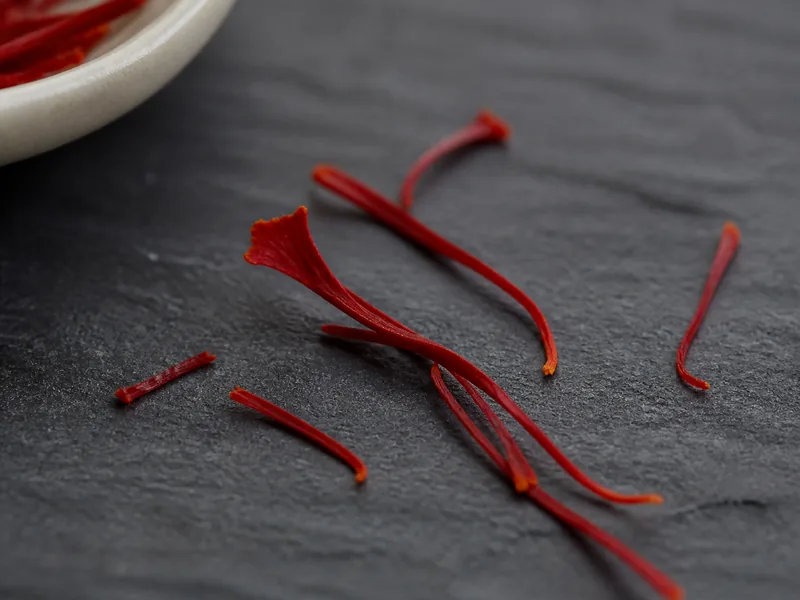
- Flared tip: The upper end opens into an uneven trumpet rather than a straight cut strip.
- Narrow filament: Each stigma tapers into a thin flexible thread.
- Natural variation: Deep crimson can shift toward orange-red near the narrow end.
- Organic shape: Real threads curve and vary instead of repeating one manufactured width.
The water test that actually works
Drop a few threads into a small glass of cold water. Wait 15 minutes.
Genuine saffron releases color slowly, a gradual golden bloom that deepens over time. The threads remain red or dark orange after releasing their color.
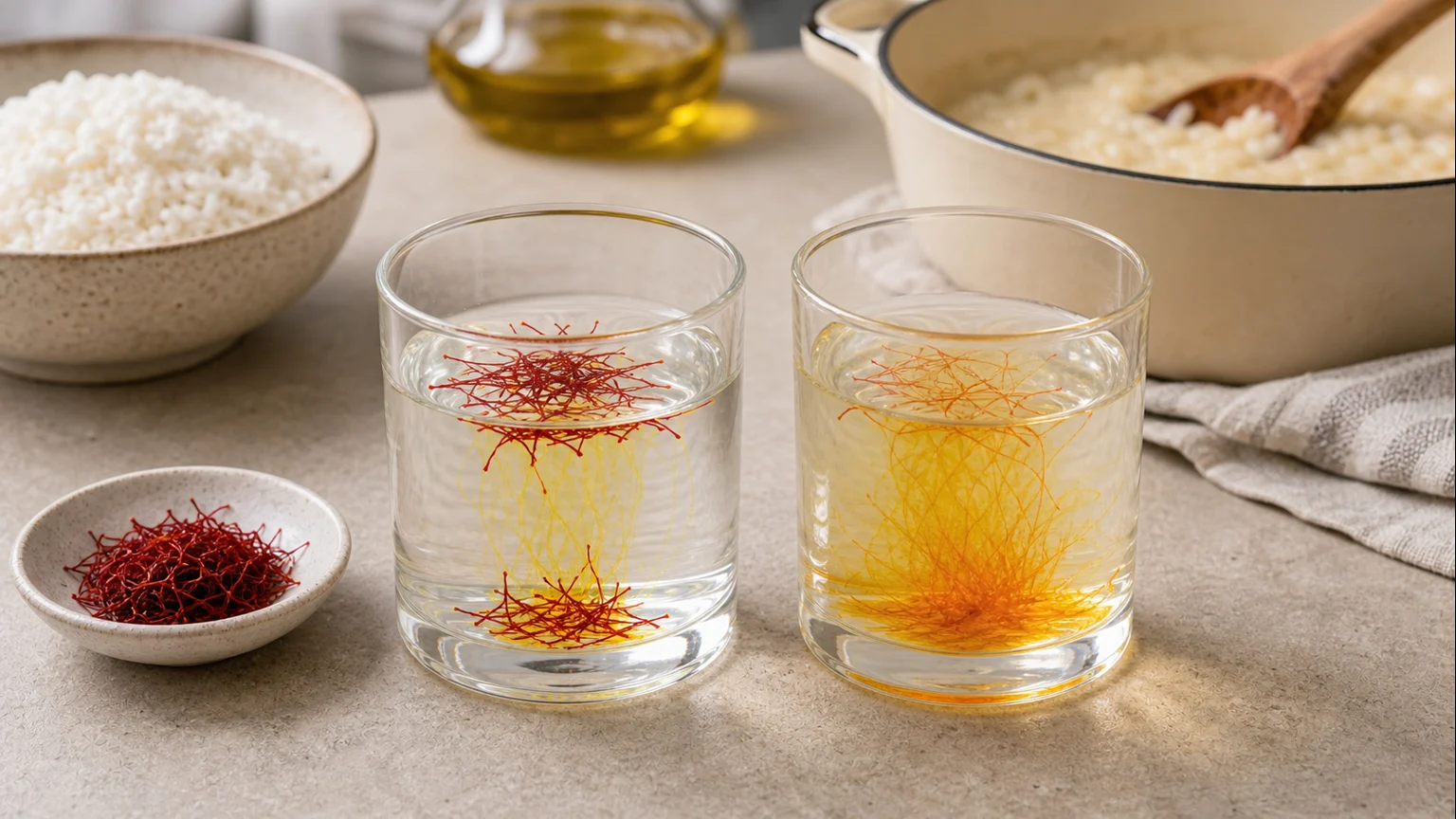
- Slow gold: Real saffron colors water gradually instead of dumping dye instantly.
- Thread color: The stigma should stay red or dark orange after the bloom.
- Pale threads: White or straw-colored threads after soaking suggest dye or filler.
- Test first: Waste a few threads before risking a whole pot of rice.
The test is useful because it separates color from aroma. A fake can make water yellow, but it cannot keep stigma texture, smell, and slow release aligned.
Fake saffron turns the water bright red or orange within seconds. The threads go pale or white.
A second test: rub a thread between wet fingers. Real saffron stains skin yellow-orange, but the thread survives intact.
Dyed material bleeds uniformly and falls apart.
What real saffron actually tastes like
Real saffron has an unusual bitter-sweet-floral combination with a faint metallic edge, more interesting than any single descriptor suggests.
At low doses it lifts and brightens other ingredients without announcing itself. At high doses it turns medicinal or soapy.
The art of saffron use is restraint.
Saffron's flavor compounds are safranal (aroma) and picrocrocin (bitterness). Both degrade at high temperatures.
That is why cooks across Middle Eastern culinary traditions bloom saffron in warm liquid, not a hot pan.
How to use saffron correctly
Saffron must be bloomed before use. Lightly crush the threads between your fingers.
Add to 2–3 tablespoons of warm liquid, water, broth, or milk. Let sit 15–20 minutes, then add both liquid and threads to the dish.
| Bloomed (correct) | Added dry (common mistake) | |
|---|---|---|
| Color distribution | Even golden throughout | Uneven, concentrated near threads |
| Flavor release | Full extraction, uniform | Partial and spotty |
| Dosage needed | 10–15 threads for 4 servings | 2–3× more to compensate |
| Prep time | 15–20 minutes | None |
Use warm liquid, not hot. Temperatures above 80°C degrade safranal, the primary aromatic compound.
In Persian rice dishes, saffron blooms in warm water beside the cardamom-infused butter layer. Both spices stay below the base cooking heat.
In Gulf-region rice preparations, bloomed saffron is layered over baharat-seasoned rice near the end. Steam carries color and fragrance downward.
Saffron's fat-solubility is lower than spices like cumin. It releases primarily into water-based liquids, so bloom it in water or broth.
Threads or powder?
Buy threads, and grind them yourself if a recipe wants powder.
Whole threads are the only form you can inspect, and inspection is the point with a spice this often adulterated. Powder hides everything.
Ground saffron is where the fakes live. Turmeric, safflower, marigold, and dyed corn silk all disappear into a red powder, and no test at home will separate them once they are milled.
Powder does have one honest advantage.
It disperses faster and more evenly than threads, which matters in a dry rub or a delicate custard where a soaked thread would sit visibly in one place.
Grind threads with a pinch of sugar or salt. The crystals give the pestle something to work against, because dry saffron threads are too light and too flexible to crush cleanly on their own.
Buy powder only from a producer you already trust for threads.
Grading terms are worth learning before you compare prices.
Sargol and mongra mean the red stigma alone with the yellow style cut away, negin means whole unbroken red threads, and pushal leaves part of the yellow style attached. A gram of pushal is not a gram of sargol.
| Grade name | What is in the tin | What it means for value |
|---|---|---|
| Sargol, mongra | Red stigma only, yellow style cut away | Strongest by weight, priced accordingly |
| Negin | Whole unbroken red threads | Premium look, same red material |
| Pushal | Red stigma with part of the yellow style | Cheaper per gram, weaker per gram |
| Powder | Unverifiable by eye | Only worth buying from a trusted thread seller |
Dosage by dish, not by guesswork
Saffron is measured by threads because weight is impractical in a home kitchen.
The useful range is narrow.
A small pinch should perfume the dish, not make it taste medicinal.
If you need handfuls, the saffron is weak or fake.
- Paella: Use 12 to 18 threads for 4 servings. Bloom them in warm stock before the rice goes in.
- Risotto: Use 10 to 15 threads for 4 servings. Add the bloom liquid near the middle of cooking.
- Biryani: Use 15 to 20 threads for a large pot. Bloom in warm milk and drizzle over the top layer.
- Desserts: Use 6 to 10 threads for custard or ice cream. Dairy amplifies saffron quickly.
- Tea: Use 2 or 3 threads per cup. More turns the drink bitter instead of fragrant.
The dose should change with the medium. Fat, dairy, stock, and rice pull different amounts of aroma from the same threads.
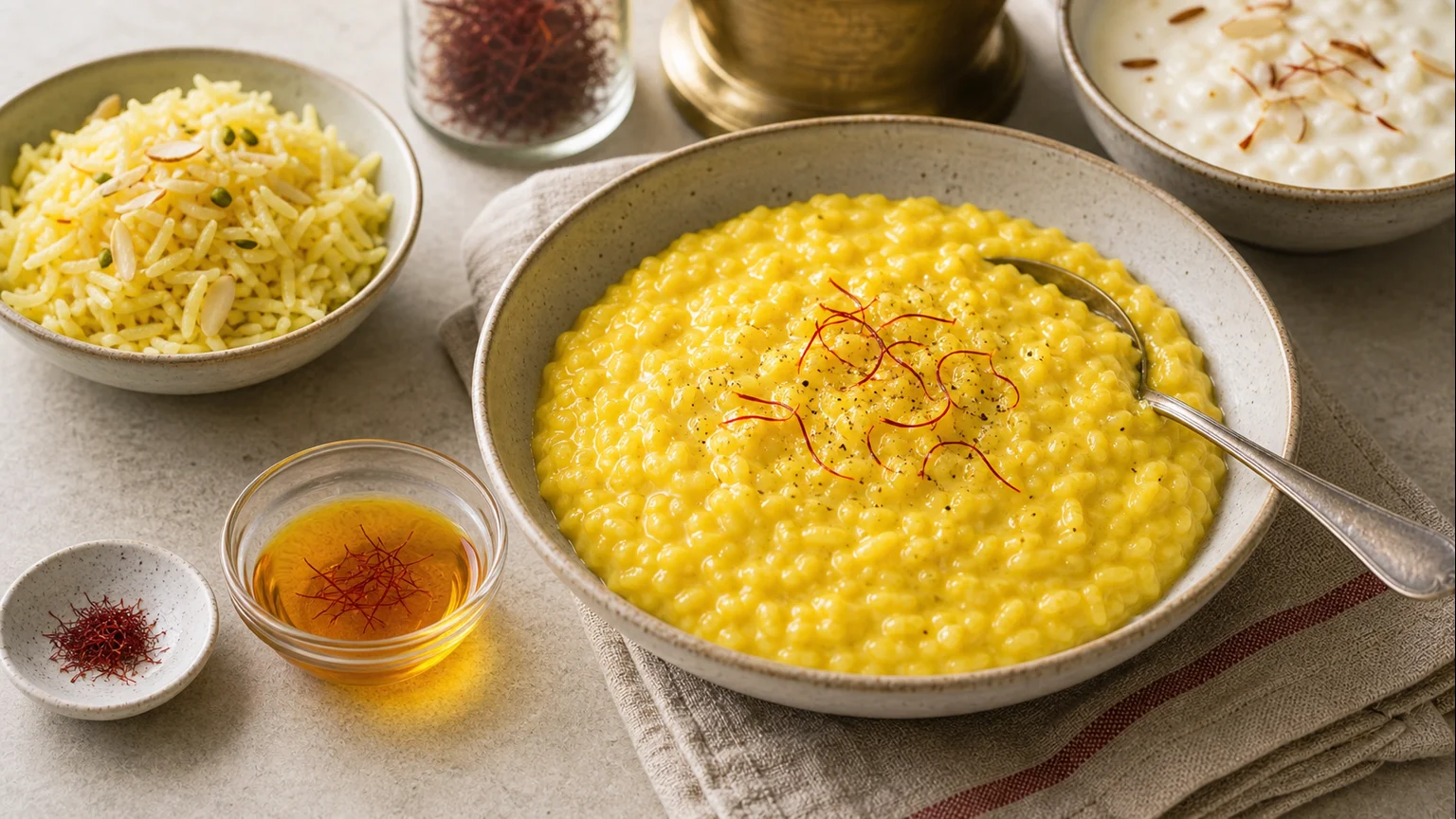
- Rice: Bloom in stock or water so color spreads before the grains finish.
- Dairy: Use fewer threads because milk and cream carry aroma clearly.
- Broth: Add the bloom after the base is seasoned, not during hard boiling.
- Overdose cue: Bitter, soapy flavor means the answer is less or better saffron.
That is why a custard can need fewer threads than a paella pan.
Pale dairy exposes saffron quickly, while rice and stock spread it through more volume.
What the label should tell you
A trustworthy saffron label gives origin, grade, harvest or packing date, and whole-thread form. Missing details are not harmless.
Look for ISO 3632 grade information when available.
It is not a flavor guarantee, but it gives a measurable baseline for color, aroma, and bitterness.
- Good sign: Whole red threads, named origin, small glass jar, and harvest year or packing date.
- Weak sign: Large bargain pouch, no origin, no grade, and unusually bright orange color.
- Bad sign: Powder sold as saffron. It may be useful as color, but you cannot verify it at home.
Good saffron is expensive, but expensive saffron is not automatically good. The label still has to prove traceability.
A small harvest-dated jar is better than a large anonymous pouch. Saffron is bought for performance, not pantry volume.
Where saffron actually belongs
Saffron belongs in dishes where a small amount of aroma can travel through rice, dairy, broth, or syrup. It is wasted in noisy sauces.
The best saffron dishes give it a pale canvas and enough liquid to distribute evenly.
- Rice: Paella, tahdig, biryani, and pilaf let saffron perfume steam and starch.
- Dairy: Custard, ice cream, kheer, and panna cotta carry saffron aroma without burying it.
- Broth: Fish stew and shellfish stock use saffron as a top note, not a base spice.
- Syrup: Simple syrup extracts saffron gently for desserts, tea, and fruit.
Avoid using saffron where smoked chili, heavy garlic, or long browning already dominate. Those flavors erase the reason you paid for saffron.
What can you use instead of saffron?
Nothing replaces saffron, and the honest answer is usually to cook a different dish.
Its color, its aroma, and its faint bitterness come as a package, and every substitute delivers one of the three at most. A paella without saffron is rice with seafood.
Turmeric replaces the color and nothing else.
It is the swap people reach for most and the one that misleads most, because a yellow rice looks right and tastes nothing like the dish it is imitating.
Safflower, sold as bastard saffron, gives color with almost no flavor. It is honest about what it is when sold under its own name, and it is the most common adulterant when it is not.
Sweet paprika with a pinch of turmeric gets the color closer than either alone.
Neither brings the hay-like aroma, so use this in a dish where saffron was a background note rather than the reason for cooking.
For a rice dish that needs an aroma rather than a color, a strip of lemon zest and a bay leaf will carry it somewhere else worth going.
| Instead of saffron | What you get | What you lose |
|---|---|---|
| Turmeric | The color, at low cost | All of the aroma and the bitterness |
| Safflower | Color, almost no flavor | Everything except the look |
| Paprika with turmeric | Color closer to the real thing | Still no hay-like aroma |
| Lemon zest and bay | A different aroma worth having | Any resemblance to saffron |
| Nothing, change the dish | An honest result | The dish you planned |
How should you store saffron?
Saffron keeps better than most spices and still fades faster than the price suggests.
An airtight container in a dark cupboard holds usable aroma for two to three years, and the color outlasts the aroma by a wide margin. A jar that still stains water can easily have nothing left to smell.
Light is the enemy that matters most. Crocin breaks down under it, which is why saffron is sold in tins and small opaque boxes rather than in the clear jars used for everything else.
Do not refrigerate it.
Every time a cold container is opened in a warm kitchen it collects condensation, and damp threads clump and lose aroma faster than dry ones in a cupboard.
Keep it in the container it came in. A tin sized for the amount you bought leaves little air, and decanting a gram of saffron into a large jar surrounds it with the oxygen that fades it.
Buy in the quantity you will actually cook through within a couple of years.
A gram is enough for roughly ten paella-sized dishes, so the large tin that looks better value usually fades before it is finished.
- Airtight and opaque: Light breaks down crocin, which is why saffron ships in tins rather than clear jars.
- Two to three years: Usable aroma. Color outlasts aroma, so staining water proves little.
- Never the fridge: Cold containers opened in a warm kitchen collect condensation and the threads clump.
- Original container: A tin sized for what you bought leaves less air than a big jar does.
Buying saffron without getting burned
Price is the first filter. Genuine saffron costs at minimum $10–15 per gram from a reputable source.
A very low price usually means weak grade, old stock, or adulteration risk. Treat the bargain as a warning, not a win.
Origin matters. Spanish La Mancha saffron with protected designation and Iranian saffron are the global quality standards.
Both have protected designations with traceability. Saffron with no listed origin is a warning sign.
Buy whole threads, never powder. Saffron powder is trivially easy to adulterate and impossible to test visually.
Threads can be examined, water-tested, and handled.
Premium threads are deep red with minimal yellow. Yellow tips (the style portion of the flower) are normal.
All-yellow material is low grade. Uniform bright orange throughout suggests dyeing.
For sourcing, South Asian specialty importers who stock Kashmiri saffron often carry harvest-dated product. Freshness matters because safranal drops after 2 years.
Treat saffron like other volatile spices: small quantity, dark container, replaced when the aroma fades.
Store in an airtight glass container away from light and heat. The same conditions that preserve other volatile aromatics preserve saffron.
| Check | What good looks like | What should worry you |
|---|---|---|
| Price | At least 10 to 15 dollars per gram | A bargain means weak grade, old stock, or adulteration |
| Origin | Named, with a protected designation | No origin listed at all |
| Form | Whole threads you can examine | Powder, which cannot be tested by eye |
| Color | Deep red, some yellow tips are normal | All yellow, or a uniform bright orange |
| Dating | Harvest-dated product from a real importer | No date anywhere on the tin |