
What Is Cumin, and Why Does It Make Food Taste Finished?
Cumin supplies the earthy bass note that connects Indian dal, Mexican chili, and Middle Eastern hummus, and heat transforms it completely.
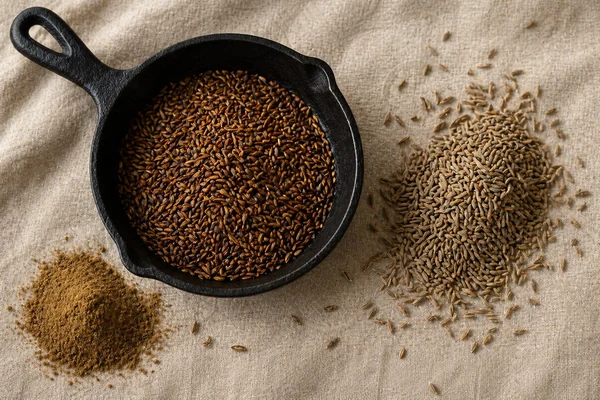
Cumin supplies the earthy bass note, cuminaldehyde, that anchors other flavors in place across Indian, Mexican, and Middle Eastern cooking, and it is fat-soluble, so it requires hot oil to release fully. Buy whole seeds and toast them fresh for 60–90 seconds before grinding, because pre-ground jar cumin is a significant downgrade. Pair with coriander: 2:1 cumin for chili, 1:2 for lighter Indian dishes, 1:1 for balanced blends.
What cumin actually does in a dish
Cumin (Cuminum cyminum) is not a background spice. Remove it from a chili and the dish loses structural depth, other flavors float without an anchor.
The active compound is cuminaldehyde, an aldehyde with a persistent earthy, slightly smoky character that holds up under long cooking. This heat stability is why cumin works in slow braises and long-cooked curries where delicate aromatics would vanish.
Cumin is fat-soluble. Like turmeric, cumin releases its aromatic compounds fully in hot fat.
Dry cumin stirred into liquid delivers only a fraction of that flavor.
The fat-blooming requirement explains why cuisines as different as Indian, Mexican, and Moroccan treat cumin identically: oil first, cumin second, liquid last. The technique is universal because the chemistry demands it.
Whole seeds, ground, and freshly toasted, three different tools
Whole cumin seeds and ground cumin are not the same ingredient in different packaging. They behave differently and belong at different moments in cooking.
Whole seeds work in tadka. Spices hit very hot oil, pop and crackle, then the dish builds on that aromatic fat.
Seeds stay intact in the finished dish, delivering concentrated bursts of flavor.
Ground cumin integrates fully and distributes evenly. It belongs in spice blends, rubs, and any preparation where uniform seasoning matters.
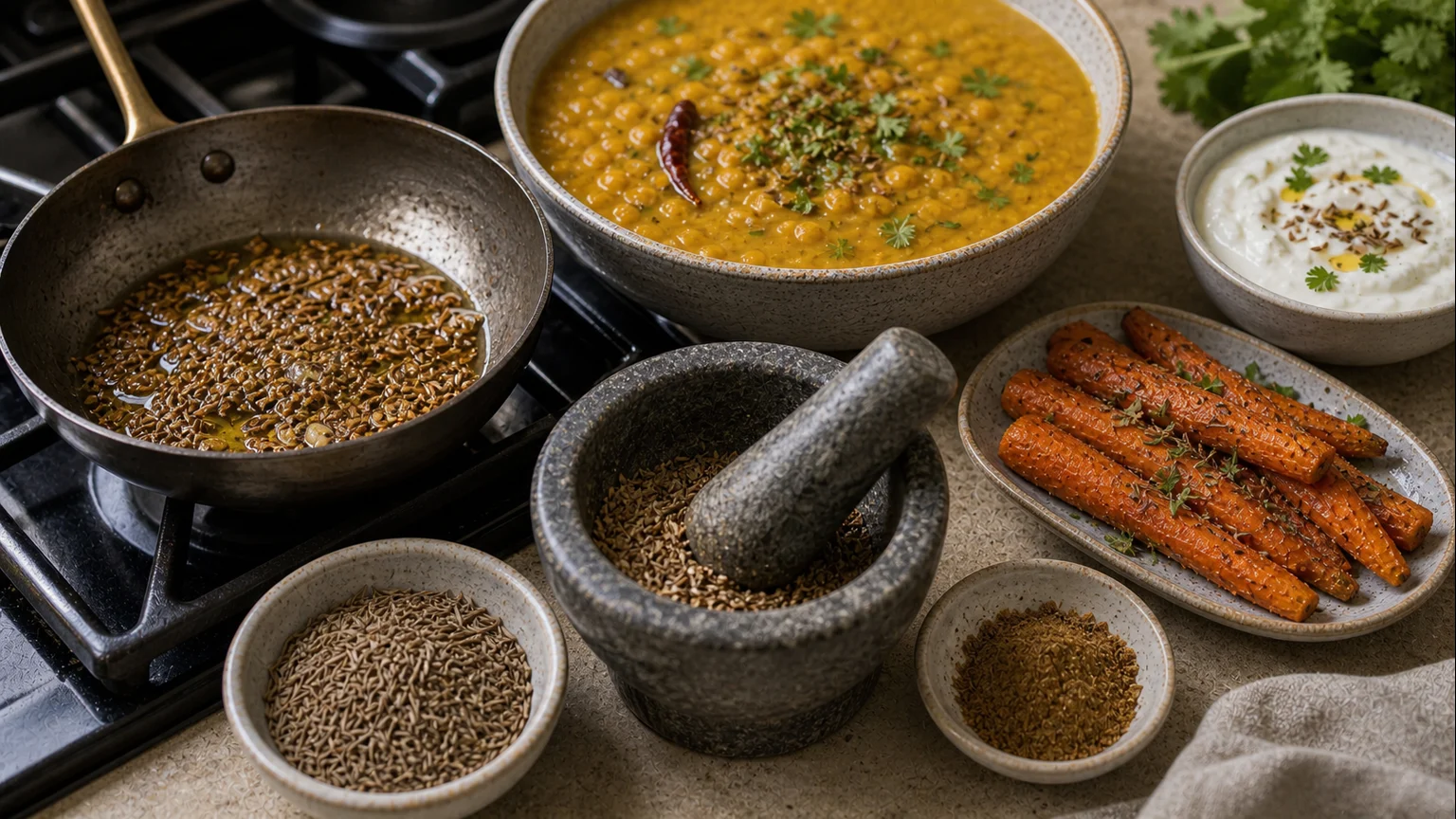
- Whole seeds: Use when texture and popping aroma matter.
- Fresh powder: Use after toasting when a sauce needs full distribution.
- Jar powder: Use in rubs or quick weeknight food, but bloom it in fat.
- Cooling step: Let toasted seeds stop steaming before grinding for cleaner aroma.
The decision is not premium versus cheap. The decision is whether the eater should meet cumin as a burst, a sauce base, or a quiet background.
I buy cumin in one form only: whole seeds. Ground cumin from a jar has already lost the toasting opportunity. Once you toast and grind fresh, jar cumin tastes like cardboard by comparison.
David SharmaCulinary researcher, UC Davis Food Science
Freshly toasted and ground is the best state of all. Dry pan, medium heat, shake for 60–90 seconds until the kitchen smells of warm earth and faint popcorn.
Grind immediately while warm. The difference over pre-ground is the difference between depth and flatness in the finished dish.
Cumin in Indian, Mexican, and Middle Eastern cooking
The same spice works differently in every tradition that uses it. Technique, not the ingredient itself, determines what cumin becomes.
| Tradition | Form used | Application method | Key dish context |
|---|---|---|---|
| Indian | Whole seeds + ground | Whole in tadka; ground in masala paste | Dal, rice dishes, garam masala, curry powder |
| Mexican | Ground only | Bloomed in fat with chili and oregano | Taco seasoning, chili, black beans, birria |
| Middle Eastern | Toasted whole + ground | Toasted for hummus; ground in meat blends | Hummus, baharat, kofta, lamb seasoning |
In Indian cooking, cumin often appears in two states. Whole seeds crackle in the opening tadka, then ground cumin joins the later spice base.
In blends, garam masala, the foundation blend of northern Indian cooking, typically balances equal weights of cumin and coriander before the warming spices are added.
Mexican cooking rarely uses whole seeds. Ground cumin blooms in fat alongside smoked paprika to build the baseline for chili, beans, and adobo.
North African cooking anchors complex multi-spice blends on cumin's earthy backbone. In ras el hanout, a blend that can contain 30 or more spices, cumin holds the other aromatics in place without competing with them.
Why does cumin smell the way it does?
Cumin gets described as sweaty more often than any other spice in the rack.
That reaction is real and it has a cause. Cuminaldehyde and a group of related compounds sit close to some of the molecules the human body produces, so the nose files them together.
Toasting shifts the balance.
Heat drives off part of the sharp raw top note and brings forward the nutty, warm side, which is why toasted cumin reads as comforting where raw ground cumin can read as rank.
Dose does the rest of the work.
A small amount reads as savoury depth and a heavy hand reads as body odour, and the line between them is narrower with pre-ground cumin than with seed you toast yourself.
If someone at the table dislikes cumin, stale powder is the usual culprit rather than the spice itself.
The cumin-coriander ratio
In the dish, coriander and cumin appear together in nearly every cuisine that uses either one. Food scientists consider them a functional flavor pair: cumin brings deep earth and persistence, coriander brings citrus lift and brightness.
Alone, each has gaps. Together, they create a balanced baseline that individual use of either cannot achieve.
| Dish context | Ratio (cumin : coriander) | Flavor effect |
|---|---|---|
| Indian dal, sambhar | 1 : 2 | Coriander leads with brightness; cumin anchors without dominating |
| Garam masala blend | 1 : 1 | Balanced earth and citrus through the blend |
| Chili, taco seasoning | 2 : 1 | Cumin dominates; coriander adds background lift |
| Falafel, kofta | 1 : 1 | Equal weight; structure from cumin, freshness from coriander |
The cumin vs coriander comparison covers the flavor chemistry in detail. It shows what changes when you shift the ratio in either direction.
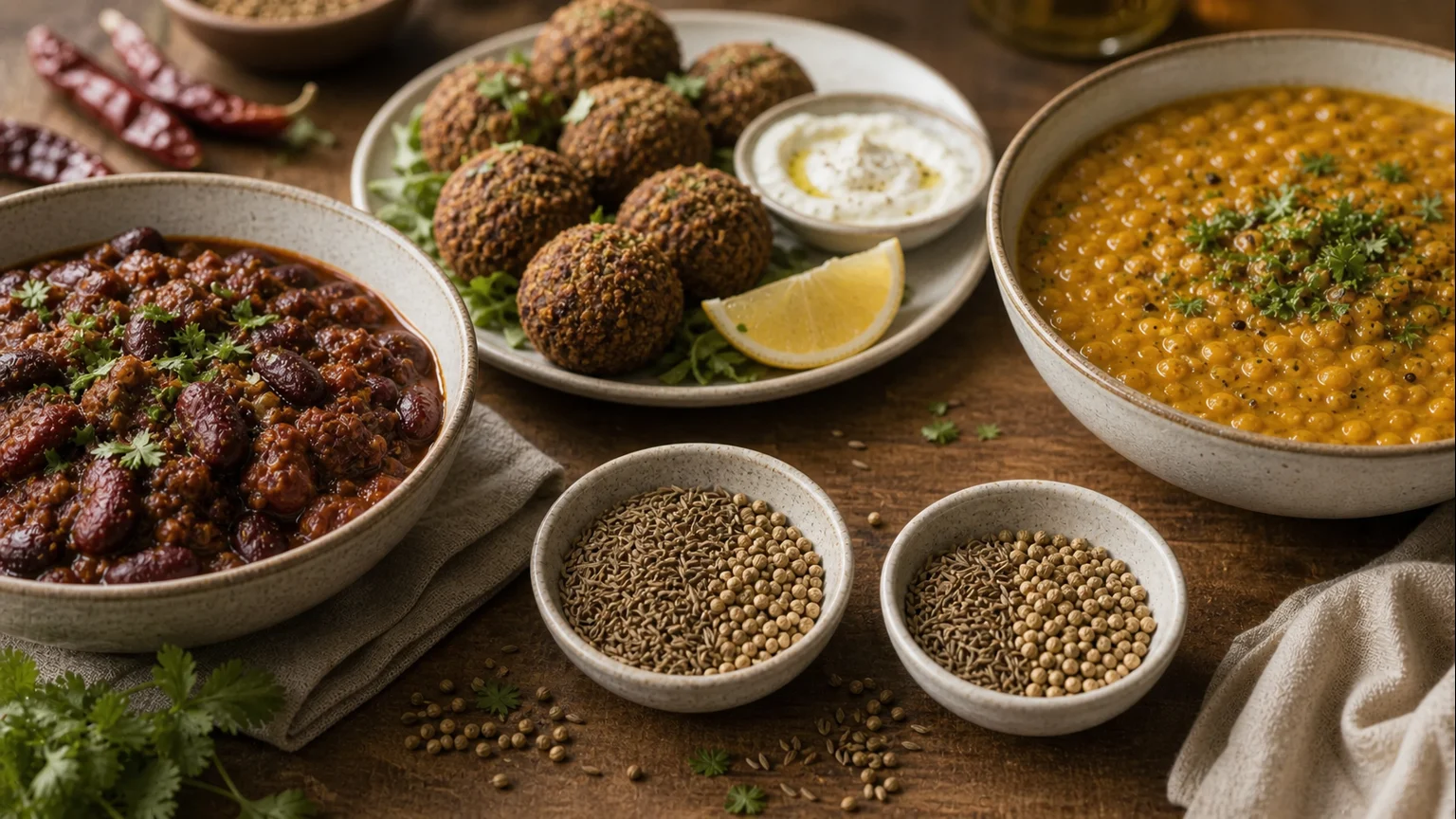
- 2:1 cumin: Use for chili, beef, beans, and taco-style seasoning.
- 1:1 balance: Use for falafel, kofta, hummus, and roasted vegetables.
- 1:2 cumin: Use for dal, curry bases, and turmeric-heavy food.
- Final correction: Add coriander for lift before adding more cumin for volume.
A practical rule: if a dish tastes flat or one-dimensional despite adequate cumin, add coriander before adding more cumin. The problem is usually balance, not volume.
Should you toast cumin before blooming it in oil?
Pick one, because doing both usually overshoots.
Dry toasting and blooming in fat are two routes to the same place, and running them in sequence takes the seed past the point where its aroma is at its best. The second heat is what turns cumin bitter.
Dry toast when you plan to grind.
A dry pan gives you control over how far the seed goes, and the cooled seed keeps that aroma until you crush it. This is the route for a spice blend, a rub, or a finishing sprinkle.
Bloom in fat when the seed is going straight into the pot.
Hot oil pulls the aromatic compounds out and carries them through the whole dish, which a dry pan cannot do on its own. This is the route for a curry base, a dal, or a pot of rice.
The one case for both is a small correction.
If a blend tastes flat halfway through cooking, a pinch of freshly toasted ground cumin stirred in at the end adds aroma the earlier bloom has lost.
Watch the seed rather than the clock in either route.
Cumin goes from fragrant to acrid in about fifteen seconds, and the color shifts before the smell does.
- Dry toast: For grinding into blends, rubs, and finishing sprinkles. Cool before crushing.
- Bloom in oil: For curry bases, dal, and rice, where fat has to carry aroma through the dish.
- Not both: The second heat is what makes cumin bitter.
- The exception: A pinch of freshly toasted ground cumin at the end lifts a blend that has gone flat.
- Timing: Fifteen seconds separates fragrant from acrid, and color changes first.
Whole cumin seeds stay in the dish, unlike a bay leaf or a cardamom pod.
They soften enough during cooking to eat without complaint, and finding one is part of what a tempered dal is supposed to taste like. Nobody needs to pick them out.
"Black cumin", three different seeds
The label "black cumin" is applied to at least three unrelated seeds in different markets. Using the wrong one changes the dish entirely.
- Nigella seeds (kalonji): The most common mislabel. Small black seeds with an onion-pepper-oregano character used on naan, in pickles, and across South Asian cooking. Completely different from cumin in flavor, do not substitute.
- Bunium persicum (true black cumin): Smaller and darker than common cumin, with a more complex, sweeter flavor. Used in Kashmiri biryanis and Persian rice dishes. Difficult to source outside specialty importers.
- Caraway: Sold as black cumin in some European and Middle Eastern markets. Sharper and slightly anise-like, substitutable in European dishes where either was historically used, but wrong in South Asian or Middle Eastern preparations.
Context resolves most confusion. A Kashmiri or Persian recipe specifying black cumin means Bunium persicum.
Everything else almost certainly means nigella, and nigella and common cumin have no meaningful culinary substitution relationship.
How much cumin to use without making food muddy
Cumin gets heavy fast. The right amount depends on whether it is carrying the dish or only grounding brighter spices.
Start with less when the dish already contains smoked chili, tomato paste, or long-cooked onions. Those ingredients amplify cumin's earthy side.
- Chili or taco meat: Use 1 teaspoon ground cumin per pound of meat. Bloom it with chili powder before adding tomato.
- Dal or lentils: Use 1/2 teaspoon ground cumin for 4 servings. Add coriander if the dish tastes dark or flat.
- Rice pilaf: Use 1/2 teaspoon whole seeds per cup of uncooked rice. Crackle the seeds in fat before adding rice.
- Hummus: Use 1/4 teaspoon freshly toasted cumin per cup of cooked chickpeas. More can make the dip taste dusty.
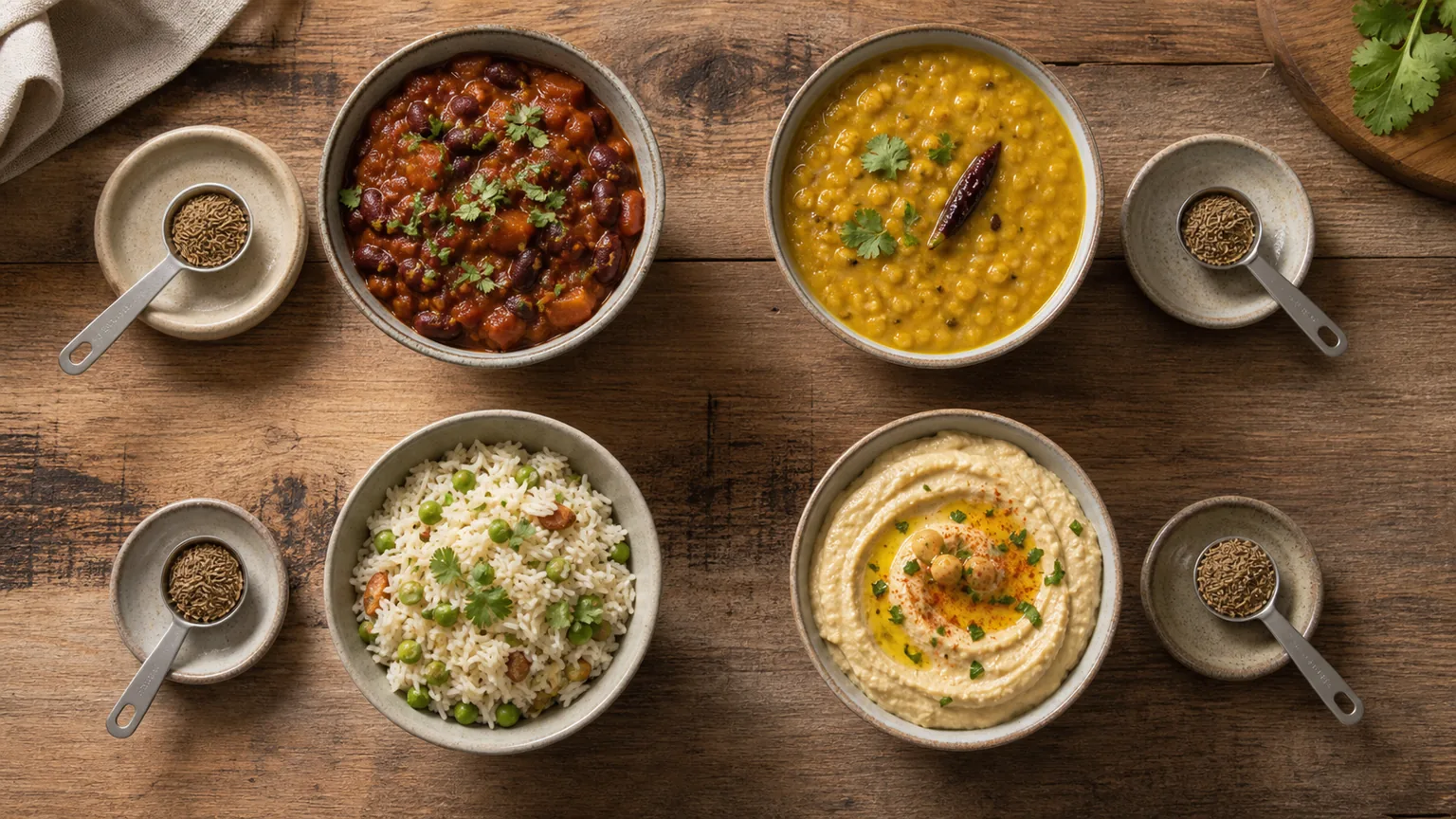
- Bean dishes: They can carry more cumin because starch and tomato absorb earthy flavor.
- Dal: Use less cumin when turmeric and coriander already shape the base.
- Rice: Whole seeds work better than powder because each bite stays clean.
- Cold dips: Toast first because raw ground cumin tastes dusty in hummus or yogurt.
If cumin takes over, do not add sugar. Add acid, fresh herbs, or coriander to lift the flavor back into balance.
For tomato-heavy food, wait until the tomato paste has browned before judging cumin level. Raw tomato can make cumin taste harsher than it will after simmering.
For yogurt sauces, toast cumin first and use less than you think. Cold dairy exposes dusty powder more clearly than hot beans or meat.
The useful test is whether cumin makes the main ingredient taste fuller. If it becomes the main flavor, the dish needs lift before it needs another spoonful.
How do you fix a dish with too much cumin?
Cumin does not fade with more cooking.
The compounds survive long simmering, so a pot that tastes too cumin-heavy after ten minutes still tastes that way after an hour. Dilution is the first and best move.
Add more of the unseasoned base before anything else.
More beans, rice, tomato, stock, or potato spreads the same amount of cumin across more food, which is the only change that reliably works.
Acid cuts the heaviness.
Lemon, lime, or vinegar lifts a dish that has gone muddy, and fresh coriander leaf does the same job from a different direction.
Do not answer it with more of everything else.
Doubling the chilli and the garlic to balance the cumin gives you a louder dish rather than a corrected one.
- Dilute: More beans, rice, tomato, or stock. The only move that reliably works.
- Add acid: Lemon, lime, or vinegar lifts a dish that has turned muddy.
- Add fresh herb: Coriander leaf cuts the heaviness from a different direction.
- Do not simmer it off: Cumin survives long cooking unchanged.
- Do not chase it: Doubling every other spice makes the dish louder, not better.
When cumin should stay in the background
Cumin does not always need to be the flavor you notice first. In many dishes, its best work is structural.
Use it quietly when the dish already has a clear lead ingredient: lamb, black beans, roasted squash, tomato, or charred chili.
- Use more when the dish needs earthiness, smoke, or a base note under heat.
- Use less when the dish already has dark roasted flavors or long-cooked tomato.
- Add late only when using freshly toasted powder as a finishing aroma.
- Skip entirely when a dish already depends on delicate herbs. Cumin can bury basil, dill, mint, and tarragon.
- Balance with acid when cumin tastes heavy. Lime, yogurt, tomato, or vinegar can reopen the flavor.
- Pair with sweetness in roasted carrots, squash, and onions. Natural sugars soften cumin without making it dessert-like.
- Watch smoke when using smoked paprika or chipotle. Cumin can make smoke taste dusty if both are heavy.
- Use whole seeds when texture helps. Jeera rice and tadka need small bursts, not even powder.
If every bite tastes like cumin, the seasoning has stopped supporting the dish and started flattening it.
This is why good cumin seasoning often tastes quieter than expected. You notice the dish more than the spice.
That restraint is the difference between depth and heaviness.
It also makes leftovers taste cleaner the next day.
What can you use instead of cumin?
Nothing replaces cumin exactly, because its earthiness sits under a dish rather than on top of it.
The nearest single swap is caraway, and the swap needs care. Caraway carries an anise edge cumin does not have, so use about half as much and taste before adding more.
Ground coriander works when the dish needs warmth without the heaviness.
It brings citrus lift instead of earth, which suits a vegetable curry better than it suits chilli.
Chilli powder and taco seasoning already contain cumin.
Reaching for one of those in a pinch works. You are also adding chilli, oregano, and often salt, so cut the other seasonings back.
Caraway plus a pinch of paprika gets closer than caraway alone.
The paprika supplies some of the warm red depth that cumin usually contributes to a chilli or a stew.
When a dish is built on cumin, such as a taco filling or a bowl of dal, cook something else instead.
| Instead of cumin | Use | What changes |
|---|---|---|
| General savoury | Caraway, half the amount | Anise edge arrives with it |
| Vegetable curry | Ground coriander | Citrus lift replaces the earth |
| Chilli or stew | Caraway with a pinch of paprika | Closer, adds warm red depth |
| In a pinch | Chilli powder or taco seasoning | Brings chilli, oregano, and salt too |
| Dish built on cumin | Nothing, cook something else | A taco without cumin is not a taco |
Turmeric and paprika are the two swaps that never work.
Both are reached for because they look like cumin in the jar, and neither carries any of its earthiness, so the dish ends up colored rather than seasoned.
Buying and storage
Whole cumin seeds stay potent for 3 years in an airtight container. Ground cumin loses half its volatile cuminaldehyde content within 6 months, the window when most home cooks finally notice the spice has stopped performing.
The freshness test: rub a pinch of seeds between your fingers and smell immediately. Fresh cumin is sharp, earthy, and immediate.
Stale cumin is faint or dusty. If you need to work for the aroma, the jar needs replacing.
In the dish, ground spices share the same 6-month freshness window. Cumin, coriander, and turmeric often go stale together.
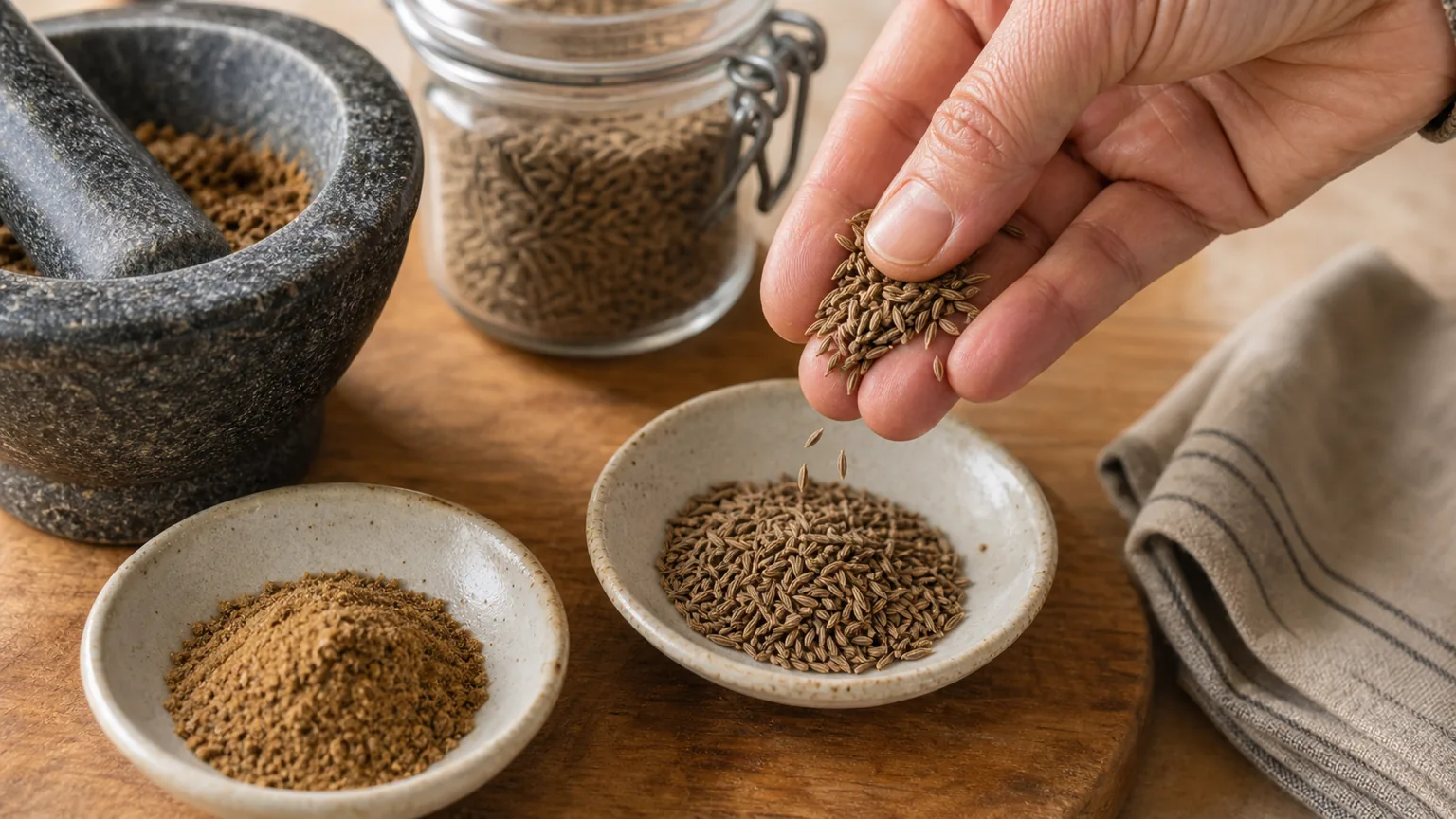
- Whole seed test: Rub a few seeds and expect an immediate earthy aroma.
- Powder test: If the powder smells dull, blooming cannot rebuild lost aroma.
- Buying choice: Whole seed gives you the option to toast and grind only what you need.
- Storage choice: Keep cumin sealed, dark, and away from stove steam.
Iranian cumin (from Yazd province) and Indian cumin (from Gujarat) carry higher cuminaldehyde concentrations than generic commercial cumin. Either is available at Middle Eastern or South Asian grocery stores and outperforms supermarket product in side-by-side cooking.
That sourcing detail matters most when cumin leads the dish. In a small hummus bowl or jeera rice, weak cumin has nowhere to hide.
Buy the smallest jar that covers 3 months of use. Replacing three small jars per year costs less than throwing away one large bag that sat untouched for two years.