
Fresh or Ground Ginger: What Actually Changes?
Fresh ginger brings juicy, sharp heat to savory food, while dried ground ginger carries warm spice into baking.
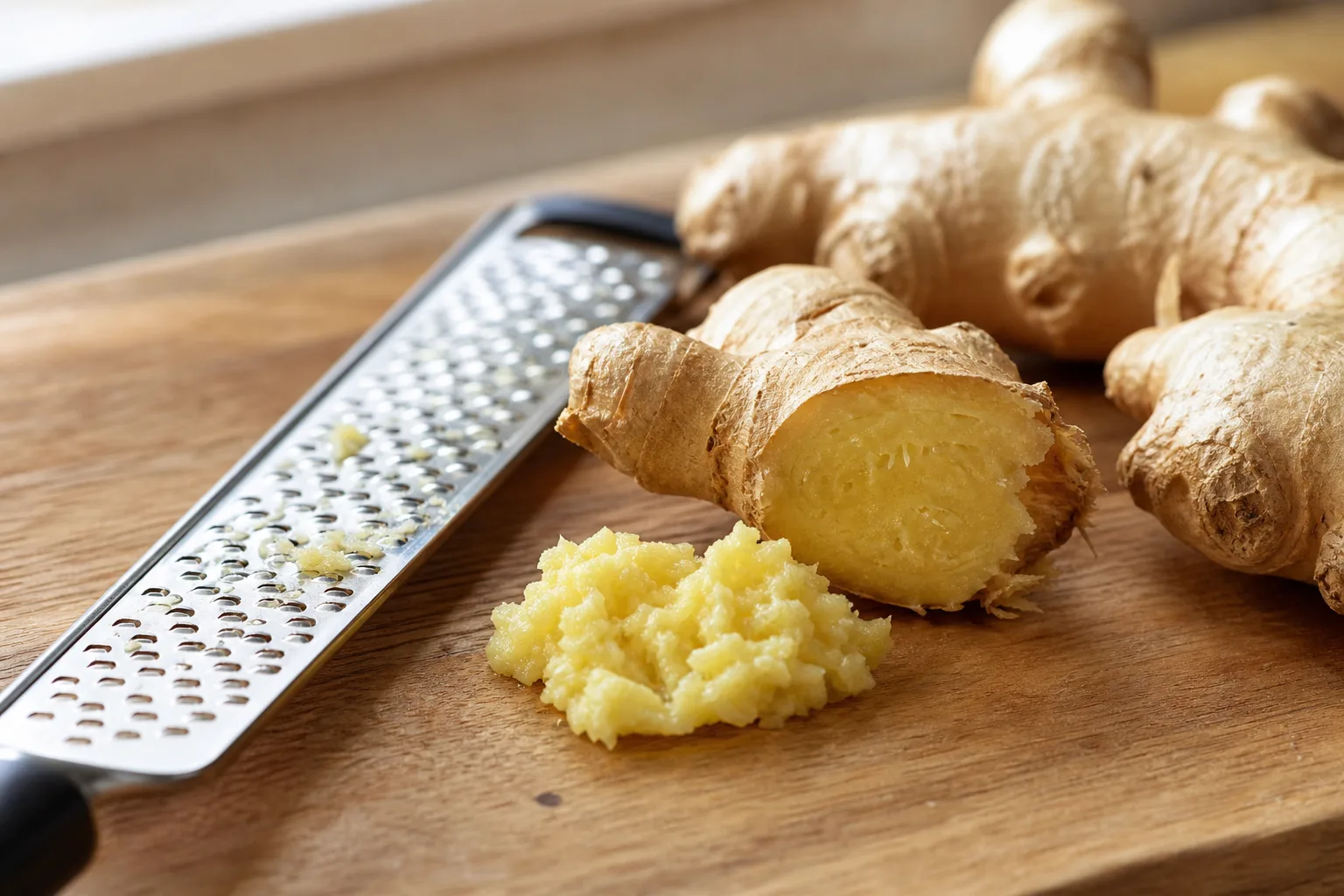
Fresh ginger and ground ginger are not interchangeable because fresh brings juicy bite, while dried ground ginger brings warm spice. Cooking mellows ginger's pungent bite, so the form, cut, and timing decide how sharp it tastes.
What is the difference between fresh and ground ginger?
Start with form before you measure.
The knobby root reaches your kitchen as fresh ginger and dried ground ginger, and they do different jobs.
Fresh ginger is juicy, sharp, and bright, with a clean pungent heat. It belongs in savory cooking, from stir-fries to curries to dressings.
Dried ground ginger is warmer, sweeter, and dustier, closer to a baking spice. It carries gingerbread, chai, and spice blends, not a fresh stir-fry.
Fresh ginger brings water, fibers, and volatile bite. Ground ginger brings dry particles that spread through flour, sugar, fat, and spice mixes.
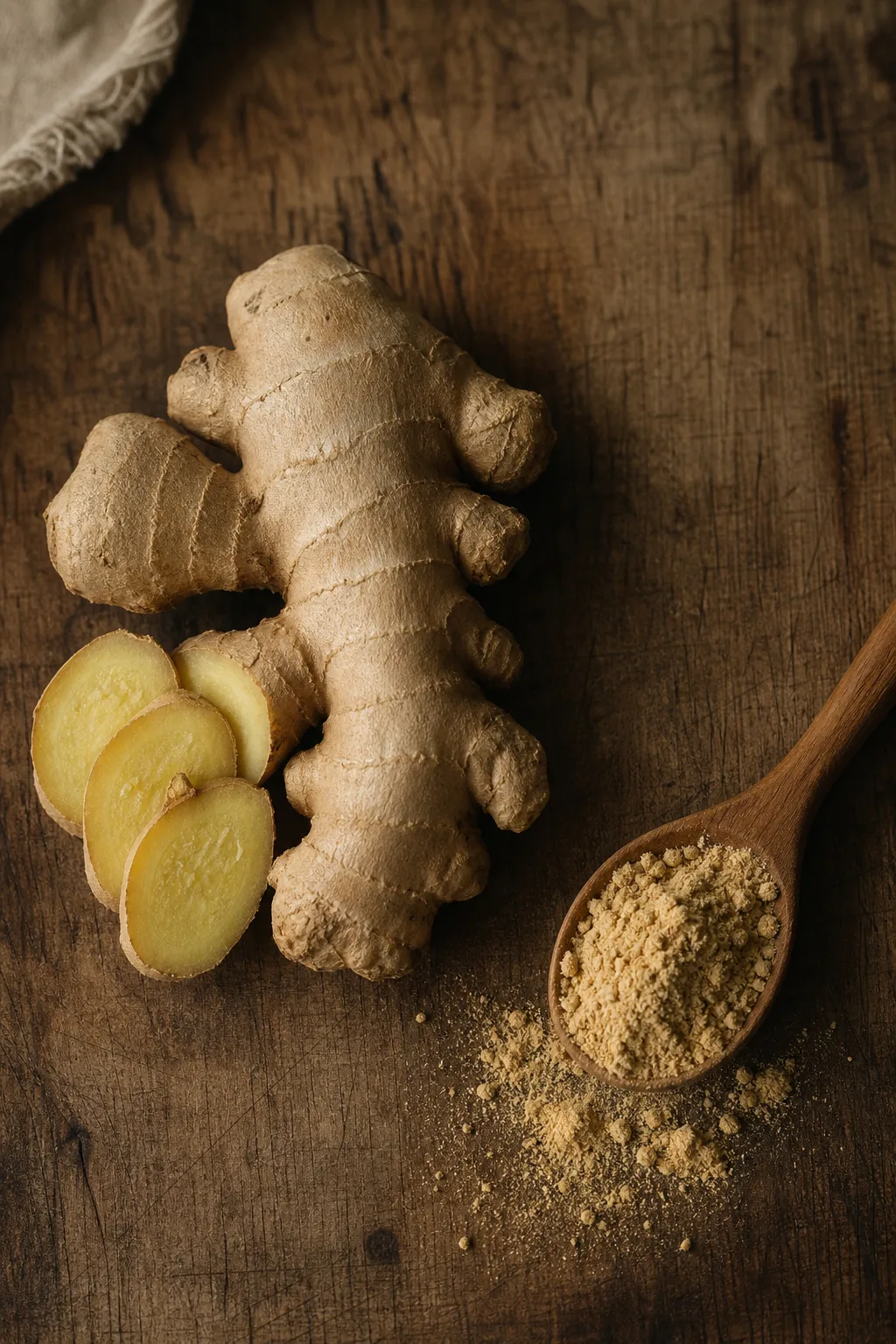
- Fresh: Sharp, juicy heat for savory dishes and aromatics.
- Ground: Warm, sweet spice for baking and blends.
- Do not swap 1:1: They taste different and behave differently in heat.
A recipe that names fresh ginger wants the juice and bite. One that names ground ginger wants dry warmth, so reaching for the wrong jar changes the dish.
The form also changes texture. Fresh grated ginger can leave pulp, while ground ginger disappears into a batter or rub.
Drying does not simply shrink ginger. It transforms the sharp fresh-root profile into a warmer spice with different uses.
What does fresh ginger do in cooking?
In savory food, the fresh root acts as an aromatic base.
Grated or minced, it cuts through fat, richness, and fishy notes with a clean, sharp lift.
It works with garlic, chile, and scallion as the flavor base of East and Southeast Asian cooking. Bloomed in hot oil first, it perfumes the whole dish.
Keep that bloom brief. Grated ginger can brown and taste harsh if it sits in dry hot oil after the garlic has already colored.
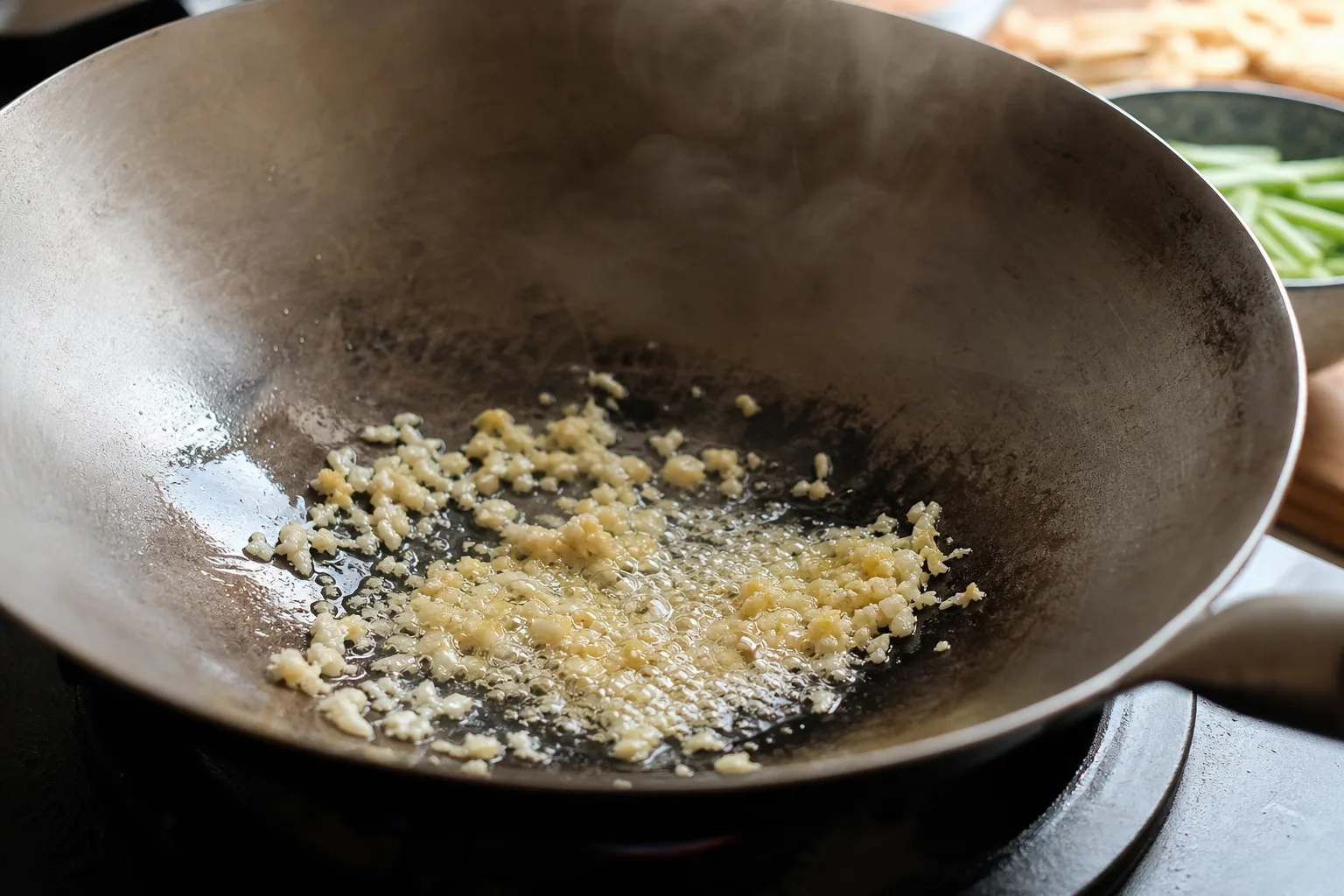
- Aromatic base: Bloom ginger, garlic, and chile in oil to start a dish.
- Cutting richness: It lifts fatty pork, duck, and coconut curries.
- Raw and bright: Grate it into dressings, tea, and dipping sauces uncooked.
Raw, fresh ginger is even sharper. A little grated into a salad dressing, a tea, or a dipping sauce adds heat and brightness with no cooking at all.
Fresh turmeric, garlic, lime, and soy join ginger in many savory dishes across Asia.
Fresh ginger also tenderizes. Its enzymes break down protein, which is why it turns up in marinades for tougher cuts of meat.
That enzyme effect is useful but not limitless. Very long ginger-heavy marinades can make the surface of fish or thin meat feel mushy.
Equal parts ginger and garlic make an Indian curry base that cooks before the spices and liquid go in.
The heat of fresh ginger is clean and warming, not burning like chile. It wakes food up without numbing the tongue the way a hot pepper does.
When does ground ginger work better?
In dry mixes, ground ginger behaves like a warm spice instead of a fresh aromatic.
Think baking, warm drinks, and dry spice blends.
It is the ginger in gingerbread, spiced cookies, and pumpkin pie, where it sits beside ground cinnamon, clove, and nutmeg. Fresh root would add moisture and the wrong kind of heat.
Ground ginger dissolves evenly into batters and dry mixes. Fresh ginger cannot do that, because its moisture and fibers would leave streaks and wet spots in a dough.
Ground ginger also belongs in dry rubs and blends. It brings warmth to curry powder and many spice mixes without any fresh bite.
It is less useful as a late garnish. Sprinkled onto finished food, ground ginger can taste chalky before it has time to hydrate.
The two forms can even work together. A curry can start with fresh ginger for the base and finish with a pinch of ground ginger for rounder warmth.
In baking, measure ground ginger with the other dry spices. That prevents one hot pocket from landing in the finished crumb.
Why does cooking mellow ginger's heat?
The sharp bite comes mostly from gingerol.
Heat and time convert it into gentler compounds, so long-cooked ginger tastes far milder than raw.
That gives you a timing lever. Add ginger early in a braise for soft background warmth, or grate it in near the end for a sharp, bright hit.
The same amount tastes different at each point. Timing can solve a too-sharp dish without changing the ingredient list.
Time changes ginger as much as dose, so early and late additions cannot be treated as equivalent.
| When you add it | How it tastes | Best for |
|---|---|---|
| Bloomed early in oil | Rounded, aromatic warmth | Stir-fry and curry bases |
| Simmered long in a braise | Soft, mild background | Stews and slow-cooked meat |
| Grated in near the end | Sharp, bright, pungent | Dressings, glazes, finishing |
| Raw, uncooked | Hottest and most fiery | Tea, dips, fresh sauces |
So if a dish tastes too fiery, cook the ginger longer. If it tastes flat, add a little fresh grated ginger at the end.
How do you prep and grate ginger?
Texture is the reason prep matters.
Ginger has tough fibers, and the cut decides whether those fibers disappear or stay in the bite.
Older ginger is usually more fibrous than young ginger. That makes the cutting direction matter more when the pieces will stay visible.
Peel only what you need. A spoon edge scrapes the thin skin off easily, which wastes less than a peeler on the knobby root.
Skip peeling when the skin is thin and the ginger will be grated fine. Peel for clear broths, pale sauces, or tea where bits of skin show.
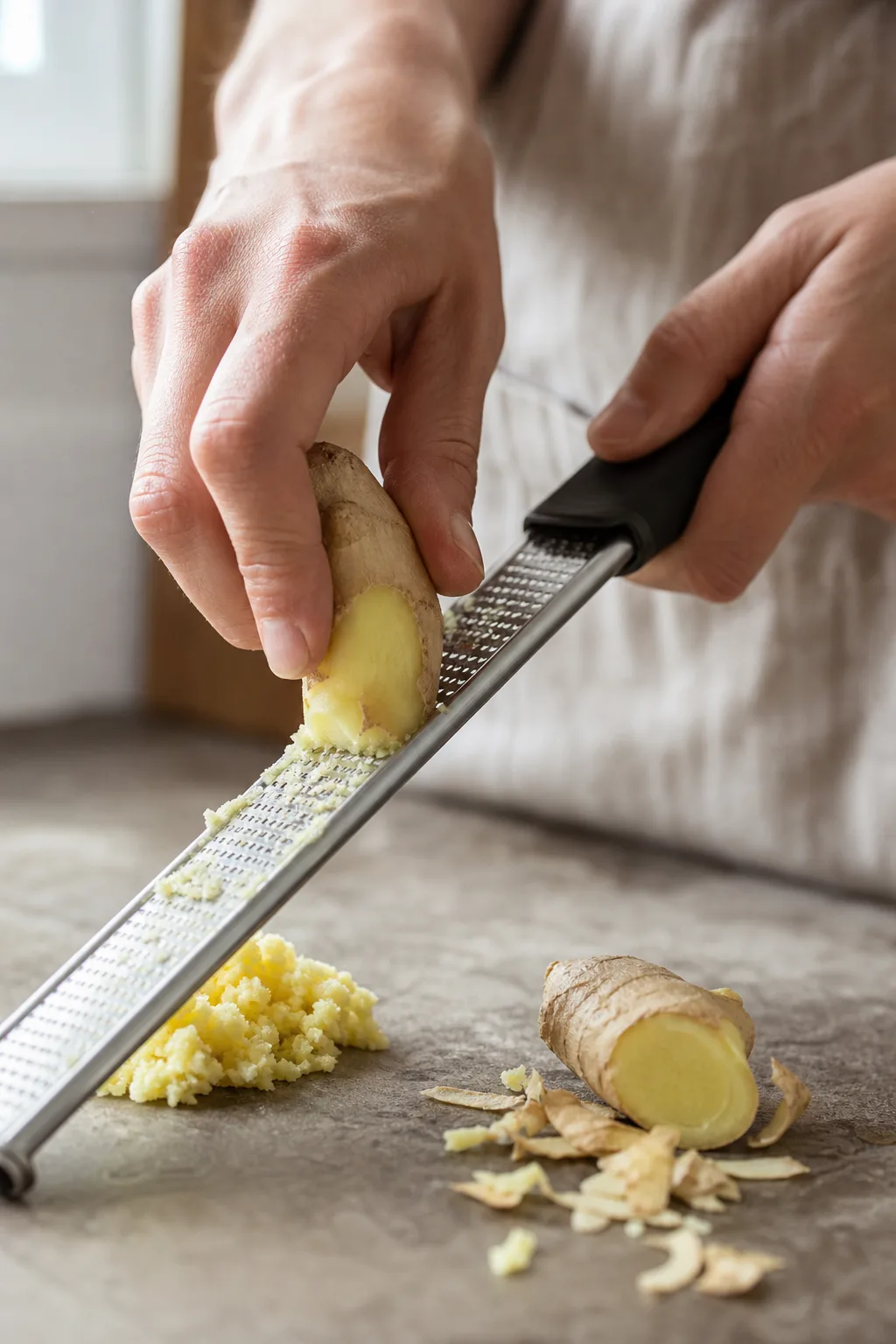
- Grate fine: A microplane makes juicy pulp and hides the fibers.
- Slice or julienne: For visible pieces in stir-fries and pickles.
- Smash: Bruise a chunk for infusing broth, then fish it out.
Cut against the fibers when you slice. Cutting with the grain leaves stringy pieces that never soften in the pan.
Julienne strips need the same rule. First cut thin coins across the fibers, then stack and slice those coins into matchsticks.
For broth or chai, you do not need to grate at all. Smash a coin-sized piece to release the flavor, simmer it, and remove it before serving.
Choose the ginger form by texture and heat
Before you grate, decide what texture should reach the plate. The same knob can become pulp, mince, matchsticks, slices, smashed chunks, or juice.
That form decides whether the eater notices smooth warmth, little bursts, visible bite, or no fiber at all.
| Form | What it gives | Best use |
|---|---|---|
| Grated pulp | Strong juice and even heat | Curries, sauces, marinades, dressings |
| Fine mince | Small bursts and light texture | Stir-fries, dumpling fillings, fried rice |
| Julienne | Visible snap and clean bite | Steamed fish, salads, pickles |
| Smashed chunk | Infused warmth without pieces | Broth, tea, braises, poaching liquid |
| Pressed juice | Sharp flavor with no fiber | Glazes, drinks, smooth sauces |
Use juice when texture would be a problem. Press grated ginger through a fine strainer for a glaze, drink, or smooth dipping sauce.
Use matchsticks when ginger should be part of the bite. They bring a clean snap that grated pulp cannot give.
Use smashed chunks when you want ginger to leave the pot before serving. That is the cleanest choice for broth, tea, and poaching liquid.
Choosing form first prevents the common mistake of adding grated ginger where the dish needed removable aroma or visible bite.
How much ginger should you use, and what can replace it?
Amounts are flexible with the fresh root. A tablespoon of grated ginger suits a stir-fry or curry for four, and you can push higher for a spicier dish.
For a dressing, sauce, or tea, start lower because raw ginger tastes sharper. You can always grate more into a finished bowl.
Ground ginger is far more concentrated. Use roughly a quarter teaspoon of ground for a tablespoon of fresh, and even then the flavor is not the same.
In a cake or cookie, that quarter teaspoon can matter. Ground ginger spreads through the whole batch, so a small increase changes every bite.
For a marinade, use fresh ginger by time and thickness. Thin fish fillets need less ginger contact than pork shoulder or chicken thighs.
For a dry rub, use ground ginger because fresh pulp adds moisture. It should support pepper, garlic, paprika, or brown sugar rather than sit alone.
| Ginger's role | Closest swap | Trade-off |
|---|---|---|
| Fresh ginger in a stir-fry | Galangal, or more garlic and chile | Different aroma, still sharp |
| Ground ginger in baking | Ground allspice or cinnamon | Warmth without the ginger bite |
| Ginger for warmth in a blend | A pinch of five-spice | Adds anise and clove too |
| Fresh ginger for tea | Sliced fresh turmeric plus lemon | Earthier, less fiery |
For warmth in a blend, a pinch of Chinese five spice covers ginger at the cost of added anise and clove.
No spice copies ginger exactly. When it defines the dish, such as a ginger tea or a stir-fry, use the substitute-by-job approach rather than a straight swap.
How do you store fresh and ground ginger?
Storage changes by form.
Fresh root, frozen grated ginger, and ground ginger fail in different ways.
A dry, unpeeled piece keeps for a few weeks in the fridge. A cut piece needs tighter wrapping because the exposed face dries and softens first.
Moisture is the enemy in the fridge. Condensation softens the cut edge and invites mold before the whole root is truly old.
If the root looks firm but the cut face is dry, trim the face and smell the center. Good ginger still smells bright and peppery when freshly cut.
For long storage, freeze ginger because the hard root grates cleanly without thawing and keeps its flavor for months.
Freeze whole knobs when you mostly grate ginger. Freeze grated portions when you want fast spoonfuls for soup, tea, or a curry base.
Do not thaw a whole frozen knob before grating. It softens quickly, and the fibers smear instead of shaving cleanly.
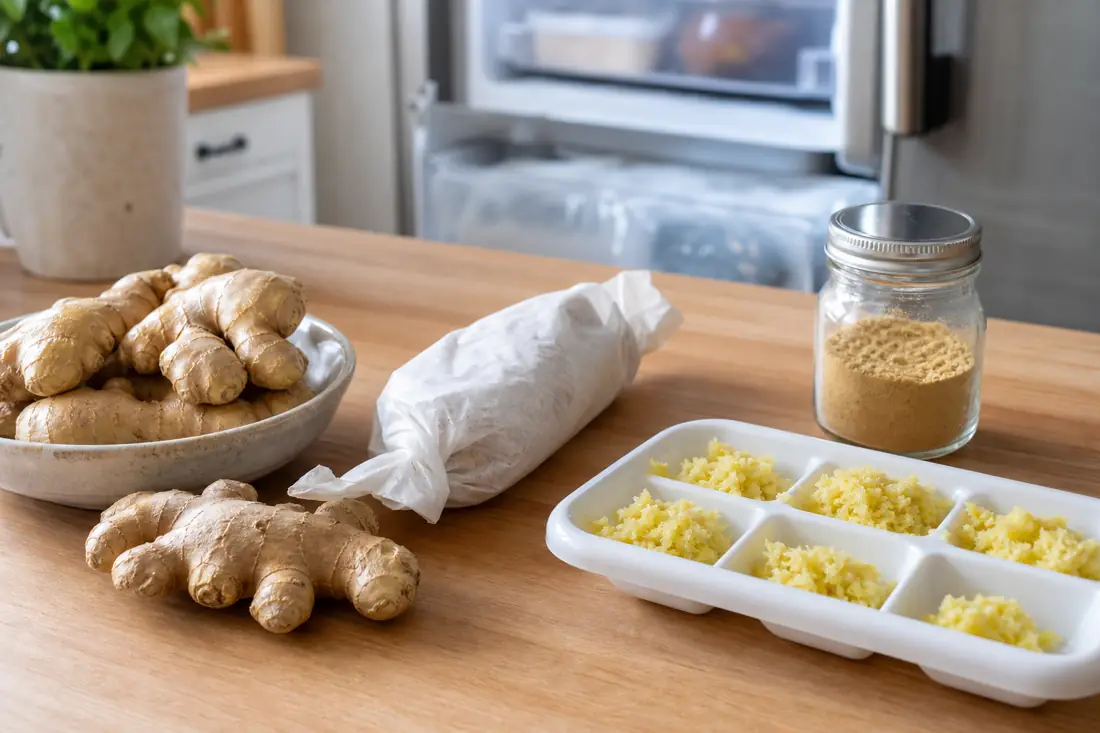
- Fridge: Keep fresh ginger dry and unpeeled.
- Freezer: Grate frozen ginger straight from the knob.
- Ground jar: Keep it sealed, dark, and away from steam.
- Fridge, unpeeled: A dry, firm piece keeps for a few weeks.
- Freezer: Freeze whole and grate frozen, or freeze grated in a small tub.
- Ground jar: Store away from the stove and replace once the smell fades.
- Toss it: Soft, wrinkled, or moldy fresh ginger is past saving.
Ground ginger needs a cool, dark, airtight jar because warmth and light turn the powder dusty.
Ground ginger fades like any dried spice. Kept away from heat and light, it holds useful flavor for about a year before it turns dusty and flat.
Check ground ginger by smell. If it no longer smells warm and spicy, it has gone the way of other spices past their prime, so replace it.
Soft, moldy, or shriveled fresh ginger is past saving. Firm root with tight skin is the sign of a piece still worth grating.