
Parsley Is an Ingredient, Not a Garnish
Flat-leaf against curly, what the stems are for, and the dishes that use parsley by the bunch.
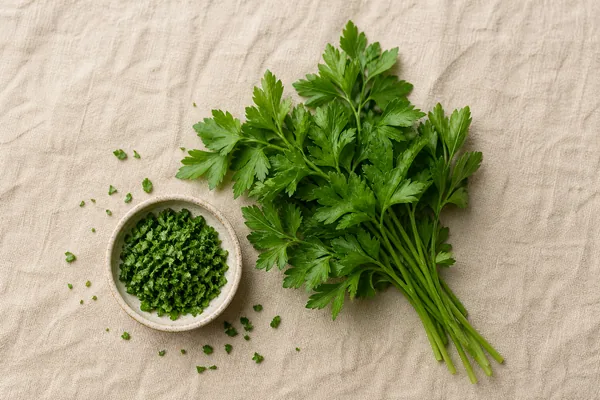
Parsley is the bulk of most dishes that made it famous, from tabbouleh to gremolata, rather than the sprig beside them. Flat-leaf carries the flavor, curly carries the structure, and the stems belong in the stockpot rather than the bin.
What does parsley add beyond a garnish?
The sprig on the side of a plate has done parsley a lot of damage.
It taught two generations of cooks that this is a herb you look at rather than eat, and that a teaspoon of it chopped over something counts as using it.
The dishes parsley actually built are nothing like that. In tabbouleh it is the main ingredient by volume, with the bulgur playing a supporting role rather than the other way round.
Gremolata is parsley, lemon zest and garlic and nothing else. Persillade is parsley and garlic.
Italian salsa verde is a bowl of parsley held together with oil, capers and anchovy.
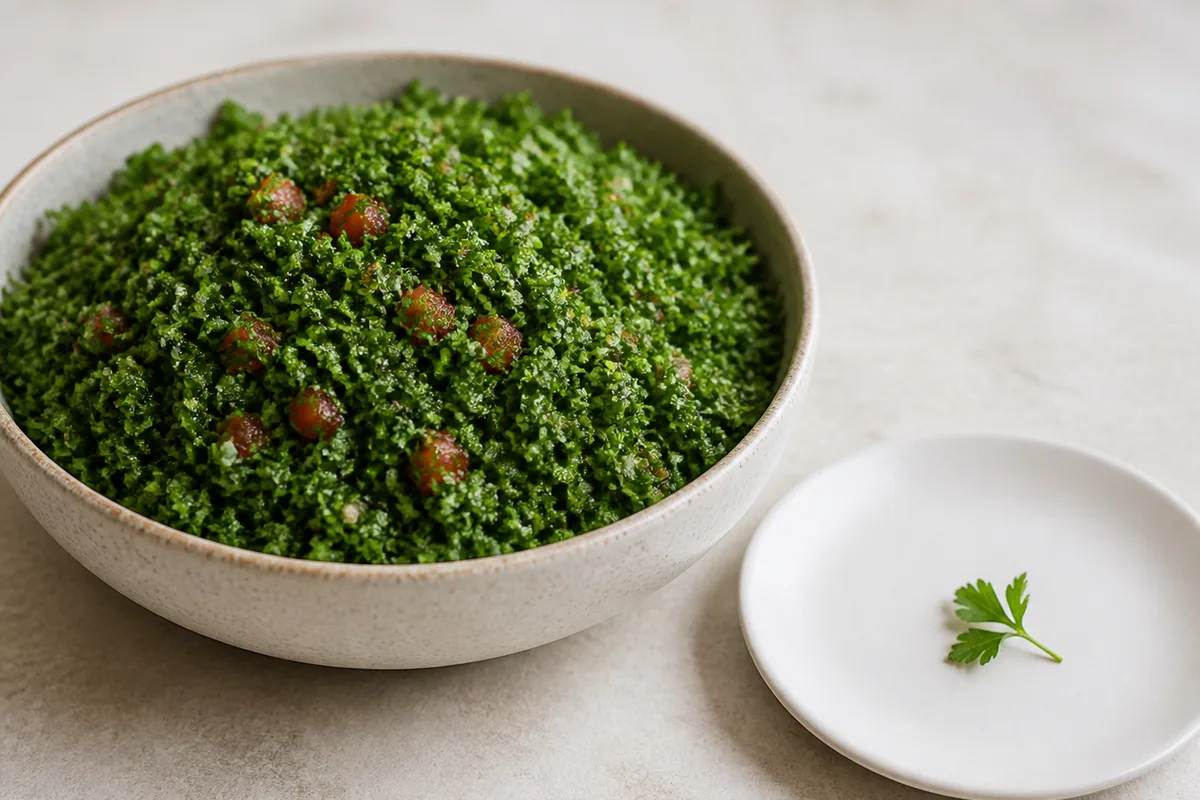
- Left: Tabbouleh, where parsley is the bulk and the grain is the accent.
- Right: The garnish sprig, which flavors nothing.
- Scale: A serious parsley dish uses whole bunches, not spoonfuls.
Once you treat it as a green vegetable that happens to be intense, the amounts in real recipes stop looking like mistakes.
Parsley reads as green, and underneath that there is more going on than most people notice.
The dominant impression is fresh and vegetal, close to the smell of cut grass but cleaner. Behind it sits a light pepperiness and a faint bitterness that arrives at the end of the mouthful.
It belongs to the Apiaceae family, alongside carrot, celery, fennel, coriander and dill, and the family resemblance is easy to taste once you look for it. Parsley and celery leaf are close enough that one substitutes for the other.
The aroma compounds behind it are volatile, which is the whole reason parsley is a finishing herb rather than a base one. They leave with heat and with time.
What parsley adds to a dish is not really flavor in the way cumin or clove add flavor. It is freshness, and freshness works as a contrast rather than as a taste in its own right.
That is why it turns up on rich, heavy, slow-cooked food and almost never on something already light.
Should you buy flat-leaf or curly parsley?
Both are Petroselinum crispum and they are not interchangeable in practice.
Flat-leaf, sometimes sold as Italian parsley, has broad pointed leaves and a stronger, cleaner, faintly peppery flavor. It is the one to buy if the parsley has a job to do.
Curly parsley is milder and more vegetal, with tightly ruffled leaves that hold their shape and their moisture far longer.
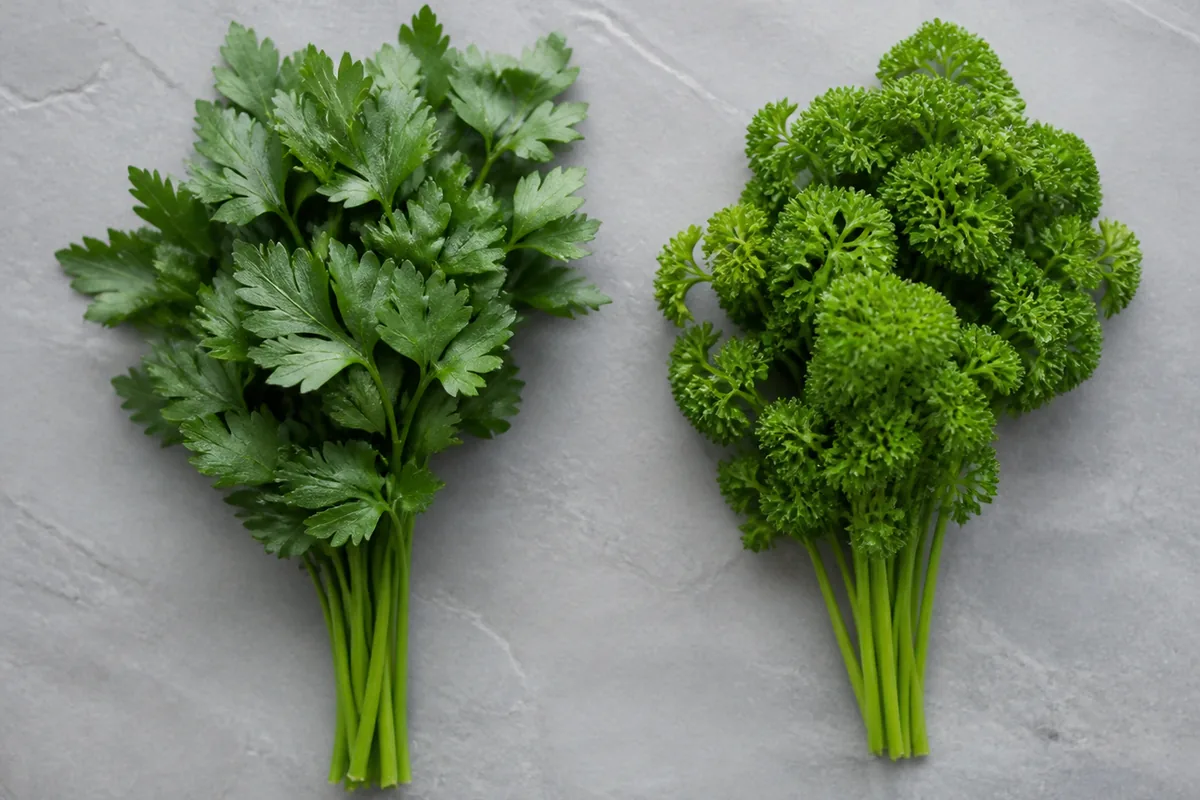
- Flat-leaf: Stronger and cleaner, and the default for cooking.
- Curly: Milder, sturdier, and the one that holds up fried or on a buffet.
- Not a swap: Curly in gremolata tastes thin, flat-leaf on a hot plate wilts.
That sturdiness is a real advantage in the right place. Curly parsley is what you want deep-fried as a garnish, or sitting on something warm for twenty minutes, because flat-leaf goes limp and dark in both situations.
A third type exists that most shops never carry. Hamburg or root parsley is grown for a thick pale taproot used like a parsnip, with leaves that are an afterthought.
Can you eat parsley stems, and how should you wash them?
Parsley stems carry a great deal of the plant's aroma and almost none of its delicacy.
They are too fibrous to chop into a finished dish, which is why the advice to use them is often given badly. Chopped into a salad they read as string.
Their proper home is liquid. A bundle of stems tied with string is the backbone of a bouquet garni, and they go into stock, braises and soups where hours of simmering can extract them.
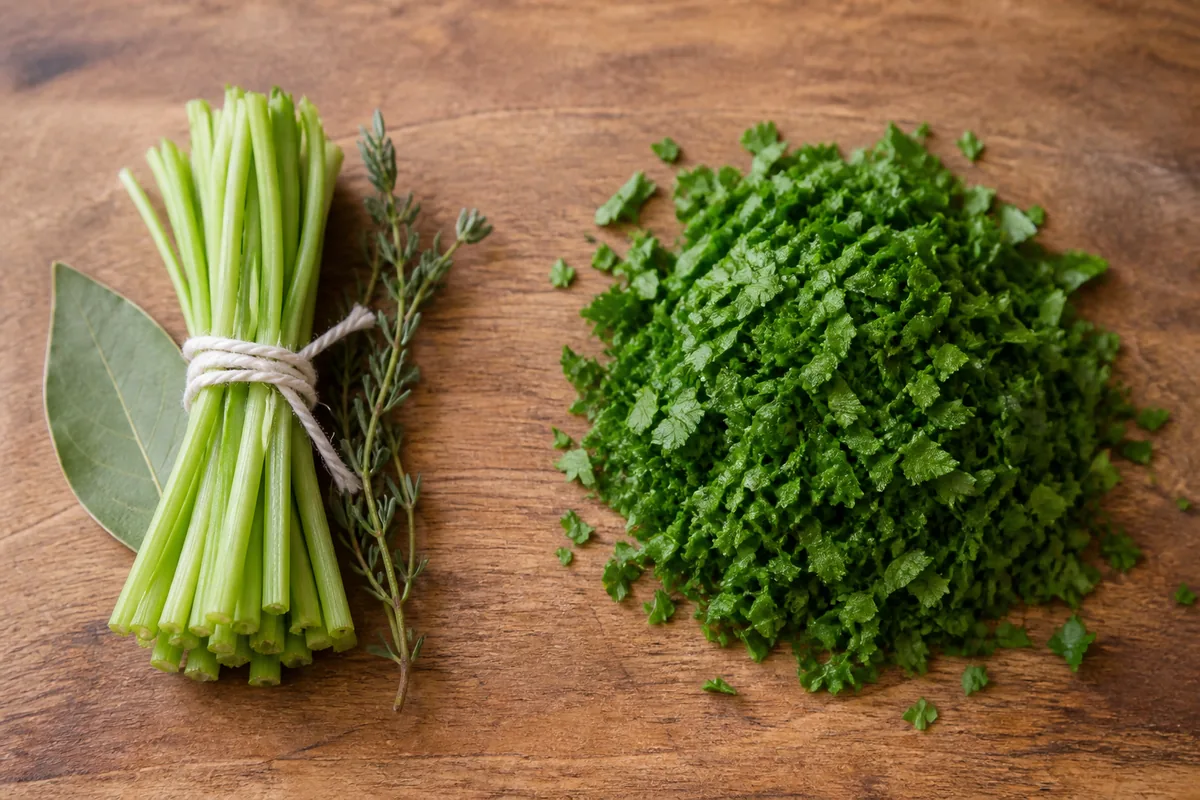
- Stems: Tied into a bundle for stock, braises and long soups.
- Leaves: Chopped and added off the heat, or used raw by the handful.
- Rule: If it needs chewing, it belongs in the liquid.
Keep them in the freezer. A bag of accumulated parsley stems costs nothing and improves any stock you make.
Parsley grows low and dense, and it traps soil in a way that most herbs do not.
Rinsing a bunch under the tap drives the grit further into the leaves rather than removing it. You get it out by floating it instead.
- Fill a bowlCold water, deep enough to submerge the whole bunch.
- Swish itMove the parsley through the water with your hands so the grit works loose.
- Lift, do not pourThe grit sinks and the leaves float, so lift the parsley out and leave the sediment behind.
- Repeat if neededTwo changes of water is usually enough, three for a muddy garden bunch.
- Dry it fullyA salad spinner, or ten minutes rolled loosely in a towel.
Wet parsley is the reason a lot of chopped parsley turns to paste. The water carries the bruised cell contents around the board rather than leaving them in the leaf.
Which dishes use parsley by the bunch?
These are worth knowing as a set, because they are all built on the same idea and they use quantities that look wrong until you try them.
| Dish | Parsley | Everything else |
|---|---|---|
| Tabbouleh, serves 4 | 3 to 4 large bunches, finely chopped | A few tablespoons of bulgur, tomato, mint, lemon, oil |
| Gremolata, serves 4 | A small bunch, about 30 g | Zest of one lemon, one garlic clove |
| Persillade, serves 4 | A small bunch | Two garlic cloves, oil |
| Italian salsa verde, serves 4 | Two bunches | Capers, anchovy, garlic, oil, vinegar |
| Maitre d'hotel butter | 3 tbsp chopped, per 100 g butter | Lemon juice, salt |
Tabbouleh is the one people get most wrong. A Levantine version is a herb salad with grain in it, not a grain salad with herbs on top, and the ratio is what makes it taste alive rather than stodgy.
Gremolata is the cheapest way to rescue a heavy braise. Scattered over osso buco or any long-cooked meat, the raw parsley and lemon zest cut through fat that has been reducing for three hours.
When should you add parsley, and can you fry it?
Parsley is tougher than its neighbors, and that changes when you add it.
Basil, chives and dill collapse within seconds of meeting heat. Parsley does not.
It will sit in a warm dish for several minutes and stay green, and it survives brief cooking without turning to slime.
That does not make it a herb for long cooking. Simmer it for half an hour and the fresh note goes, leaving a vegetal background that is pleasant but no longer the point.
The practical rule is minutes rather than seconds. Stir it into a stew as it comes off the heat, or into a sauce a minute or two before serving, and it holds.
Deep-frying is the one place parsley meets real heat and improves, and it works beautifully. Curly parsley dropped into hot oil for a few seconds turns crisp and translucent, and it keeps its color completely.
The oil has to be properly hot and the parsley properly dry, because wet leaves in hot fat spit violently. Lift it out the moment the bubbling slows, which is usually under ten seconds, and drain it on paper.
Use curly for this and not flat-leaf. The ruffles trap air and crisp evenly, while flat leaves stick together and go leathery.
How much parsley should you use, and how should you cut it?
Parsley is measured in handfuls and cups, not in teaspoons.
A supermarket bunch is roughly 30 grams and yields around a cup loosely chopped. For a finishing scatter that is enough for four generous portions.
Chop it dry. Wet parsley bruises under the knife and turns to a dark paste, so wash it well ahead and dry it thoroughly first.
| Use | Amount | Note |
|---|---|---|
| Scatter over a finished dish | 1 tbsp per portion | Chopped just before serving |
| Stirred through a stew or grain | Half a bunch per 4 servings | Off the heat |
| Gremolata or persillade | A whole small bunch | It is the dish, not a seasoning |
| Herb salad or tabbouleh | 3 to 4 bunches | Treat it as the vegetable |
| Stock or braise | A bundle of stems | Removed before serving |
A sharp knife matters more than technique. Rock a blunt blade through parsley and you get bruised green mush that stains the board and loses its aroma to the air.
Does parsley really freshen breath?
The sprig on the plate started as a practical thing rather than a decorative one, and the practice has some basis.
Parsley is high in chlorophyll, which has a long history of use as a deodoriser, and chewing it does mechanically clear the mouth while producing saliva.
The effect on garlic breath in particular is partly real and partly a swap. Some of it is masking, since a strong fresh aroma displaces a strong stale one, and some of it comes from compounds in the leaf reacting with the sulfur compounds garlic leaves behind.
What it will not do is address anything systemic. Garlic breath comes largely from compounds carried in the blood and released through the lungs, which is why it outlasts anything you chew.
So the garnish is worth eating, and it is worth understanding as a partial fix rather than a cure.
How do you buy, store, and freeze parsley?
Look for a bunch with firm upright stems and no yellowing at the base of the leaves.
Parsley keeps better than most soft herbs. Trimmed and stood in a glass of water, loosely covered, it holds in the fridge for a week or more.
Do not wash it until the day you use it. Water sitting on the leaves is what turns a good bunch to black slime.
Freezing works acceptably, which is not true of every soft herb. Chopped parsley frozen in a bag keeps its flavor well enough for cooked dishes, though it is too limp to garnish with.
Dried parsley is the weakest form and the one to skip. It keeps a faint grassiness and none of the fresh lift, which is the entire reason to use the herb.
How do you grow parsley, including root parsley?
Parsley is a biennial, which explains most of what a gardener notices about it.
In its first year it makes leaf, and that is the year you want. In its second it puts everything into flowering and setting seed, the leaves turn sparse and bitter, and the plant dies.
So treat it as an annual and sow it again. A plant that has bolted is not recoverable and is best pulled.
Germination is famously slow, often two to four weeks, and it does not indicate failure. Sowing into warm soil and keeping it damp is most of what helps.
Hamburg parsley is the variety grown for its root rather than its leaf. The root looks like a pale parsnip, tastes like a cross between parsley and celeriac, and roasts or goes into soup, while the leaves are edible but coarse.
It is common in Central and Eastern European cooking and almost absent from British and American shops, which is why most people have never met it.
Is parsley safe in concentrated forms?
Parsley eaten as food, even by the bunch in a tabbouleh, is not a concern for most people.
Concentrated forms are a different matter. Parsley seed oil and strong parsley extracts contain apiol and myristicin at levels far above anything in the leaf, and those have been used historically in ways that make them a poor idea to experiment with.
The relevant caution is pregnancy, where medicinal quantities and the essential oil are specifically advised against even though culinary parsley is not. The general position on spices in pregnancy sits under spices during pregnancy.
Anyone on warfarin has a separate reason to keep intake steady rather than low. Parsley is high in vitamin K, and it is the sudden change in how much you eat rather than the herb itself that matters there.
What can replace parsley when volume matters?
No single herb replaces parsley, because the job is usually bulk and freshness rather than a distinctive flavor.
Celery leaf is the closest in character and is usually free, since it comes attached to the celery you already bought.
Chervil is more delicate and more aniseed, and works where parsley was providing softness rather than bite.
| Instead of parsley | Use | What changes |
|---|---|---|
| Celery leaf | The same volume | Very close, slightly more bitter |
| Chervil | The same volume | Softer, faintly aniseed, more fragile |
| Carrot tops | Two thirds the volume | Greener and more assertive, needs a fine chop |
| Coriander leaf | Half the volume | A completely different dish, not a substitute |
Coriander deserves the warning, because the two look similar enough on a shelf that people reach for the wrong bunch.
The result is not a weaker version of the dish but a different cuisine entirely, which is covered under cilantro.
There is one more distinction worth making before you swap anything. Parsley is doing a structural job in most of these dishes rather than a flavoring one, so a substitute has to match the volume as well as the character.
Half a bunch of something more assertive will not stand in for two bunches of something mild. If you cannot match the quantity, the honest move is to cook a different dish rather than a thin version of this one.