
What Is Galangal, and How Is It Different From Ginger?
Galangal brings pine, citrus, pepper, and a firm texture that calls for a sharp knife and a clear plan.
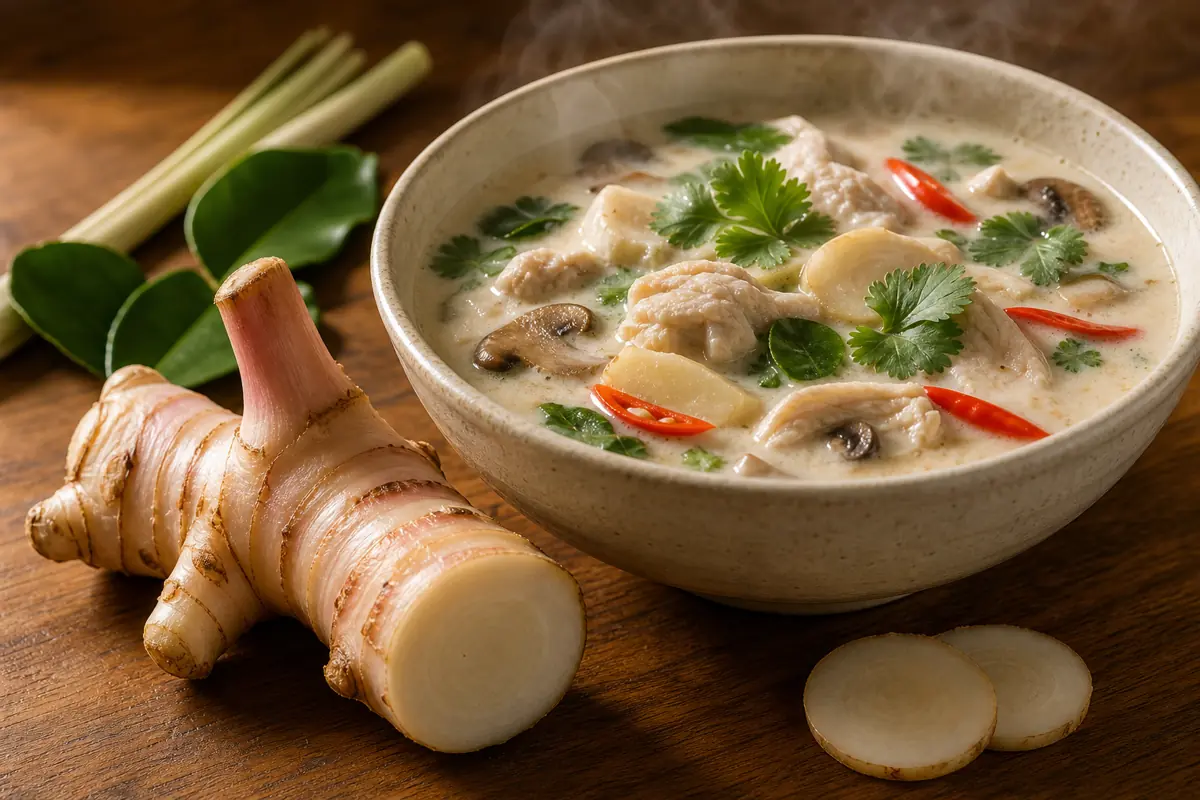
Galangal is a pale, firm rhizome with a piney citrus aroma that ginger cannot fully copy. Slice it across the grain to infuse broth, pound small pieces into curry paste, and leave thick woody slices in the bowl rather than chewing them. Frozen galangal is the closest backup for fresh, while dried slices and powder change the flavor.
What is galangal, and what does it taste like?
Galangal is an aromatic rhizome in the ginger family, but its flavor and texture make it a separate cooking ingredient. Most Thai and Southeast Asian recipes that name galangal mean greater galangal, or Alpinia galanga.
Fresh galangal smells of pine needles, lemon peel, white pepper, and damp earth. The aroma feels cool and resinous before a gentle peppery warmth appears.
The skin is pale cream to pink-beige with firm rings around the rhizome. Cut flesh is ivory or pale yellow and much denser than common ginger.
Market labels may use galanga, Thai ginger, Siamese ginger, laos, or lengkuas. The ginger names describe family resemblance, not equal flavor.
That hard structure guides every useful method. Thick coins perfume liquid and come out later, while very small pieces can be pounded or blended into a paste that stays in the food.
| Cue | What you notice | Cooking consequence |
|---|---|---|
| Skin | Pale, smooth, and visibly ringed | Scrub young pieces; trim tough skin for paste |
| Flesh | Ivory, dense, and fibrous | Use a sharp knife and cut across the grain |
| Aroma | Pine, citrus peel, and pepper | Pair with coconut, seafood, herbs, and chile |
| Texture | Firm even after simmering | Remove thick slices or pound very finely |
Is galangal the same as ginger?
Galangal is not the same as ginger. Both are rhizomes in the Zingiberaceae family, yet they belong to different genera and behave differently on the cutting board.
Ginger usually has tan matte skin, knobby fingers, yellow flesh, and enough moisture to grate easily. Galangal is paler, smoother, more evenly ringed, and resistant to a grater.
Ginger tastes warm, juicy, and lightly sweet with a clean burn. Galangal is drier and more resinous, with pine, lime peel, and white-pepper notes that remain distinct in coconut broth.
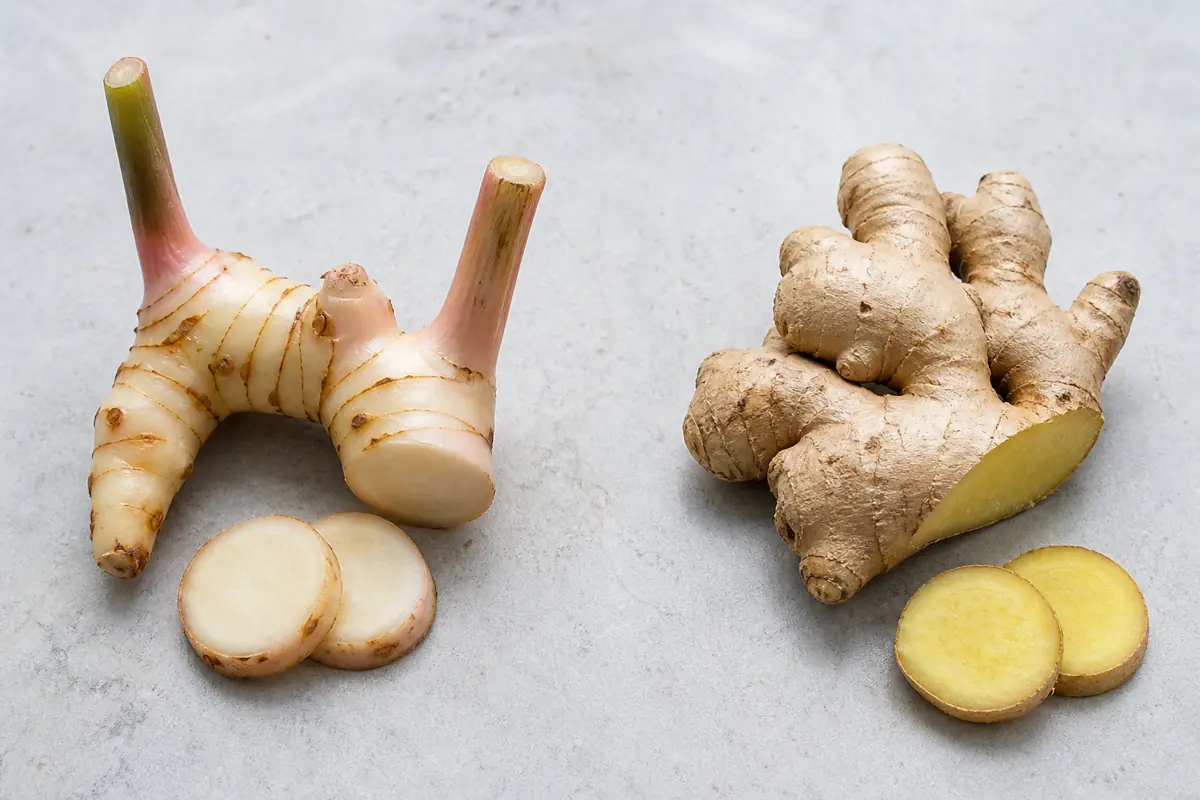
- Galangal skin: Pale with even rings
- Galangal flesh: Dense ivory and fibrous
- Ginger cue: Tan knobs and moist yellow flesh
A recipe can use grated ginger raw or add it to a quick sauce. Mature galangal needs slicing, mincing, or pounding, and raw chunks are too hard for pleasant eating.
| Question | Galangal | Ginger |
|---|---|---|
| What does it look like? | Pale, smooth, ringed rhizome | Tan, matte, knobby rhizome |
| What does it taste like? | Piney, citrusy, peppery | Warm, juicy, lightly sweet |
| How firm is it? | Dense and fibrous | Tender enough to grate |
| Where does it lead? | Thai and Southeast Asian soups, pastes, braises | Broad savory, sweet, drink, and pickle uses |
| Can one replace the other? | Defining aroma in galangal-led dishes | Emergency warmth with a different flavor |
Use ginger only when the recipe can tolerate a different aroma. That change is easy to taste in tom kha, rendang, or a galangal-led curry paste.
The missing pine note is part of the dish itself.
Can you eat galangal slices?
You can eat galangal, but a thick mature slice is usually too fibrous to enjoy. In soup it acts like a bay leaf, releasing aroma while keeping most of its woody structure.
Diners commonly push thick galangal coins to the side of a tom kha bowl. Leaving them uneaten is normal and does not mean the cook prepared the soup incorrectly.
Young galangal cut paper-thin can be chewed, and finely minced or thoroughly pounded galangal disappears into curry paste, sambal, fish cakes, and cooked relishes. Smaller pieces also soften more evenly during cooking.
Warn diners when thick pale slices resemble edible ginger. The clue is resistance: a piece that stays stiff under a spoon will be tougher under the teeth.
How do you peel and cut fresh galangal safely?
Wash galangal under running water and scrub soil from the rings. Dry it before cutting so the hard rhizome does not slide under the knife.
Young galangal with thin clean skin usually needs no peeling for an infusion. Trim thick, leathery, bruised, or dirty skin when the galangal will be pounded into a paste.
Use a sturdy chef's knife or cleaver on a stable board. Cut a thin slice from one side first, place that flat surface down, and keep fingertips behind the blade.
For soup, cut across the grain into coins about 3 to 5 millimeters thick. A firm downward cut is safer than forcing the knife back and forth through a rolling knob.
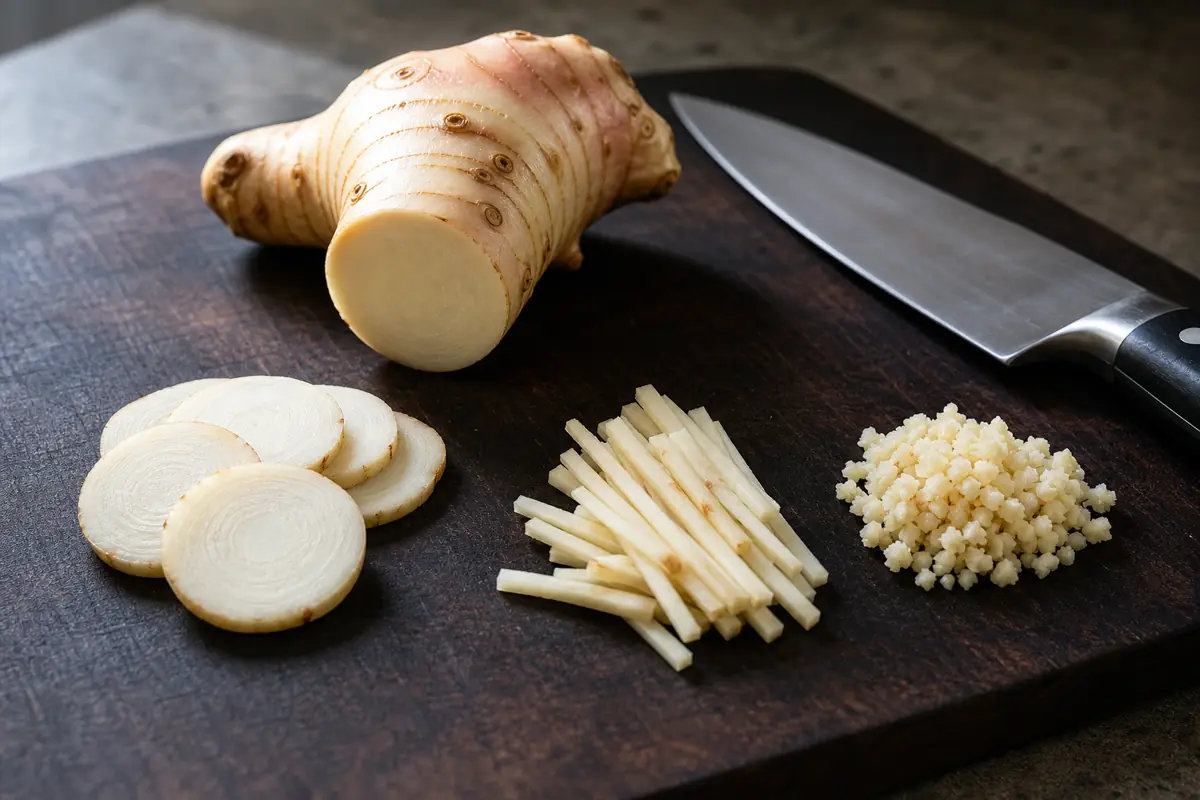
- Stabilize: Cut one flat side first
- For broth: Slice cross-grain coins
- For paste: Mince before pounding
For mince, stack a few thin coins, cut narrow strips, then turn and cut small cubes. Add only a small handful to a processor because large hard chunks can make the blade jump or leave stringy pieces.
- For broth: Cut firm cross-grain coins that are easy to find and remove.
- For stir-fry: Make thin matchsticks or a fine mince so the fibers cook through.
- For curry paste: Slice, mince, then pound the smallest pieces before wet ingredients enter.
- For freezing: Portion coins and minced galangal separately for later use.
A mortar handles the fibers more predictably when galangal is already minced. Follow a deliberate home grinding method and pound it with a pinch of coarse salt before softer aromatics enter.
Stop and sharpen the knife if the blade skids or crushes the rhizome. Extra force with a dull edge makes the preparation less controlled, not faster.
How do you use galangal in soup, curry paste, and stir-fry?
Use galangal slices early in soup so water, stock, or coconut milk has time to collect the aroma. Five to eight thin coins can clearly perfume a four-serving pot without filling every spoonful with woody pieces.
Bruise thick coins once with the flat of a knife when the broth cooks briefly. More exposed surface speeds infusion, but smashing the rhizome into ragged fibers makes removal harder.
For curry paste, pound minced galangal before lemongrass, garlic, shallot, or soaked chile. The hardest ingredient needs the longest contact with the mortar.
A paste should not show pale splinters. If the mortar cannot smooth the fibers, mince them again or press the finished paste through the cook's fingers and remove obvious strands.
For stir-fry, use a fine mince or short matchsticks and apply the early spice timing needed to soften them. Thick raw coins will stay rigid during a fast cook.
Galangal works especially well with coconut milk, lemongrass, makrut lime leaf, garlic, shallot, chile, seafood, chicken, mushrooms, and fermented sauces. Those partners support its fresh high notes without hiding the piney center.
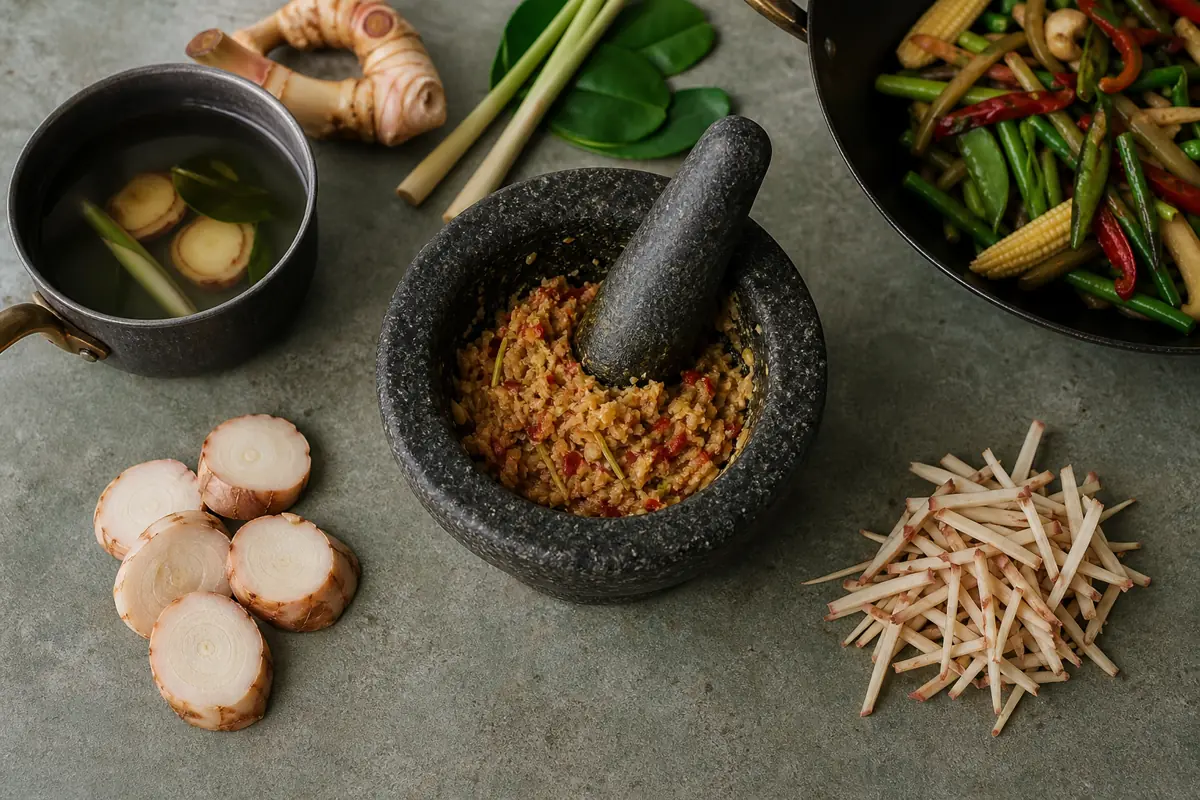
- Coins: Infuse soup, then remove
- Fine mince: Pound into curry paste
- Matchsticks: Use in quick cooking
| Method | Best galangal form | When to add | What happens at serving |
|---|---|---|---|
| Soup or broth | 3 to 5 mm coins | Early | Leave visible or remove before serving |
| Curry paste | Minced, then pounded smooth | Into the paste | Disperses through the sauce |
| Stir-fry | Fine mince or short matchsticks | Early in the oil | Small pieces remain edible |
| Braise | Bruised coins or fine paste | With the cooking liquid | Remove coins; leave paste |
A brief oil bloom helps fine galangal mince release aroma before wet ingredients cool the pan. Keep the heat moderate so small fibers do not brown hard.
If galangal dominates, add more unseasoned broth, coconut milk, vegetables, or protein. Long boiling can soften the top aroma, but it will not turn a woody excess into ginger.
Fresh, frozen, dried, or powdered galangal: which works best?
Fresh galangal gives the clearest pine and citrus aroma. Choose it for tom kha, curry paste, and dishes where the rhizome is easy to notice.
Look for dense pieces with tight skin and moist, pale cut ends.
Frozen galangal is the best practical backup. It loses some crisp texture after thawing, but the aroma stays closer to fresh than dried slices or powder.
Dried slices work as removable aromatics in soup and braising liquid. Soak them in warm water for 20 to 30 minutes, then use the slices and some strained soaking liquid if it smells clean.
Galangal powder tastes warmer, flatter, and less piney than fresh rhizome. It spreads easily through a dry blend or sauce, but it cannot create the clean layered aroma of fresh coins in broth.
| Form | Best use | Preparation | Main tradeoff |
|---|---|---|---|
| Fresh | Soup, curry paste, stir-fry | Slice, mince, or pound | Shorter storage life |
| Frozen | Soup and curry paste | Use from partly frozen or thaw briefly | Softer texture |
| Dried slices | Longer soup or braise | Soak before cooking | Less fresh citrus aroma |
| Powder | Dry blends and backup seasoning | Whisk into liquid or fat | Warm and flat rather than fresh |
Use the whole versus ground choice as a flavor decision, not a convenience label. Buy frozen before powder when a Thai recipe depends on fresh galangal aroma.
A reputable online spice shop can be more useful than supermarket powder when it sells frozen rhizome with clear cold-shipping terms.
What can substitute for galangal, and how much should you use?
Start a four-serving soup with five to eight thin slices of fresh or frozen galangal. Use a level tablespoon measurement of fine mince as a cautious beginning for stir-fry or paste.
Galangal strength changes with age, cut size, and storage. Smell a fresh cut and adjust the next batch instead of doubling the pot before the first infusion is complete.
No common ingredient exactly replaces galangal. A substitution by function starts with young ginger for warmth, while accepting that it lacks dry pine and resin character.
For one tablespoon of minced galangal, try two teaspoons minced young ginger with one thin strip of lime peel, avoiding the bitter white pith. Remove the peel before serving and expect a brighter, juicier result.
| Need | Starting point | Adjustment |
|---|---|---|
| Four-serving soup | 5 to 8 thin fresh coins | Add 2 more after the broth infuses |
| Four-serving paste or stir-fry | 1 tablespoon fine mince | Increase in 1-teaspoon steps |
| Galangal powder | 1/2 teaspoon | Taste after it hydrates; do not match fresh by volume |
| Emergency substitute | 2 teaspoons young ginger plus lime peel | Remove peel and accept missing pine notes |
In a dish named for galangal, postponing the recipe or buying frozen rhizome gives a truer result than building a large substitute mixture. In a flexible broth or stir-fry, ginger alone may be the cleaner compromise.
How do you buy, freeze, and store galangal?
Buy galangal that feels heavy, hard, and smooth for its size. Pink-beige rings and a strong clean aroma at a cut end signal a fresher piece.
Avoid rhizomes with deep wrinkles, soft dark spots, slime, visible mold, or a fermented smell. A dry surface scar is less concerning than wet decay spreading under the skin.
For short spice storage, wrap the unwashed rhizome in a dry towel and place it in a loose bag in the refrigerator. Keep it away from standing water and wash only the amount you will cut.
Freeze extra galangal as coins, minced portions, or curry-paste amounts on a tray, then move the firm pieces to an airtight bag. Flat small portions let you remove one cooking amount without thawing the rest.
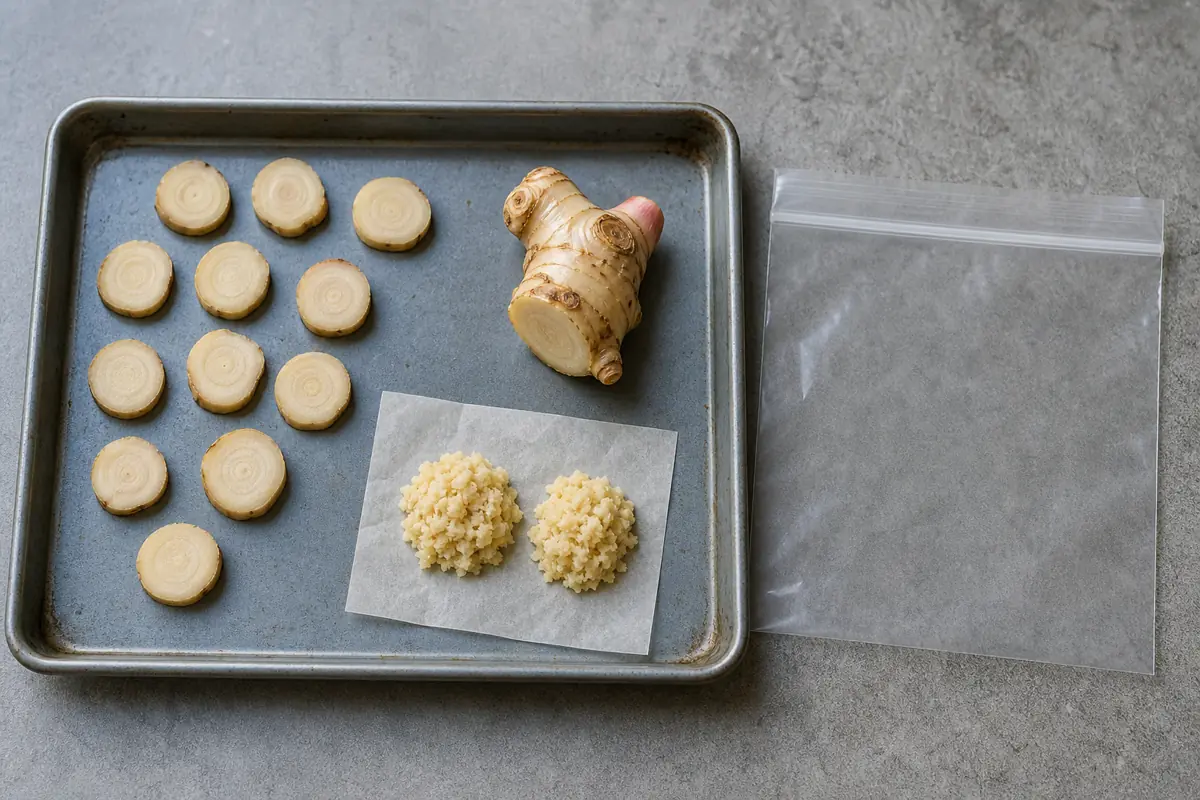
- Portion: Cut for the planned dish
- Tray freeze: Keep pieces separated
- Store: Bag only after firm
- Buy: Firm, dense rhizomes with tight skin and a pine-citrus smell.
- Refrigerate: Keep dry and loosely wrapped for the next few meals.
- Freeze: Portion before bagging so the hard root is ready for its intended cut.
- Discard: Remove galangal with slime, mold, spreading soft spots, or an alcoholic smell.
Partly frozen galangal can be easier to slice cleanly than a fully thawed piece. Let the surface soften just enough for the knife to bite, then use the slices directly in hot liquid.