
What Are Makrut Lime Leaves, and How Do You Cut Them?
Use the double leaf whole when it should leave the pot, or slice it fine enough to disappear into the bite.
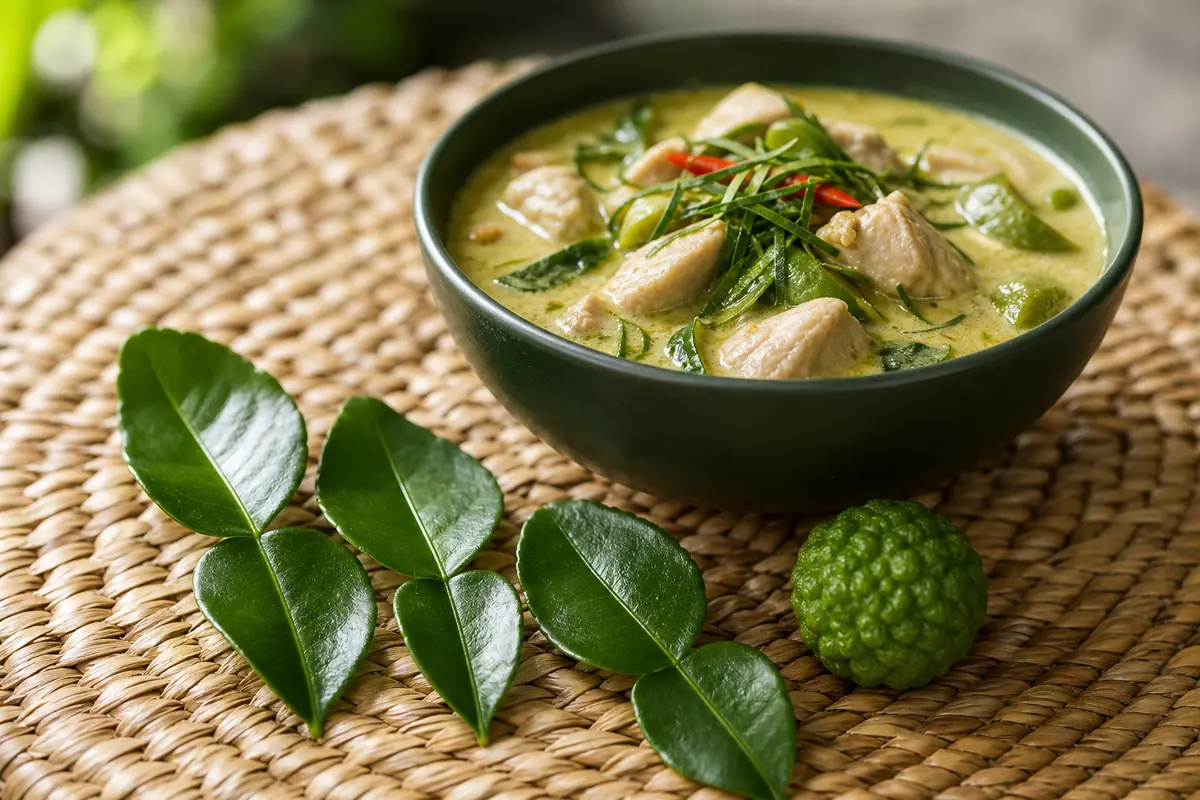
Makrut lime leaves are the same ingredient sold as kaffir or Thai lime leaves. Tear whole leaves to perfume soup and curry, then remove them if their leathery texture would distract. For edible garnish, pull out the thick center vein and slice the stacked leaves into hair-thin shreds, and note that fresh and frozen leaves keep the clearest aroma while dried leaves need more time in liquid.
Are kaffir lime leaves the same as makrut lime leaves?
Kaffir lime leaves and makrut lime leaves come from the same Citrus hystrix tree. Thai lime leaf is another market name for the same ingredient.
Many cooks, writers, and stores now prefer makrut.
The older English name is also a racial slur in southern Africa, even though its citrus history is disputed.
A makrut leaf looks like two glossy leaves joined end to end. Botanically, the lower section is a wide winged leaf stalk attached to the blade.
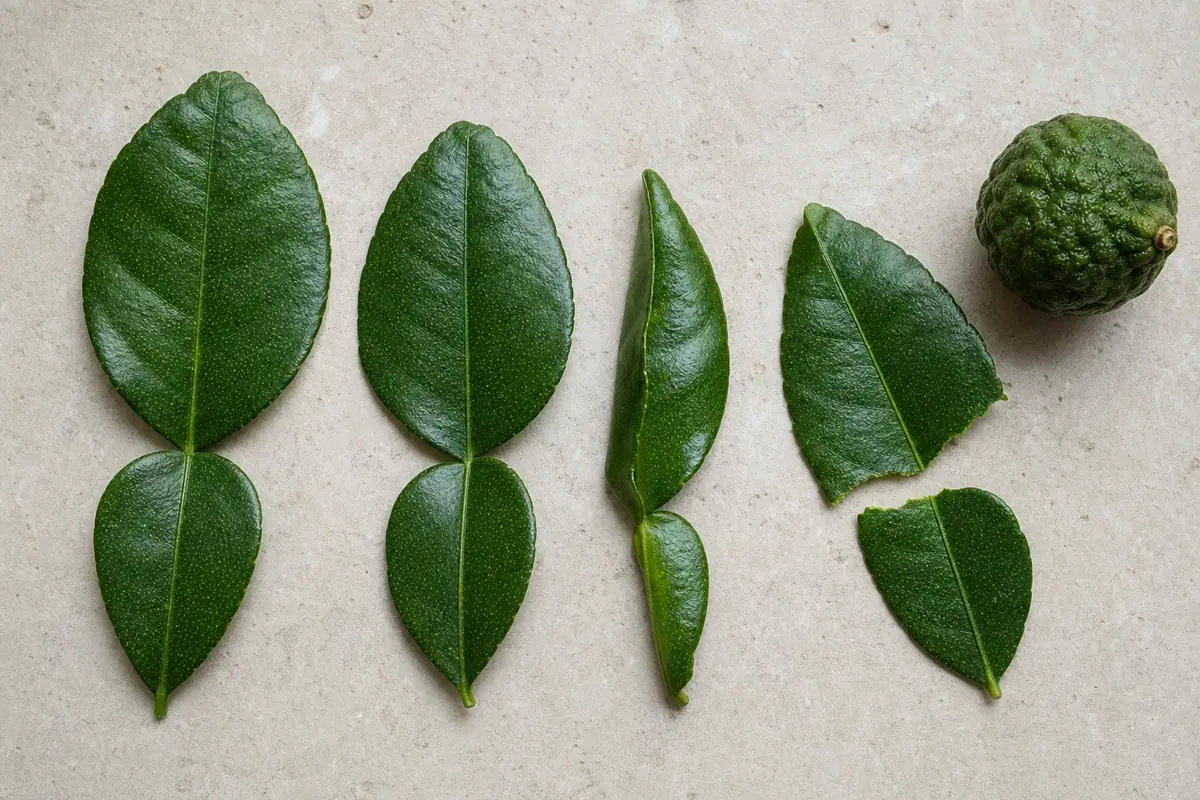
- Leaf shape: Two joined lobes
- Center: Firm folded vein
- Fruit cue: Deeply dimpled rind
Fresh leaves are deep green, firm, and slightly leathery. Crushing an edge should release a powerful floral citrus smell within seconds.
| Label | What it means | What to check |
|---|---|---|
| Makrut lime leaves | Preferred common English name | Glossy joined double leaf |
| Kaffir lime leaves | Older name for the same leaf | Same Citrus hystrix ingredient |
| Thai lime leaves | Retail shorthand | Confirm the double-leaf shape |
| Bai makrut | Thai name for the leaf | Fresh, frozen, or dried form |
Do not substitute leaves from a Persian lime tree growing in the yard.
Regular lime leaves lack the joined shape and the concentrated makrut aroma.
What do makrut lime leaves taste like?
Makrut lime leaves taste intensely floral and citrusy, with citronella, pine, and fresh green notes. Their smell is sharper and more perfumed than ordinary lime zest.
The leaves are aromatic rather than sour.
They cannot replace lime juice when a soup, curry, or salad needs acidity.
Tearing, crushing, or slicing breaks oil glands across the glossy surface. Heat then carries those volatile oils through broth, coconut milk, or cooking fat.
The aroma fits coconut milk, fresh galangal, lemongrass, chile, garlic, seafood, chicken, mushrooms, and fish sauce. A small amount stays noticeable beside strong fermented flavors.
| Ingredient | Main effect | Can it replace makrut leaf? |
|---|---|---|
| Makrut lime leaf | Floral citrus, pine, green perfume | The reference flavor |
| Regular lime zest | Sharp peel aroma | Only part of the citrus note |
| Lime juice | Sourness and fresh juice aroma | No, it changes acidity |
| Bay leaf | Woody herbal infusion | Only copies the infusion method |
A fresh or frozen leaf should smell vivid after one tear.
Gray-brown dried leaves with little scent will add rough texture before useful aroma.
Can you eat makrut lime leaves?
You can eat makrut lime leaves, but whole leaves are leathery and hard to chew. Treat torn whole leaves like bay leaves and remove them when practical.
Whole leaves may stay visible in a rustic curry or soup.
Diners usually push them aside rather than chew the thick blade and central vein.
Very fine shreds are edible in curries, salads, fish cakes, relishes, and fried garnishes. The cut must be thin enough to soften quickly and spread through the food.
Wide ribbons remain tough even after simmering.
More cooking may dull their aroma without making a thick vein pleasant to eat.
How do you tear, devein, and slice makrut lime leaves?
Rinse fresh makrut lime leaves and dry them well. Water on the surface makes stacked leaves slip under the knife.
For soup or curry, fold each leaf along the center vein and tear it into two or three large pieces. Tearing opens aromatic oil glands without creating hard fragments.
A thin young center vein can remain in an infusion.
Pull out a thick mature vein when the leaf will be sliced or pounded.
To devein, fold the glossy sides together and pinch the tip. Pull the leafy halves away from the vein toward the base.
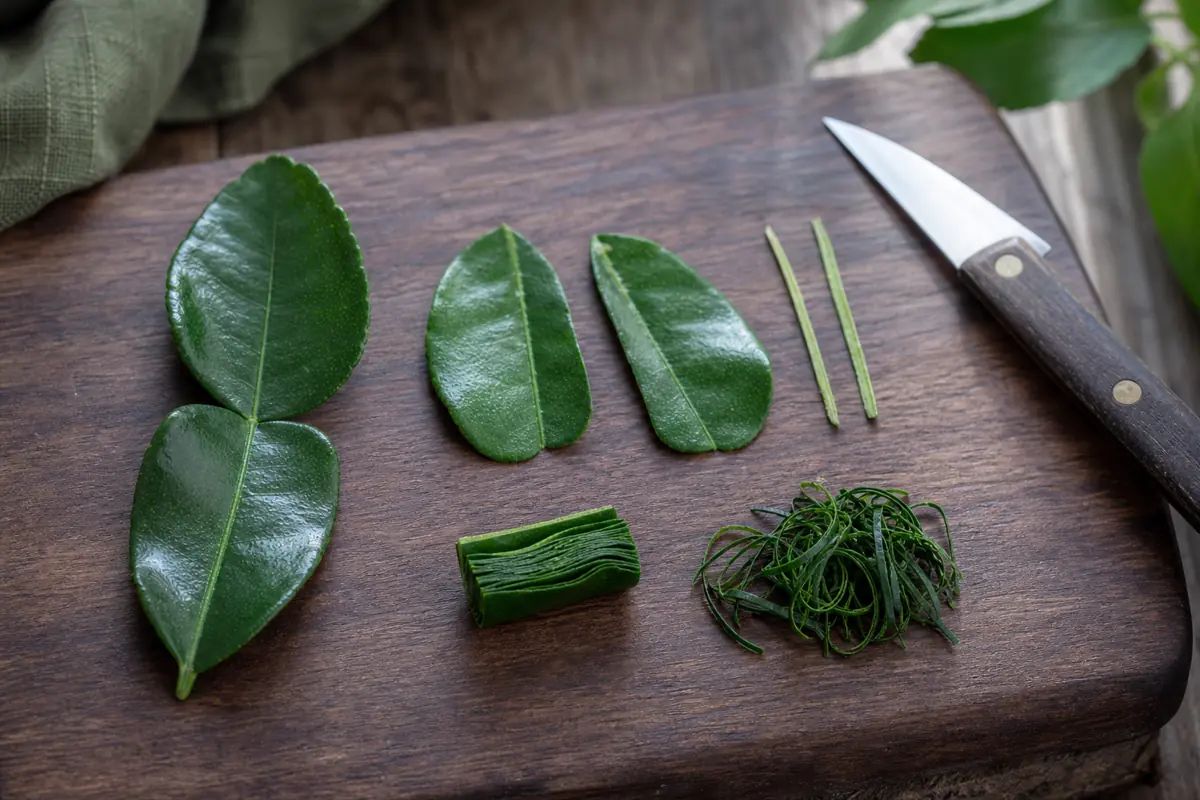
- First: Fold and pull out the vein
- Next: Stack and roll the halves
- Cut: Slice into hair-thin threads
Stack three or four deveined halves, roll them into a tight cigar, and hold the roll with curled fingertips. Cut crosswise with a sharp knife.
- For infusion: Tear a whole leaf into two or three pieces.
- For curry: Remove the thick vein and slice very fine.
- For paste: Devein, mince, then pound with harder aromatics.
- For frying: Dry the shreds completely before they meet hot oil.
Aim for threads about one millimeter wide when the leaf stays in the dish.
A wide decorative ribbon looks attractive but chews like paper.
Slice frozen leaves while they are still firm if the knife can cut them cleanly. Let icy leaves dry before frying to prevent splatter.
How do you use makrut lime leaves in soup, curry, and stir-fry?
Add torn makrut lime leaves early enough to infuse soup, coconut broth, or braising liquid. Three to five fresh leaves can perfume a four-serving pot.
Bruise each torn piece once when cooking time is short.
Fish out the large pieces before serving if diners should not meet a leathery leaf.
For curry, add some torn leaves during simmering and a smaller pinch of fine shreds near the end. The first amount seasons the sauce, while the second keeps aroma vivid.
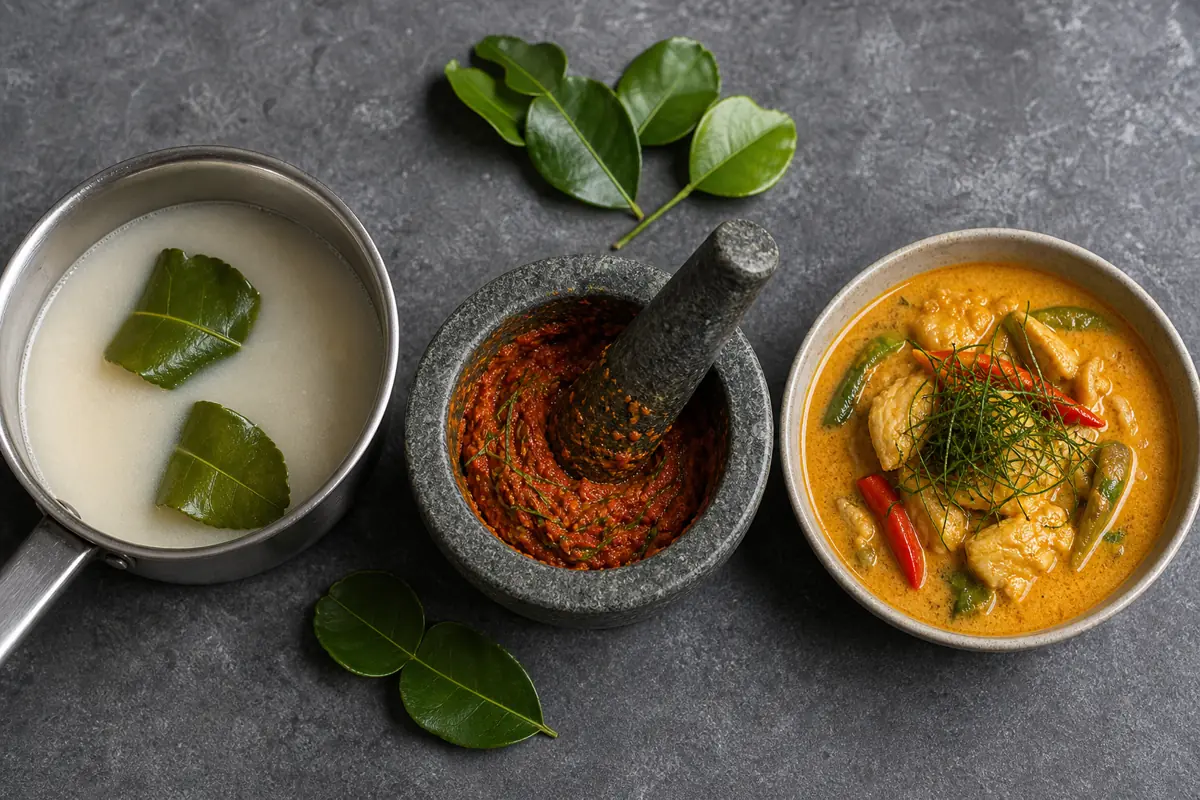
- Soup: Torn leaf, remove later
- Curry paste: Finely minced or pounded
- Finish: Deveined hair-thin shreds
Some curry pastes use makrut rind or leaf. Devein and mince leaf before pounding so green fibers disperse instead of wrapping around other ingredients.
For stir-fry, follow late spice timing to protect the aroma.
A long hard fry makes the leaf taste dry and medicinal.
Dry shreds need only a brief oil bloom to become crisp. Remove them as soon as the thin edges deepen in color.
| Method | Leaf preparation | Timing | Serving texture |
|---|---|---|---|
| Soup or braise | Torn large pieces | Early | Remove or leave for diners to avoid |
| Curry sauce | Torn leaves plus fine shreds | Early and late | Remove large pieces; keep shreds |
| Curry paste | Deveined and minced | Pound into paste | Dispersed |
| Stir-fry or garnish | Hair-thin shreds | Late or briefly fried | Edible |
| Rice pot | One or two torn leaves | At the start | Remove before serving |
If the perfume becomes harsh, add more unseasoned base and fresh acid at the end.
Extra lime leaf will not restore aroma lost through long boiling.
When should you use the leaf, fruit rind, or juice?
The same makrut tree gives cooks a fragrant green leaf, a deeply dimpled rind, and a small amount of juice, but those three clearly distinct parts do very different kitchen jobs.
Use the leaf when aroma needs to travel through soup, coconut milk, a rice pot, or a finished garnish. Its broad oil-rich surface releases perfume after tearing, while a whole piece remains large enough to retrieve before serving.
Use the colored outer rind when the citrus aroma must disappear into a paste.
Finely grated makrut zest pounds smoothly with chile, lemongrass, garlic, and galangal, where leathery leaf fibers can resist the mortar. Grate only the green skin because the white pith underneath brings concentrated bitterness without useful perfume.
| Plant part | Best job | Preparation | Main mistake |
|---|---|---|---|
| Leaf | Infuse broth, curry, or rice; finish as shreds | Tear whole or devein and slice | Leaving a wide strip in the bite |
| Green rind | Disperse aroma through curry paste | Grate finely without white pith | Treating a large strip like a removable leaf |
| Juice | Limited specialty use | Taste before adding | Assuming it behaves like regular lime juice |
The fruit usually gives little juice, and what it yields can taste sharply bitter as well as sour.
Use ordinary lime, tamarind, or the acid named by the recipe when a dish simply needs brightness. Reserve makrut juice for a recipe that specifically calls for it, then add it by taste instead of pouring it as though it were Persian lime juice.
This distinction explains why a Thai curry paste may contain grated makrut rind while the finished curry receives torn leaves. They reinforce the same aromatic family at different stages, a pattern that also appears across the broader Thai spice pantry.
If a recipe says only “makrut lime,” check the method before choosing a part: pounding points to rind, simmering points to leaf, and souring should name the juice explicitly.
Fresh, frozen, or dried makrut lime leaves: which should you buy?
Fresh makrut lime leaves offer the clearest aroma and the best texture for fine slicing. Buy glossy green leaves without yellow patches, slime, or brittle edges.
Frozen leaves are the best everyday backup and work nearly like fresh in cooked dishes.
Their texture softens slightly, but tearing and slicing remain easy.
Dried leaves suit long soups, braises, and rice pots where they can rehydrate. They smell lighter and may stay brittle, so use more time and remove them later.
Powdered leaf fits home spice grinding but fades quickly after opening.
It cannot produce the fresh green threads used in a garnish.
| Form | Aroma | Best use | Main limit |
|---|---|---|---|
| Fresh | Brightest and most layered | Any method, especially slicing | Short refrigerator life |
| Frozen | Very close to fresh | Soup, curry, paste, and shreds | Softer after thawing |
| Dried | Muted and floral | Long liquid infusion | Brittle and less vivid |
| Powder | Fast but short-lived | Dry blends and fine seasoning | No whole-leaf infusion or garnish |
Check the freezer at a Southeast Asian market or a trusted online spice shop before buying dried leaves. Frozen packs preserve the defining aroma better.
How many makrut lime leaves should you use, and what can substitute?
Use level kitchen measurements where the recipe calls for shreds or powder. For whole leaves, start a four-serving soup or curry with three to five.
Use one or two leaves for a small rice pot.
Begin a fine garnish with half a leaf because thin shreds reach many bites.
Dried leaves vary widely in strength. Start with about twice the fresh count and allow extra simmering time rather than adding a large handful at once.
No substitute exactly copies makrut lime leaf. A substitution by function can combine regular lime zest with half a bay leaf.
| Need | Starting point | Adjustment cue |
|---|---|---|
| Four-serving soup or curry | 3 to 5 fresh or frozen leaves | Add one leaf after 10 minutes |
| Small rice pot | 1 to 2 torn leaves | Remove before fluffing |
| Edible garnish | 1/2 leaf in hair-thin shreds | Add pinches at the end |
| Dried leaf infusion | About twice the fresh count | Give it more time |
| Emergency substitute | Lime zest strip plus 1/2 bay leaf | Remove before serving |
The zest supplies sharp citrus and the bay leaf supplies a woody infusion.
The mixture still lacks the floral green note of true makrut leaf.
How do you buy, freeze, and store makrut lime leaves?
Buy glossy deep-green makrut leaves that feel firm and smell strong after a gentle rub. Check the middle of a bundle for trapped moisture or mold.
For short spice storage, place dry leaves with a dry towel in a sealed refrigerator container. Replace the towel if condensation appears.
Freeze extra leaves before they yellow.
Wash them, dry every surface, arrange them flat in a bag, and press out excess air.
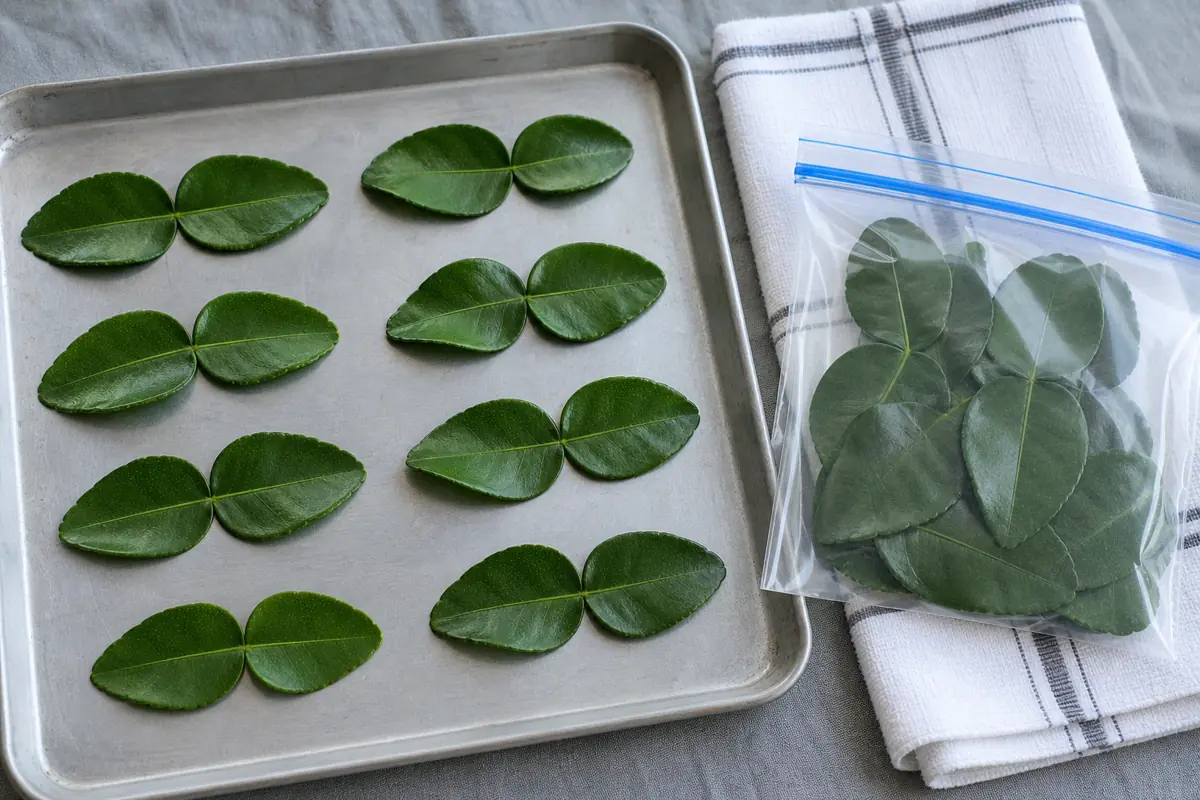
- Before freezing: Pat every leaf dry
- Freeze shape: Lay the leaves flat
- Bag: Press out excess air
Flat leaves separate from the bag one at a time. Use them straight from frozen for tearing, simmering, or slicing.
- Buy: Deep green, glossy leaves with a strong citrus scent.
- Dry: Remove surface water before refrigeration or freezing.
- Freeze: Lay flat and press out air so leaves stay separate.
- Discard: Remove slimy, moldy, or sour-smelling leaves.
The whole versus ground choice matters after drying because intact leaves retain aroma longer.
Keep both forms away from heat and steam.