
What Is Pickling Spice, and Why Is It Always Whole?
The spices in the blend, how much a jar needs, and why ground spice clouds a brine and turns it bitter.
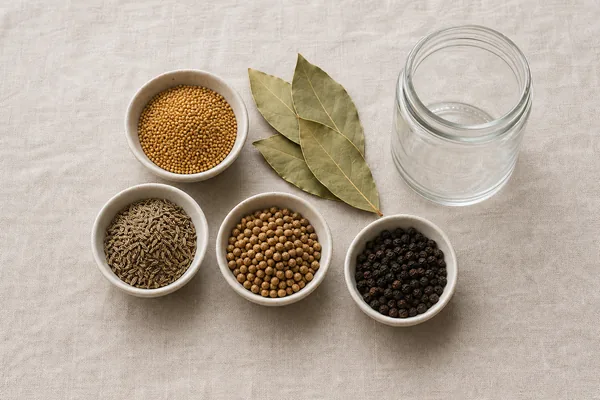
Pickling spice is a whole-spice blend built on mustard seed and coriander, with pepper, allspice, bay and small amounts of cinnamon and clove around them. It is never ground, because ground spice clouds a brine, settles as grit and keeps leaching bitterness.
What spices are in pickling spice?
There is no fixed recipe, but the blends sold under that name agree on a core.
Mustard seed and coriander do most of the work. Black peppercorns, allspice berries and bay leaves fill out the middle, and small amounts of cinnamon bark, clove, dill seed and dried chile sit around the edges.
Some versions add ginger, mace or juniper. Others lean hard on dill and read almost like a crab boil.
What none of them do is grind anything.
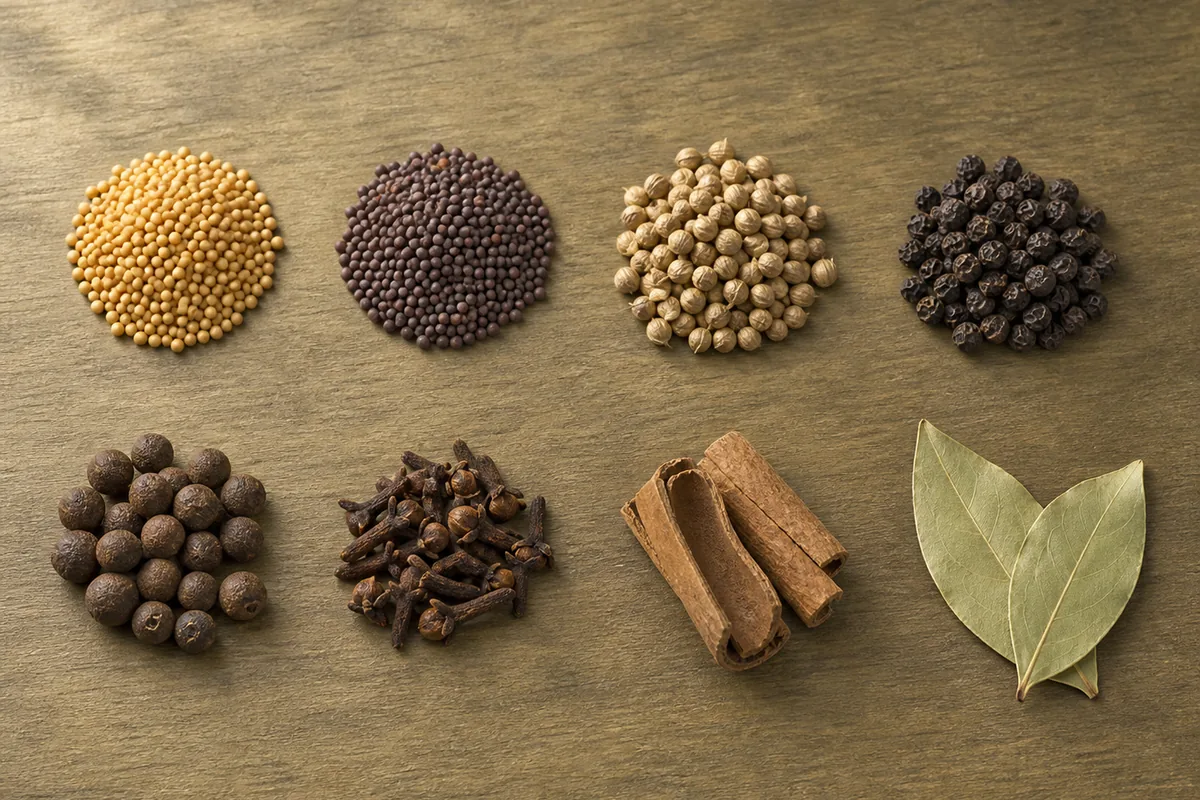
- The base: Mustard seed and coriander, in the largest amounts.
- The middle: Peppercorns, allspice and bay.
- The edges: Cinnamon, clove, dill seed and chile, all used sparingly.
| Spice | Share of the blend | What it contributes |
|---|---|---|
| Mustard seed | The largest single part | Sharp pungency, and it keeps working in cold brine |
| Coriander seed | Nearly as much | Citrus lift that stops the jar tasting flat |
| Black pepper | A moderate amount | Warmth without heat, and it survives long soaking |
| Allspice | A moderate amount | Rounds the sharp edges of vinegar |
| Bay leaf | One or two leaves | A savoury backbone you notice only when it is missing |
| Cinnamon bark | A small shard | Sweet warmth against the acid |
| Cloves | Two or three | A dark edge, and the fastest way to overpower a jar |
| Dill seed | Varies by blend | The flavor most people mean by pickle |
Why is pickling spice whole instead of ground?
Drop ground spice into a brine and three things go wrong at once.
The liquid clouds immediately and never clears, because the particles are too fine to settle out of an acidic solution and too light to stay down.
Then they do settle, as a gritty layer at the bottom of the jar that ends up on whatever you pull out of it.
And the extraction runs away from you. Ground spice has no husk left to slow it down, so it gives everything it has in the first day and then keeps leaching the bitter, tannic parts of the bark and seed coat for the rest of the month.
Whole spice does the opposite. The seed coat meters the release, so a jar tastes better at three weeks than at three days and does not tip into bitterness.
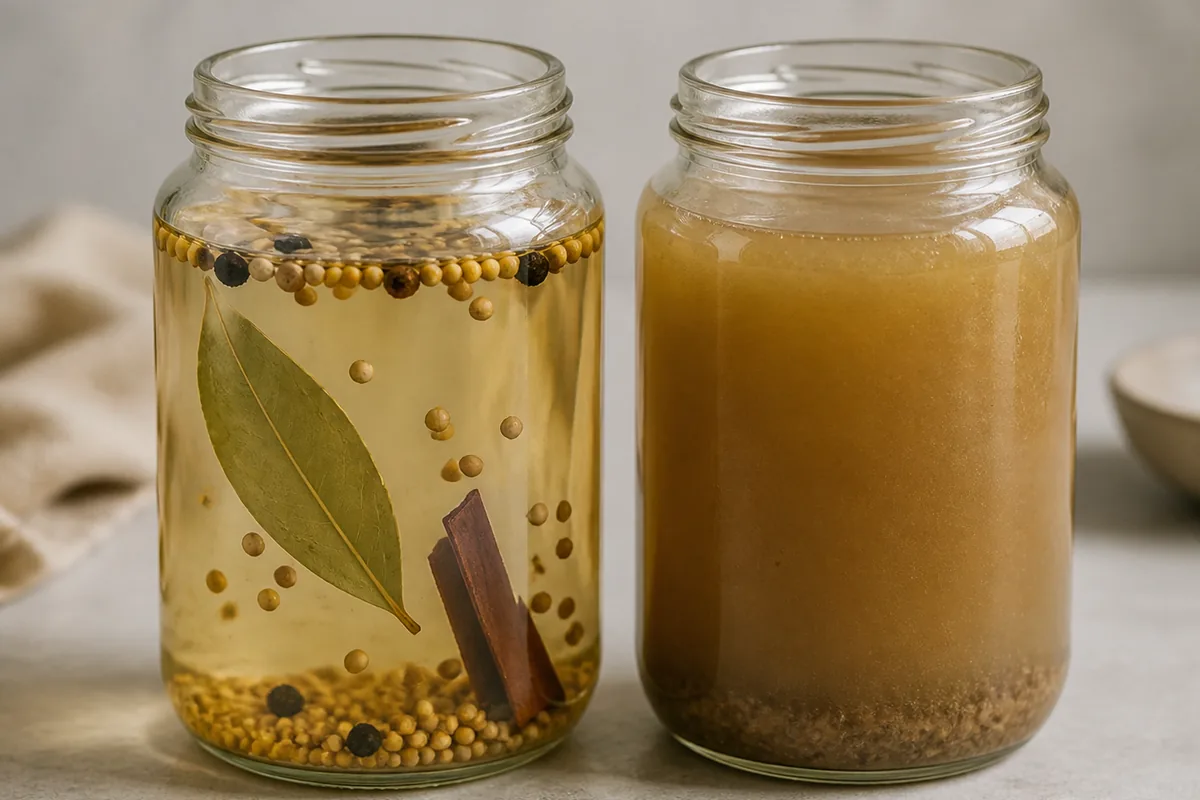
- Left: Whole spice, clear brine, slow release over weeks.
- Right: Ground spice, permanent cloud, grit at the base.
- The tell: If it clouds on day one, it will be bitter by week three.
How much pickling spice should you use per jar?
A tablespoon of pickling spice per quart of brine is the working amount, and most recipes that give a figure land within a teaspoon of it.
For a single pint jar of refrigerator pickles, a rounded teaspoon is enough.
Go heavier and the vegetable disappears behind the blend. Cucumbers, beans and onions all have mild flavors that are easy to bury, and the spice is meant to frame them rather than replace them.
There is one adjustment worth making by hand. If the blend you bought is heavy on clove, and many are, pick a few out before they go in.
Cloves and cinnamon are the two parts to watch because both keep extracting long after the rest have finished.
Cloves carry eugenol, which is potent enough that three or four in a quart is the top of the useful range. Past that the jar tastes medicinal rather than spiced, and there is no way to take it back out.
Cinnamon bark is slower but just as persistent. A shard the size of a thumbnail is plenty for a quart, and a whole stick will dominate a jar within a fortnight.
Both are worth removing early if you are keeping a jar for months rather than weeks.
What can you pickle besides cucumbers?
The name points at cucumbers and the jar gets used for a great deal more than that.
Beetroot, red onion, green beans and cauliflower all take the same blend at the same measure, and firmer vegetables benefit from the slow release because they need longer in the brine anyway.
Pickled eggs are the other classic, though they want a lighter hand. An egg absorbs quickly and has nothing of its own to push back with, so half the usual amount is plenty.
Then there is meat. Corned beef and pastrami are brined with essentially this blend, which is why a corned beef spice packet and a jar of pickling spice are interchangeable.
It also turns up in a boil. Shrimp, crab and crawfish boils lean on the same mustard and coriander base, usually with far more chile and a lot more of it in the pot.
How does vinegar change spice extraction?
It does, and it is part of why pickling behaves unlike any other spice extraction.
A pickling brine is usually vinegar at around five percent acidity, cut with water and carrying a good deal of salt. That combination pulls differently from plain water.
Acid is better than water at extracting some compounds and worse at others, and salt draws liquid out of the spice as well as out of the vegetable. The general rule about which spice compounds go into water and which need fat is set out under fat-soluble versus water-soluble flavors.
The practical consequence is patience. Cold acid works slowly, so a jar keeps developing for two to three weeks and there is very little you can do to hurry it.
Heating the brine before pouring speeds the start, which is why most recipes tell you to. It does not change where the jar ends up a month later.
Knowing when it is ready is mostly a matter of tasting the brine rather than the vegetable. The liquid tells you what the spice is doing well before the cucumber does, because the vegetable takes longer to absorb than the brine takes to extract.
Can pickling spice make a jar shelf-stable?
This one is worth stating plainly, because the blend gets credit it has not earned.
Acid and salt do the preserving. The vinegar drops the pH low enough that spoilage organisms cannot establish, and the salt makes the environment harder still.
Mustard seed does carry compounds with some antimicrobial activity, and a few of the others do too, but they are a rounding error next to the acid. No amount of spice makes an under-acidified brine safe.
That matters for anything you intend to keep on a shelf rather than in the fridge. Shelf-stable canning depends on tested acidity ratios and processing times, and those come from a canning authority rather than from a spice blend.
Refrigerator pickles are the easy case. They live in the cold, they get eaten within a few weeks, and the spice is there purely for flavor.
Should pickling spice float loose or go in a bag?
Loose spice looks better in the jar and is what most commercial pickles do.
A muslin bag or a tea infuser is the practical choice when you plan to keep the jar a long time, because it lets you lift the whole blend out once the flavor is where you want it.
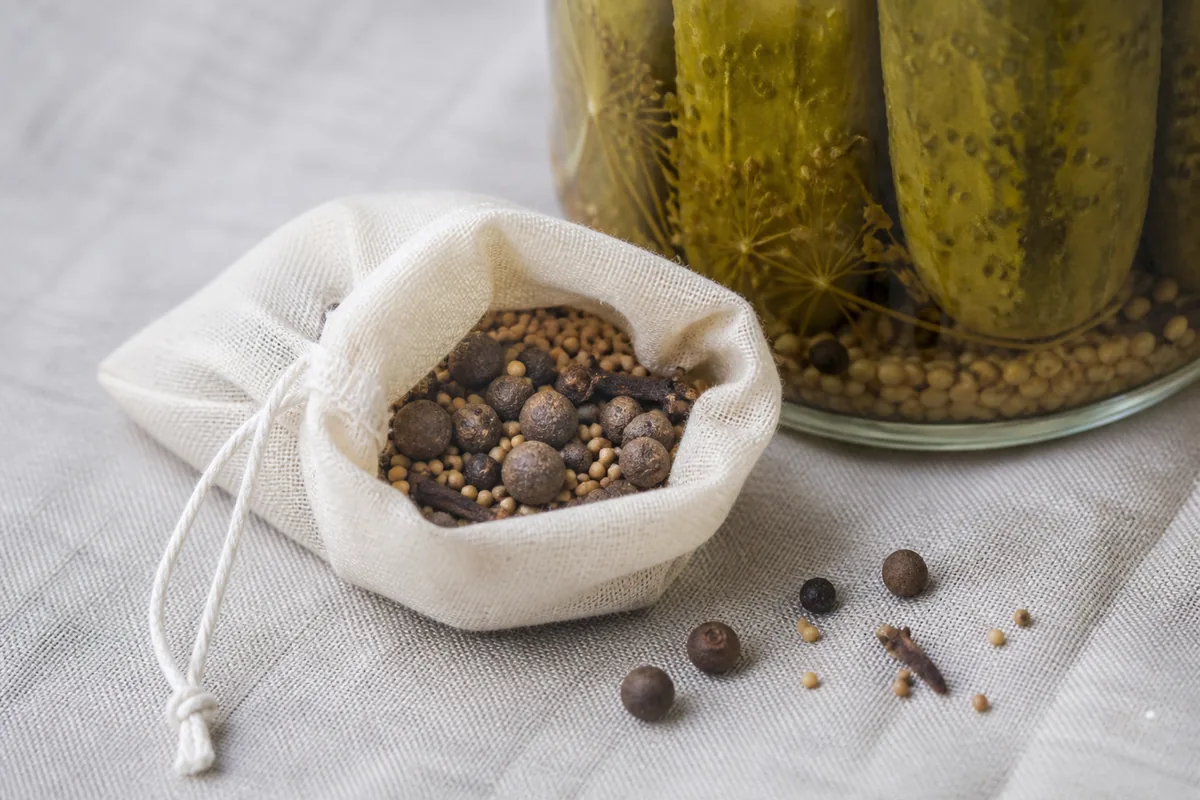
- Bagged: Lift it out when the flavor is right, and nothing keeps extracting.
- Loose: Looks better in the jar, and the spice keeps working indefinitely.
- Use a bag when: The jar is going into long storage rather than the fridge.
The other advantage is mechanical. Loose seed gets caught between vegetables and ends up in a mouthful, and biting a whole clove is a memorable way to ruin a sandwich.
Should you toast pickling spice first?
Usually not, and the reason follows from everything above.
Toasting drives off the volatile aromatics you are relying on the brine to extract slowly over weeks. It also cracks the seed coat that was doing the metering.
A brief warming in the dry pan is defensible for a quick refrigerator pickle that will be eaten within days, because there you actually want a fast release.
For anything going into long storage, put the spice in cold and let the acid do the work.
What can you use instead?
The best substitutes are the blends built for the same job, and two of them are probably already in a cupboard.
A crab boil mix is the closest single swap, since it runs on the same mustard, coriander and dill base. Use it at the same measure.
The spice packet from a corned beef joint is the other one. It is pickling spice under a different name, and it works straight across.
| What you have | Amount | Notes |
|---|---|---|
| Mustard seed | 2 tsp | The one part you should not skip |
| Coriander seed | 2 tsp | Crack a few lightly to start them off |
| Black peppercorns | 1 tsp | Whole, never cracked fine |
| Allspice berries | 1 tsp | Or swap in a few extra peppercorns |
| Bay leaves | 2 | Broken in half |
| Cinnamon bark | A thumbnail shard | Not a whole stick |
| Cloves | 3 | Count them out rather than pouring |
| Dried chile | 1 small | Optional, and it gets hotter over time |
What does not work is a ground blend. Pumpkin pie spice and similar mixes cloud the brine on contact and bring sweet baking notes that fight the vinegar.
How long does pickling spice last?
Whole spice keeps its aroma far longer than ground, so an unopened jar of pickling blend is usually good for two to three years.
The way it fails is uneven. Dill seed and coriander fade first, cloves and cinnamon last almost indefinitely, so an old blend drifts toward the two spices you least want dominating.
That drift is worth knowing when you open a jar that has been at the back of the cupboard. Smell it, and if clove is the first thing you notice, cut the amount and add fresh coriander and mustard alongside.