
What Is Fenugreek, and Why Does It Taste Maple-Like?
Use seeds early and sparingly, then use kasuri methi late when the dish needs savory maple-like lift.
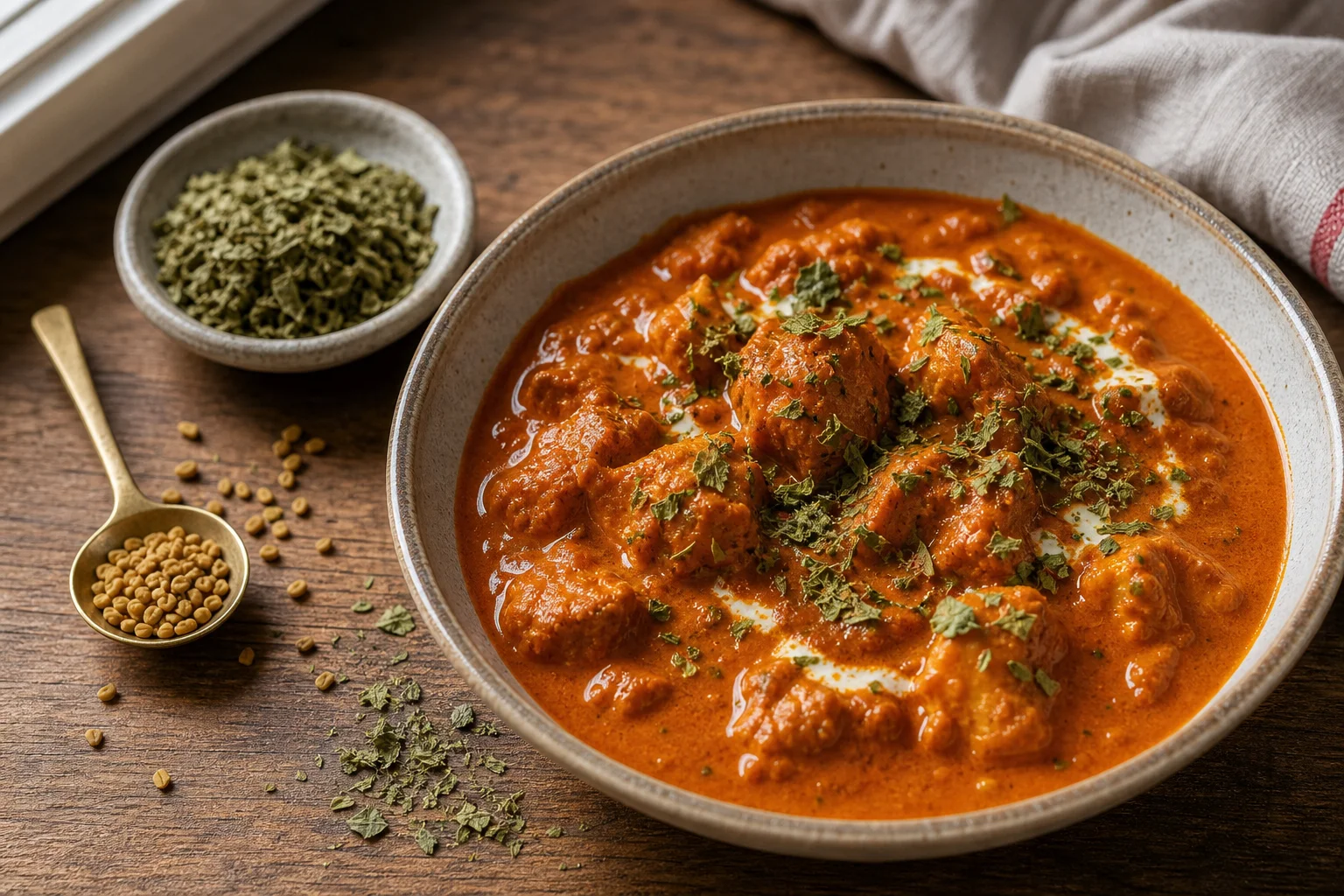
Fenugreek can mean hard yellow seeds or dried fenugreek leaves called kasuri methi. Seeds taste bitter, nutty, and maple-like when cooked carefully, while dried leaves smell savory, grassy, and slightly sweet. Use seeds early in small amounts, and crush dried leaves near the end of creamy curries, dals, breads, and sauces.
Fenugreek is one plant with three kitchen forms
Fenugreek is Trigonella foenum-graecum, an annual legume whose green leaves and hard yellow-brown seeds supply every form in the spice aisle and produce bin.
South Asian recipes use the word methi broadly for fenugreek. Kasuri methi means dried fenugreek leaves, while ground fenugreek on an English-language spice label nearly always means milled seed.
Those names describe plant parts with separate jobs, with seeds acting as a spice, fresh leaves as a green vegetable, and dried leaves as a finishing herb.
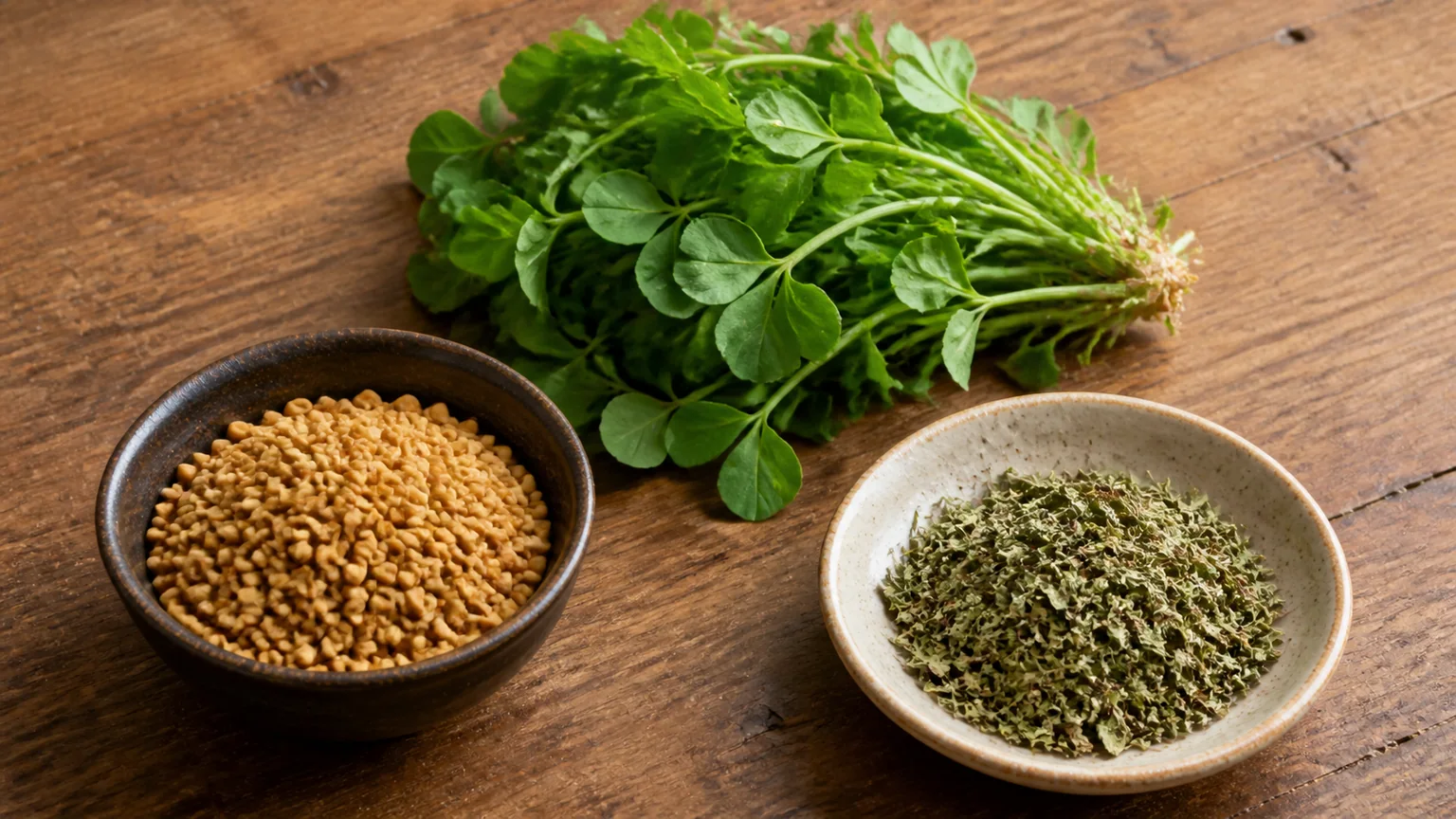
- Seed spice: Hard angular seeds build bitterness and base flavor.
- Fresh methi: Leafy stems cook by the handful as a green vegetable.
- Kasuri methi: Crumbled dried leaves add aroma near the finish.
- Label check: Ground fenugreek usually means milled seed unless the pack says leaf.
Why fenugreek seeds and leaves are not interchangeable
Fenugreek seeds and dried fenugreek leaves behave like different ingredients. The seeds are hard and bitter, while the leaves are aromatic and grassy.
The seed is common in curry bases and pickles. The leaf is common in finished sauces, breads, and creamy dishes.
The seed needs heat to become useful. The leaf needs gentler timing because its aroma fades when boiled hard.
That is the first decision on any fenugreek recipe. Identify whether the recipe wants structure in the base or aroma at the finish.
The cooking question is which form the recipe names. If it says methi leaves, do not reach for seed powder first.
That split matters in Indian, Middle Eastern, and North African cooking. A spoon of seed cannot replace a crushed handful of kasuri methi.
Many curry powder blends include fenugreek seed because its bitter maple edge supports turmeric, coriander, and cumin.
Use the seed for base flavor and the leaf for finishing aroma. Mixing up the forms is the fastest path to harsh food.
Fresh methi leaves add a third path. They behave more like a bitter green than a dry spice.
Dried leaves are stronger by weight than fresh leaves. Crush them in your palm, then add less than looks useful.
Seed powder is the riskiest form because it spreads bitterness everywhere. Use it in blends, not as a casual finishing dust.
That is why recipes often specify methi seeds, fresh methi, or kasuri methi. The word fenugreek alone is not enough.
When a label says ground fenugreek, assume seed powder. Do not use it as a substitute for dried leaves.
Where do fresh methi greens fit alongside seed and kasuri methi?
Fenugreek reaches the kitchen in three forms, and the fresh green is the one most guides leave out.
Fresh methi is sold as a leafy bunch and cooks like a vegetable rather than a seasoning. It goes into aloo methi, methi thepla, and dal by the handful, not by the pinch.
Its bitterness is stronger and greener than the dried leaf.
Salting chopped leaves for ten minutes and squeezing out the liquid removes much of that edge, which is why so many recipes start exactly there.
Treat the stems the way you would treat spinach stems. Thin ones cook down fine, while the thick lower stalks stay tough enough to be worth stripping out.
Fresh and dried leaf are not interchangeable by volume. A whole bunch of fresh methi wilts to almost nothing, whereas kasuri methi is a finishing crumble measured in teaspoons.
How to cook fenugreek seeds without harsh bitterness
Fenugreek seeds need brief heat, enough fat, and restraint.
Too much seed makes food bitter before it tastes complex.
Whole seeds can perfume oil, but they stay hard.
Many cooks temper them briefly, then let other spices carry the chew.
If you grind the seed, cut the dose. Ground fenugreek exposes more bitterness and reaches the whole sauce faster.
| Form | Best moment | Risk |
|---|---|---|
| Whole seeds | Early in hot oil or tempering | Hard bitter bites if left whole |
| Ground seed | In spice blends or pastes | Turns harsh if overused |
| Dried leaves | Crushed near the finish | Tastes hay-like if stale |
| Fresh leaves | Cooked as greens or in flatbread | Cannot mimic seed bitterness |
If you use whole seeds, keep the amount tiny or remove them after infusing oil.
The texture stays firm.
Ground seed spreads faster and tastes stronger.
Start with one quarter teaspoon in a family-size curry base.
Pair seed with onion, tomato, lentils, or cream. Those bases give bitterness a role instead of leaving it bare.
Mustard seed, cumin, and coriander can share the base.
Fenugreek should not be the loudest seed in the pan.
If the base already has bitter greens, burnt garlic, or old turmeric, skip extra fenugreek seed until the balance is fixed.
A small pinch works better than a spoon because the bitter note grows during simmering. Taste after the sauce rests.
If bitterness builds, stop adding spice. Add tomato, lentils, potato, dairy, or onion before judging the final seasoning.
A bitter curry can still be saved if the base has room. Add body first, then adjust salt and acid.
A dry dish is harder to save because the seed stays close to the tongue, so use less fenugreek there.
How much fenugreek should go into one dish?
Measure fenugreek after you know which form has the job. For a four-serving dish, a seed dose belongs in fractions of a teaspoon, while dried leaf can reach a teaspoon because it brings aroma with less seed bitterness.
| Form and dish | Conservative start | Adjustment cue |
|---|---|---|
| Whole seed in a curry base, dal, or pickle | 1/8 to 1/4 tsp | Warm briefly in fat; stop if the seed starts to darken |
| Ground seed in a sauce, blend, or paste | 1/8 tsp | Simmer and taste before moving toward 1/4 tsp |
| Kasuri methi in a curry or dal | 1/2 to 1 tsp, crushed | Add near the finish; wait for the aroma to spread |
| Fresh methi in aloo methi, dal, or flatbread | Use the recipe's cup or bunch measure | Treat it as a green vegetable, not a teaspoon-for-teaspoon swap |
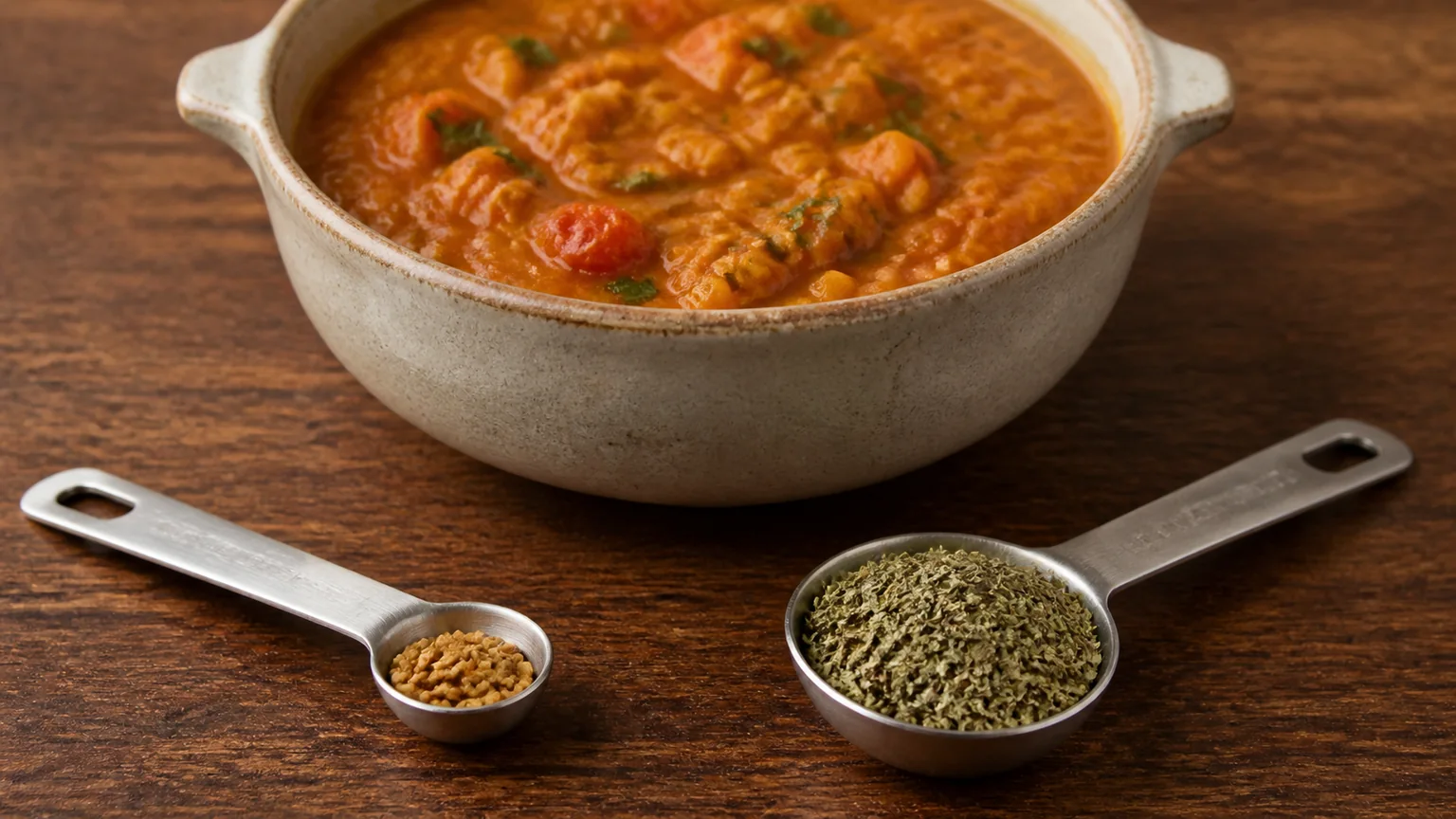
- Whole seed: Start with 1/8 to 1/4 teaspoon for four servings.
- Ground seed: Begin at 1/8 teaspoon and taste after simmering.
- Kasuri methi: A fuller 1/2 to 1 teaspoon can finish the same amount of food.
- Fresh methi: Measure it as leafy bulk, outside this spoon comparison.
These are starting points rather than fixed conversions. Seed bitterness grows during simmering, while kasuri methi can be added in another small pinch if the finished sauce still lacks its savory maple aroma.
Fresh methi is the exception to spoon measures because it supplies bulk as well as flavor. Follow the recipe's leafy volume, and never replace that volume with the same amount of dried leaves.
Wait five minutes after seed has simmered, or two minutes after adding dried leaf, before adjusting. Ground seed cannot be lifted back out, so the safer second addition is always smaller than the first.
Where fenugreek makes food taste right
Fenugreek belongs where bitterness can balance richness, sweetness, tomato, legumes, or cream.
It is not a universal curry flavor. It shines when the dish has enough body to absorb its bitter edge.
In dal, a tiny seed tempering can make lentils taste deeper. Too much makes the whole pot taste medicinal.
- Curry bases: Use seed with onion, tomato, turmeric, cumin, coriander, and chile.
- Butter chicken style sauces: Crush dried leaves near the end for a restaurant-like aroma.
- Dal: Use tiny seed amounts with ghee, garlic, cumin, and mustard seed.
- Flatbreads: Add fresh or dried leaves to dough when the bread needs savory fragrance.
- Pickles: Use seed bitterness to balance oil, salt, chile, and sourness.
The best fenugreek dishes give bitterness a job. Without fat, starch, or tomato, the seed can taste blunt.
Dried leaves behave differently. They make creamy sauces smell finished without adding seed crunch.
That late leaf aroma is one reason restaurant-style makhani sauces taste different from plain tomato cream sauce.
Crush dried leaves between your palms before adding them. The broken flakes release aroma faster into hot fat and cream.
For breads, leaves work because dough softens their bitterness. Seeds need grinding or a recipe built around their texture.
For pickles, seed bitterness belongs with oil, salt, chile, and sourness. It would feel too sharp in a plain vegetable soup.
When should kasuri methi be added to a curry?
Kasuri methi usually belongs near the end of cooking. Long simmering turns its green maple aroma into dull hay.
Crush the leaves between your palms before adding them. Smaller flakes perfume cream, butter, and tomato sauce faster.
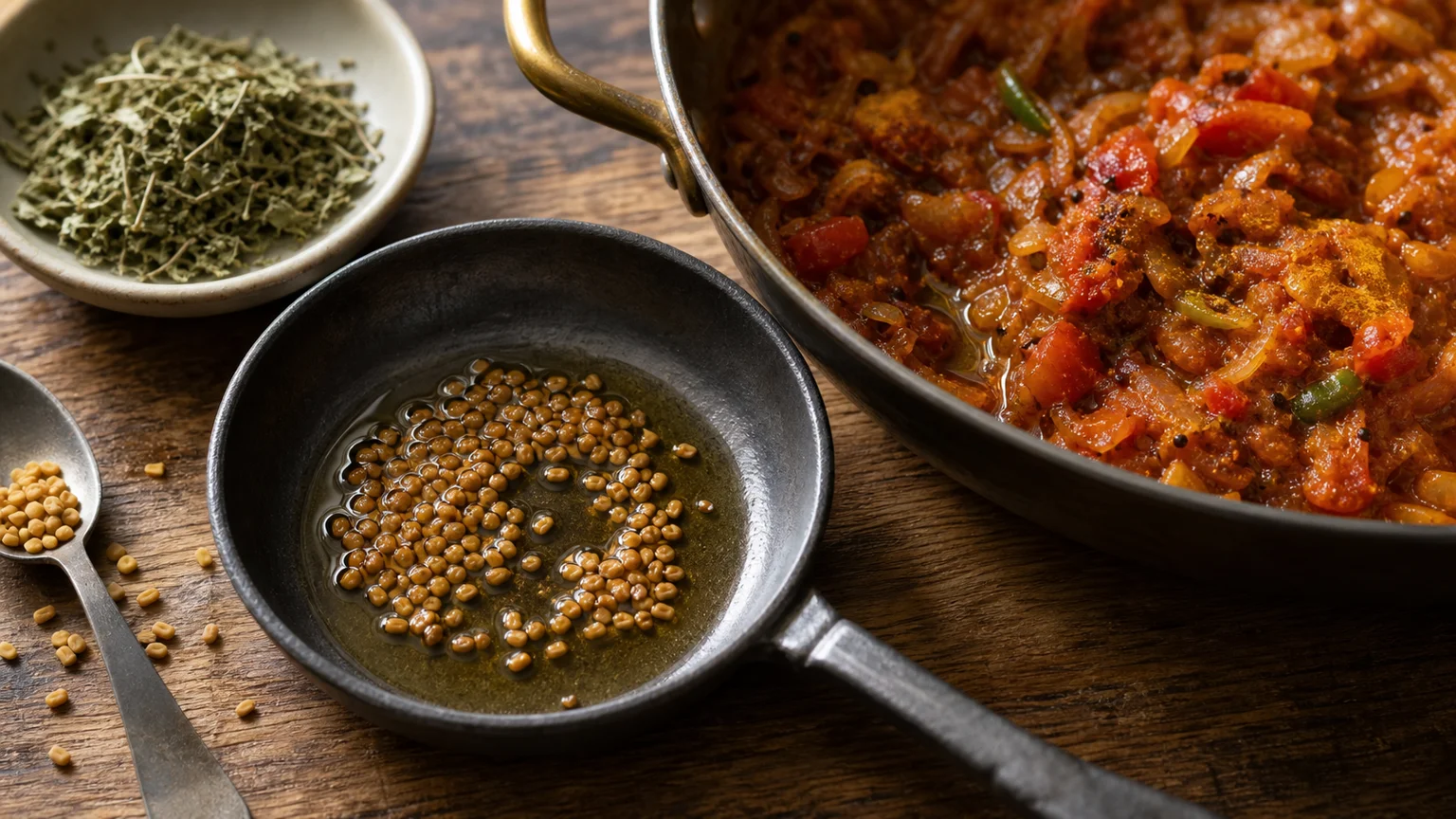
- Seeds early: Heat them briefly in oil before liquid enters.
- Leaves late: Crush kasuri methi near the finish so aroma survives.
- Small amounts: Fenugreek gets bitter faster than cumin or coriander.
- Fat helps: Oil, ghee, cream, or yogurt softens the rough edge.
Add it after the sauce tastes balanced for salt, fat, and acidity. Leaves should finish a curry, not rescue a weak base.
Butter chicken, paneer makhani, dal makhani, and creamy chickpea dishes all use this late-leaf effect well.
For a dry sabzi, add less. Without cream or sauce, the leaf note can sit on top and taste dusty.
If the dish needs more savory depth, cook the base longer before adding leaves. Kasuri methi is not a shortcut for browned onions.
If the aroma fades, add a tiny fresh pinch off heat. Do not keep boiling the whole pot to chase it.
Kasuri methi works especially well with butter and cream because fat carries the aroma across the sauce.
In tomato-heavy sauces, add leaves after the tomato tastes cooked. Raw tomato can make the leaf note feel rough.
What can replace fenugreek?
Fenugreek is hard to replace because seed bitterness and leaf aroma are separate jobs.
| Missing form | Substitute | Best use |
|---|---|---|
| Seeds | Mustard seed plus a tiny maple note | Pickles and curry bases |
| Seeds | Curry powder in small amount | When turmeric and coriander also fit |
| Leaves | Celery leaves plus a pinch of curry powder | Creamy sauces and breads |
| Leaves | Dried methi skipped, then finish with butter | When no close substitute exists |
Maple syrup alone is not a good substitute. It copies sweetness, not the bitter savory edge.
If a recipe names kasuri methi, try to buy it. The leaf aroma is the point of many finished sauces.
For seed bitterness, mustard seed is closer than cumin. It brings bite without pretending to be maple-like.
For leaf aroma, celery leaves can help only when the dish tolerates green bitterness. They do not copy the Indian pantry note.
In blends, garam masala can add late warmth, but it cannot copy the green maple note of dried fenugreek leaves.
When no substitute fits, leave fenugreek out and rebalance the dish. More cumin or coriander will not create the same finish.
If fenugreek already tastes too bitter, add more tomato, cream, lentils, potato, or onion before adding sugar. Bulk softens the edge.
For future batches, measure the seed separately from the main spice mix. That makes the bitter lever easier to control.
For leaf-heavy dishes, add kasuri methi after the sauce tastes balanced. The leaves should finish the dish, not cover a weak base.
If a curry powder already contains fenugreek, avoid adding more seed until you taste the base. Duplicate bitterness builds quietly.
When the base already has cumin, coriander, and turmeric, fenugreek should be the bitter accent, not another bulk spice.
How to buy and store fenugreek seeds and kasuri methi
Buy fenugreek seeds that smell nutty, bitter, and faintly maple-like when crushed. Dusty seeds will not improve in the pan.
Kasuri methi should smell green, savory, and sweet when rubbed between your fingers. If it smells like hay, replace it.
Seeds keep longer than leaves because the hard coat protects aroma. Dried leaves fade faster once the bag opens.
Buy leaves in small packs unless you cook South Asian dishes often. A large bag can turn dull before you finish it.
- Seeds: Store whole and grind only what you need for blends or pastes.
- Dried leaves: Keep airtight and crush only at the last moment.
- Bulk bags: Share or freeze extra if you cook with fenugreek rarely.
- Pantry check: Replace stale fenugreek when you replace cumin and coriander for curry bases.
Keep whole seeds intact instead of buying a large jar of pre-ground fenugreek powder.
Keep kasuri methi away from steam. Moist leaves lose aroma and can clump before the flavor is useful.
If you grind seeds for a blend, grind only what you need. Ground fenugreek becomes harsh faster than whole seed.
Smell the leaf pack before each use. If it smells like dry grass, it will not create the makhani finish you want.
Keep seeds and leaves in separate containers. They solve different jobs, and mixing them leads to bad dosing.