
Baking Spices: How Much Does a Cake Actually Need?
The amounts that work per 2 cups of flour, and why spice behaves differently inside a batter than it does in a pan.
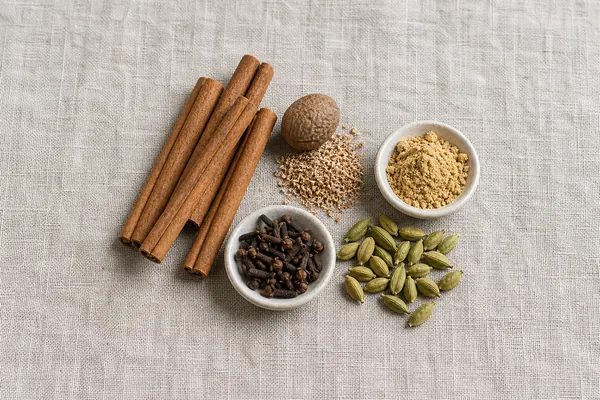
Most spiced bakes need between 2 and 3 teaspoons of total ground spice per 2 cups of flour. The amounts run lower than people expect because the inside of a cake never passes boiling point, so the spice steeps in a wet crumb instead of toasting in dry heat.
What does an oven do to spices in cake batter?
The inside of a cake never gets hotter than boiling water.
Steam holds the crumb at around 100 degrees Celsius until the bake is nearly over, no matter what the dial says. Only the crust climbs past that and browns.
So the spice in your batter is not being toasted. It is being held in a warm, wet, closed environment for forty minutes, which is much closer to steeping tea than to blooming spice in a pan.
That one fact explains most of what follows.
Three things follow from that, and together they set every amount below.
| In a hot pan | In a batter | |
|---|---|---|
| What the heat does | Brief and fierce, the spice changes | Long and mild, it only steeps |
| Where the aroma goes | Much of it leaves with the steam | The crumb traps and keeps it |
| How far it spreads | A few hundred grams, often on the surface | Diluted through nearly a kilogram |
The last row is the one people underestimate. A teaspoon that would be assertive in a pan sauce is a whisper once it is spread through a cake.
Which baking spices should you use, and how much?
Four spices do almost all the work in Western baking, and the reason is that they hold up to a long wet heat without turning bitter.
Cinnamon is the only one that can carry a bake by itself. It is sweet, broad and forgiving, and it is the spice people mean when they say a cake tastes spiced.
Nutmeg works underneath rather than on top. You notice its absence more than its presence, especially in anything with dairy or eggs in it.
Ginger in its dried form is the sharp one. It gives the heat that separates a gingerbread from a plain spice cake.
Cloves and allspice are the accents, and both are strong enough to take over if you let them.
| Spice | Usual amount | What it does | Where it goes wrong |
|---|---|---|---|
| Cinnamon | 1 to 2 tsp | Carries the whole spiced character | Rarely, it is hard to overdo |
| Dried ginger | 1/2 to 1 tsp | Sharp warmth, the gingerbread note | Over a tablespoon it turns harsh |
| Nutmeg | 1/4 to 1/2 tsp | Rounds dairy, eggs and butter | Past a teaspoon it tastes soapy |
| Allspice | 1/4 to 1/2 tsp | Bridges the sweet and the sharp | Reads as clove when overdone |
| Cloves | 1/8 to 1/4 tsp | A dark edge under everything else | The fastest way to ruin a bake |
| Cardamom | 1/2 tsp | Floral lift in Nordic and Middle Eastern baking | Perfumed and soapy above a teaspoon |
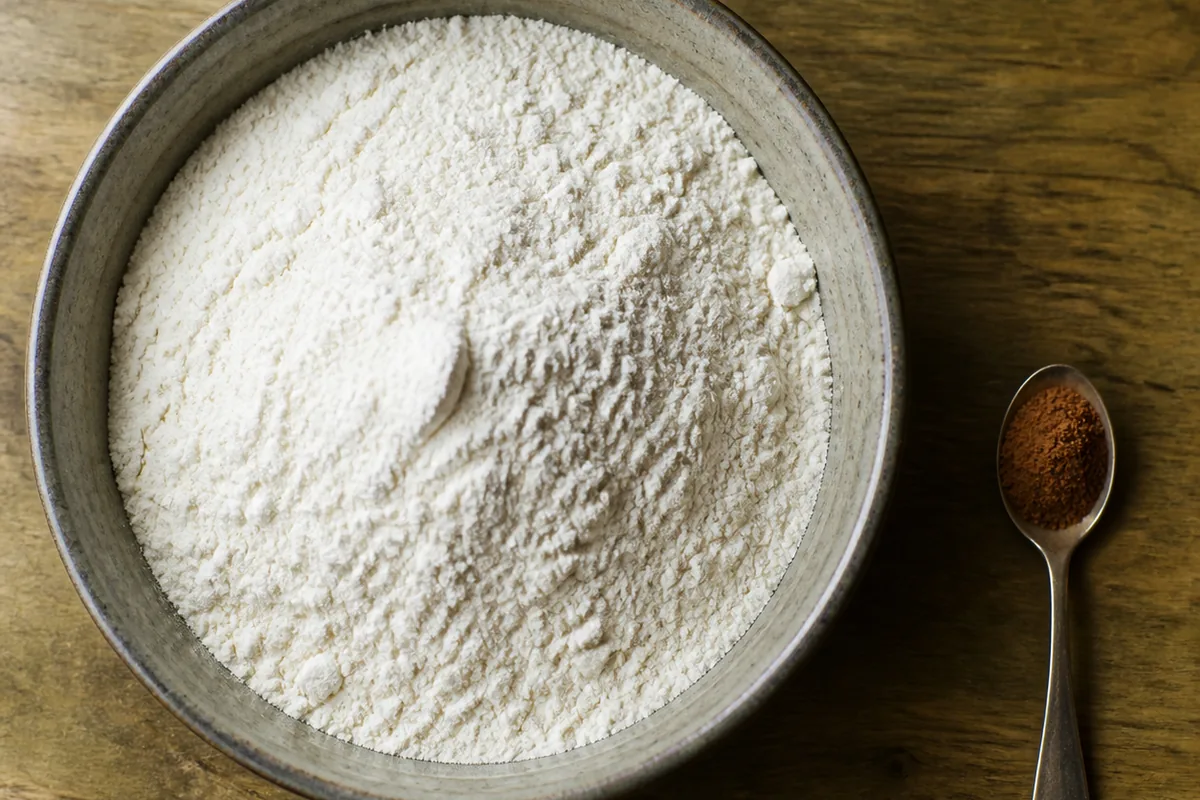
- The bowl: Two cups of flour, before sugar, eggs and fat are added.
- The spoon: The total ground spice for that whole bake.
- Read it as: You are seasoning a kilogram, not a pan of sauce.
Almost every over-spiced bake is one of these two, and it is worth knowing why before you measure.
Cloves are dominated by eugenol, the same compound dentists have used for toothache, and it is powerful enough that a small excess reads as medicinal rather than warm.
Four whole cloves ground down give you roughly a quarter teaspoon. That is already the top of the range for a standard cake, which means a heavy hand with the jar is a much larger error than it looks.
Nutmeg fails differently. It does not turn medicinal so much as soapy and slightly numbing, and it does it quite suddenly rather than gradually.
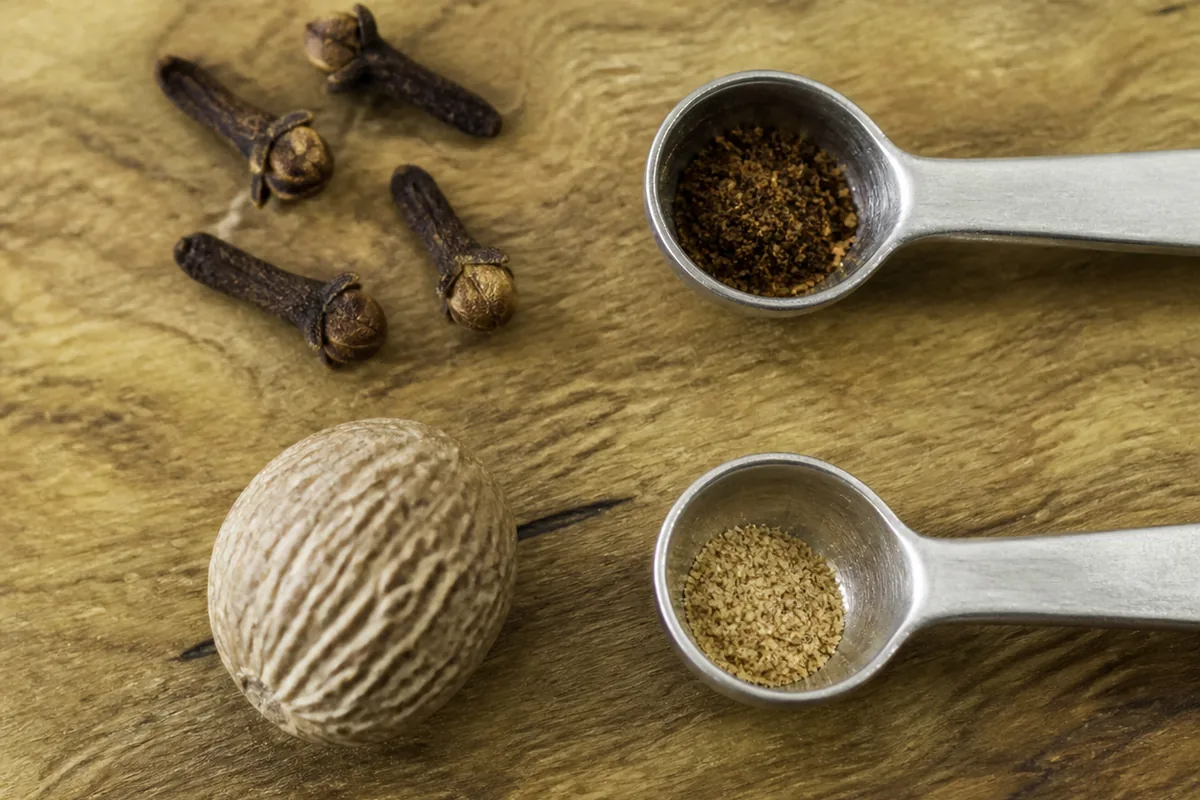
- Cloves: Four whole buds grind down to about a quarter teaspoon.
- Nutmeg: One whole seed is several bakes worth, not one.
- The rule: If you are unsure, halve it and taste the raw batter.
Tasting raw batter is the practical check, and it works better here than in cooking. Because nothing develops in the oven, batter that tastes correctly spiced raw will taste much the same baked.
This is the substitution people get wrong most often, and the two forms are not interchangeable in a batter.
Dried ginger is higher in shogaols, which is the compound behind the dry, sharp heat you expect from gingerbread. Fresh root leads with gingerols instead, which taste brighter, more lemony and considerably milder once baked.
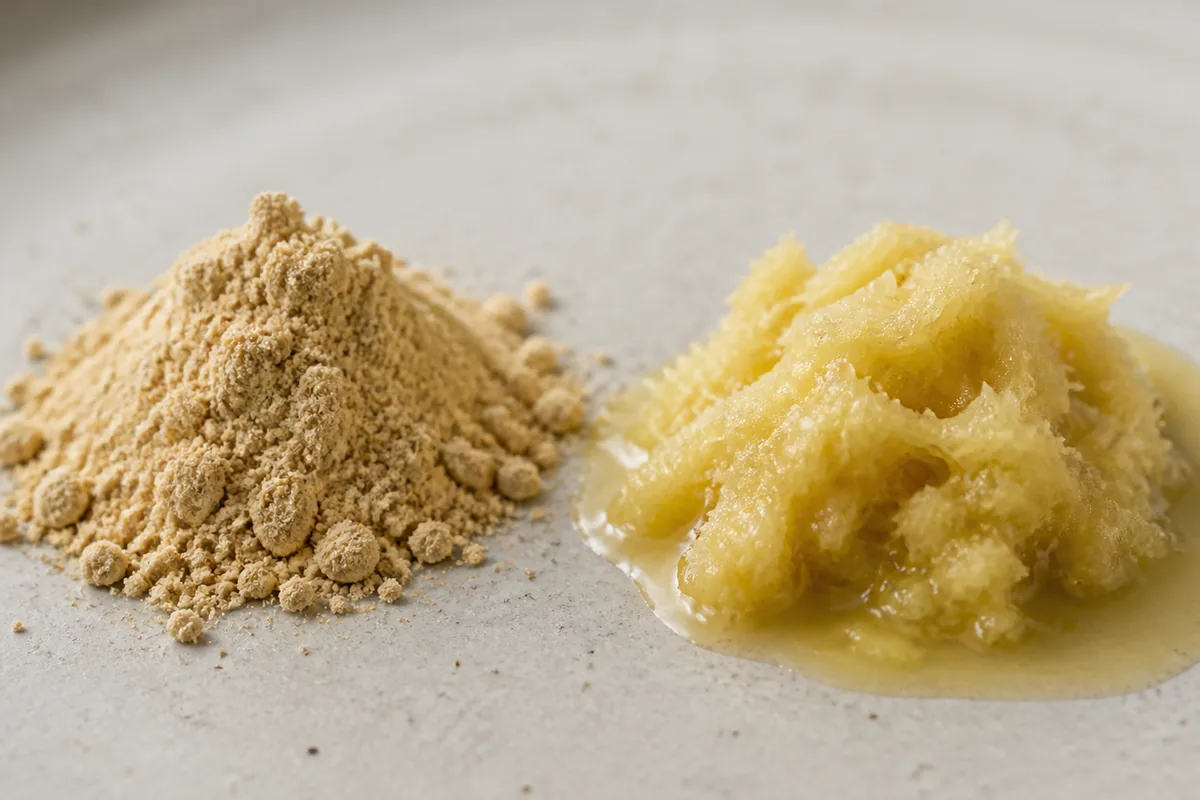
- Left: Dry powder, and nothing added to the wet ingredients.
- Right: The same volume of fresh, sitting in released juice.
- Consequence: A tablespoon of fresh is mostly water, and the crumb shows it.
Fresh ginger also brings water into a recipe that was balanced without it. A tablespoon of grated root is mostly liquid, and in a tight batter that shows up as a denser crumb.
Use fresh where the moisture is welcome and the brightness is the point, such as a sticky pudding or a syrup. Reach for dried in anything where the spice is meant to be dry, warm and assertive.
Between 2 and 3 teaspoons of total ground spice per 2 cups of flour covers most spiced cakes, quick breads and cookie doughs.
Below about a teaspoon and a half the spice reads as a background hum rather than a flavor. Above four the bake starts tasting dusty and slightly bitter, because you are adding a lot of dry plant material to a fixed amount of batter.
Within that total, a good default is roughly half cinnamon and the rest split between the others.
The pumpkin pie spice ratio is a reasonable starting point if you would rather not build a mix from scratch, and it is close to what most spice cake recipes are really using once you add their separate spices together.
Do vanilla, citrus zest, and cocoa behave like spices?
All three belong in baking. None of them belongs in the same conversation as ground spice, because each survives the oven by a different rule.
Vanilla arrives as an extract in alcohol, and alcohol carries aroma in and then leaves with the steam. A long bake blunts it more than it blunts cinnamon, which is why extract goes into the wet ingredients rather than the dry.
Citrus zest is fresh, and its oils are the most fragile thing in the bowl. Rub the zest into the sugar before you start, because the oil moves into the crystals and holds there far better than loose zest stirred through.
Cocoa is a bulk ingredient wearing a seasoning costume. It brings starch and fat in amounts that change the crumb, so recipes take flour out to make room for it.
How do you mix spices into batter evenly?
In almost every recipe the spice goes in with the dry ingredients, and whisking it thoroughly through the flour matters more than it sounds.
Ground spice clumps. A pocket of unmixed cinnamon in a batter comes out as a dark bitter streak, and no amount of beating afterwards will disperse it evenly.
Sifting the spice through with the flour is the reliable fix. It matters most with cocoa and cinnamon, which both hold their lumps.
Thirty seconds with a whisk through the dry bowl does the same job if you have no sieve.
Can you fix an under-spiced or over-spiced cake after baking?
Anything that goes on afterwards, such as an icing, a glaze or a sugar topping, carries spice that never saw the oven at all.
That spice keeps its top notes because it was never held at 100 degrees for forty minutes, so a quarter teaspoon of cinnamon in a glaze reads louder than the same amount inside the crumb.
Use it deliberately when a bake tastes flat but you cannot rebake it.
Spice cannot be stirred into a finished crumb, which narrows the options to whatever you can add on the outside.
An under-spiced cake takes its correction from the top. A spiced glaze, a dusting of cinnamon sugar or a spiced cream alongside all land louder than the same amount would have in the batter, for the reason above.
Both outcomes argue for the same habit. Taste the raw batter, because that is the last moment the amount is still a decision.
Does a long bake weaken spice flavor?
The crumb keeps most of the aromatics, but not all of them, and what leaves is the light top of the aroma rather than the body.
That is why a cake straight out of the oven smells more spiced than it tastes the next day, and why the smell in the kitchen is not a good guide to how the finished thing is seasoned.
It also means freshness matters more in baking than in a quick pan dish. A pan gives spice a short violent heat that wakes up even a tired jar, while a batter simply extracts whatever aroma the spice still had.
If you keep whole spice for anything, keep it for baking. It is the one place where the oven does none of the work for you.
Whole spice itself rarely goes into a batter, because nothing in a cake will break it down and a whole clove in a slice is unpleasant. The exceptions are wet and strained, such as a poaching syrup or mulled fruit, where a cinnamon stick has liquid to work in and gets lifted out before serving.