
Does a Cup of Spice Tea Actually Do Anything?
What hot water pulls out of ginger, turmeric and cinnamon, and how that compares with the amounts research has used.
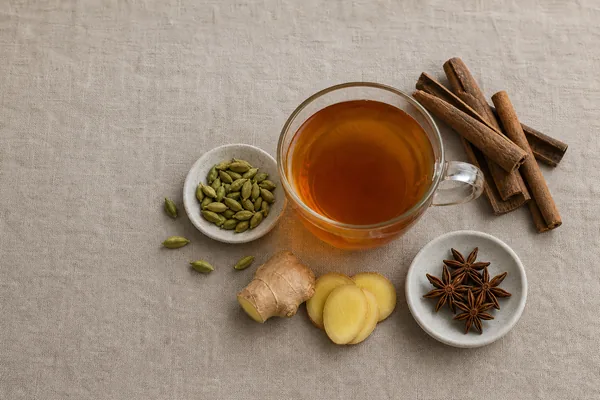
Brewing is an extraction, so what you drink is only the part hot water pulled out of the spice. Ginger dissolves well enough for a normal cup to reach the amounts research has used, turmeric barely dissolves at all, and with cinnamon the number worth watching is a safety limit.
What compounds actually make it into spice tea?
You measure a spoonful of spice, but you drink only the part hot water managed to pull out of it.
The rest stays in the strainer or settles at the bottom of the mug.
That gap is narrow for some spices and very wide for others. It is why two teas made from the same weight of powder can be worth completely different things.
So the useful question is not whether a spice contains active compounds. It is whether those compounds are water-soluble.
Ginger's mostly are. Turmeric's are not.
| Spice | The part that matters | How well water extracts it | What that means for a cup |
|---|---|---|---|
| Ginger | Gingerols and shogaols | Reasonably well | A strong cup can reach the amount studies used |
| Turmeric | Curcuminoids | Badly, they barely dissolve | Far less arrives than the spoon suggests |
| Cinnamon | Cinnamaldehyde, and coumarin | Both come across | The number to watch is a safety limit |
Why does turmeric tea deliver less than the spoon suggests?
Curcumin is close to insoluble in water, and that single fact governs everything about turmeric tea.
A level teaspoon of ground turmeric weighs roughly 3 grams and carries somewhere near 3 percent curcuminoids, so about 90 to 100 milligrams sit in the spoon before it touches water.
Very little of that reaches the liquid. Most settles, which is why the bottom of a turmeric mug is a bright sludge while the tea above it looks pale.
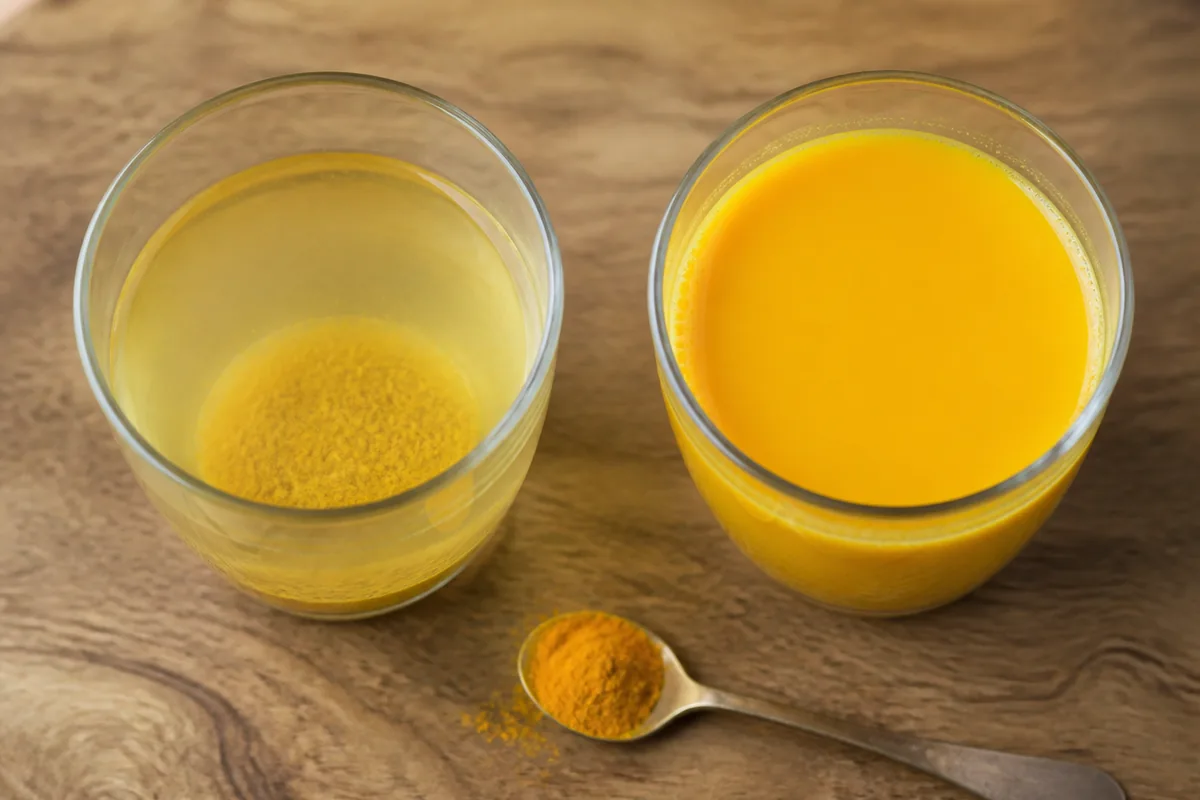
- Left: Steeped in water, pale, with the spice settled out.
- Right: Whisked into warm milk, opaque and deeply colored.
- Read it as: color in the liquid means compound in the liquid.
Heat moves the needle more than most people expect. Bringing turmeric and water to a boil and holding it there for about ten minutes has been measured to raise curcumin solubility around twelvefold against a plain steep.
Twelve times a very small number is still a small number. The trials that reported effects generally used 500 to 2000 milligrams of curcumin a day, usually as a standardised extract, and a simmered mug does not come near that.
That does not make the drink pointless. It does mean the tea and the research are separate things, and whether the compound helps at all belongs with turmeric and inflammation rather than with your kettle.
Does adding milk or fat help turmeric tea?
For turmeric, yes, and this is the one preparation change that alters the dose rather than the flavor.
Curcumin dissolves in fat far better than in water, so whisking turmeric into warm milk or any drink carrying some fat pulls more of it into the liquid instead of leaving it on the bottom.
You can see it happen. A fatty turmeric drink is opaque and deeply colored, while a watery one is thin and pale with sediment underneath.
The same principle decides which spices belong in oil and which do not, which is set out under fat-soluble versus water-soluble flavors.
Black pepper is the other common addition, and it works on absorption after you swallow rather than on extraction in the pot. That is a different mechanism with its own limits, covered under black pepper and curcumin.
Can ginger tea reach the amounts used in studies?
Ginger breaks the pattern above, and it is worth saying plainly because so much tea advice flattens all spices together.
Gingerols and shogaols dissolve in water well enough that a strong infusion carries a real share of what was in the spice.
Dried ground ginger holds somewhere around 8 to 10 milligrams of gingerols per gram. A quarter to a half teaspoon of powder is roughly 1 to 2 grams, which sits inside the range the research has used.
Most of that work falls between 1 and 3 grams of dried ginger a day, usually split across two or three doses, and it is about nausea rather than anything broader.
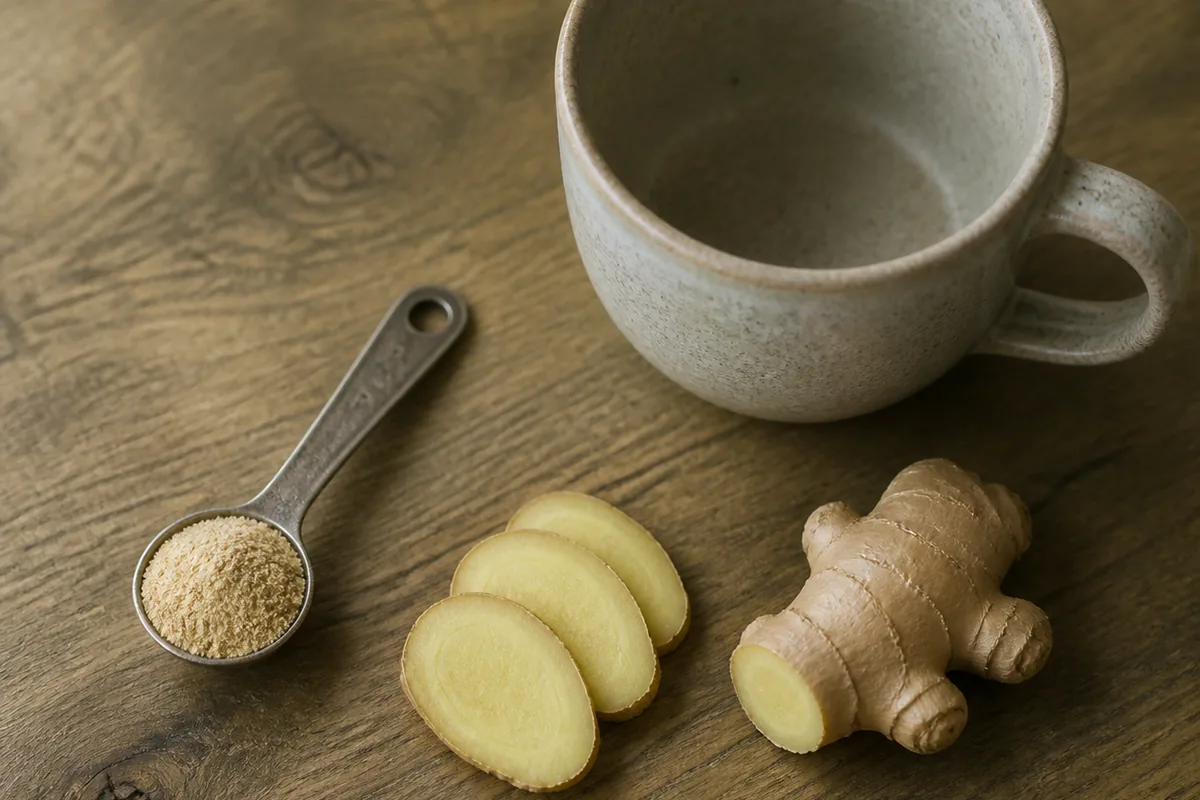
- Ground: A quarter to a half teaspoon is about 1 to 2 grams.
- Fresh: A few thin slices give a sharper, hotter cup.
- Scale: This is the whole daily amount, not a single serving of many.
Fresh root behaves a little differently from powder. It runs higher in gingerols and lower in shogaols, so a cup from slices tastes sharper while a cup from dried powder tastes rounder and warmer.
Neither is stronger in any simple sense. They are different ratios of two related compounds, and the ginger page sets out where each form belongs.
How long should you brew spice tea, and should you cover it?
Steeping time is the one lever you actually control, and it pulls in two directions.
Longer contact takes more of the water-soluble compounds out of the spice, which is why a covered ten-minute simmer of ginger gives a sharper, stronger cup than three minutes in a mug.
The volatile aromatics run the other way. They leave with the steam, so an uncovered pot loses the top notes while the pungent compounds stay behind.
Cover the pot if you are simmering. It costs nothing and keeps the aroma in the liquid instead of in the kitchen.
Grind size matters for the same reason a fine grind brews coffee faster. Ground spice gives up more in a short brew, while whole sticks and slices need real simmering time to catch up.
| What you change | What it gains | What it costs |
|---|---|---|
| Longer simmer | More of the water-soluble compounds | Bitterness creeps in past ten minutes |
| Covering the pot | Keeps volatile aroma in the liquid | Nothing worth mentioning |
| Grinding first | Faster and fuller extraction in a short brew | The cup turns cloudy and needs straining |
| Whole sticks or slices | A clean cup you can strain easily | Needs real simmering time to give much up |
If you are brewing for flavor balance rather than for yield, the timings and the whole-versus-ground trade sit on spices for tea.
Can ready-made spice tea bags provide a known dose?
A tea bag is where the dose question gets hardest to answer, because the label usually will not tell you.
Most bags weigh about 2 grams in total, and that total is shared between the tea leaf, the spice and whatever else is in the blend. The spice fraction is a portion of an already small number.
Ingredient lists rarely break it down. A bag can say turmeric near the top of the list and still carry a fraction of a gram, and terms like natural flavor cover material that contributes aroma without contributing the compound you are drinking it for.
None of that makes bags bad. It makes them unknowable in dose terms, which is a fine trade if you want a warm drink and a poor one if you are trying to hit an amount.
Loose spice you measured yourself is the only version where you know what went in.
How much cinnamon tea is safe to drink regularly?
Cinnamon tea raises the opposite problem, because the compound worth counting is not the one you are drinking it for.
Cassia, the ordinary supermarket cinnamon, carries coumarin. Reported levels vary a lot between samples, from a fraction of a milligram to several milligrams per gram of powder.
The European Food Safety Authority sets a tolerable daily intake for coumarin of 0.1 milligrams per kilogram of body weight. For an adult of 60 kilograms that is about 6 milligrams a day.
Half a teaspoon of ground cassia is around 1.3 grams. Depending on the sample, one cup can take a noticeable share of that daily allowance, and a cassia habit drunk every day can run up against it.
Whether the drink does anything for blood sugar is a separate question with its own evidence, and it sits with cinnamon and blood sugar.
Was the health evidence actually tested as tea?
Here is the boundary that marketing tends to walk past.
The work people cite for ginger, turmeric and cinnamon overwhelmingly used capsules, standardised extracts or weighed powders taken with food. Infusions were rarely the thing being tested.
For ginger and nausea in particular, no clinical trial has used ginger tea as the tested form, even though tea is how most people actually take it.
That is not an argument that the tea does nothing. It means a drink resembling the studied dose is not the studied dose, and nobody has measured the difference on your behalf.
Read any result as evidence about the form that was actually tested.
Is a cup of spice tea worth drinking?
Quite a lot, as a drink.
Hot liquid, a warm mug and ten minutes of sitting still are genuinely worth something when you feel unwell, and none of that depends on a compound crossing a threshold.
The honest position differs by spice, and it is short enough to hold in your head.
- Ginger: The one where a normal cup lands in the studied range. Cheap, pleasant, low risk.
- Turmeric: A good drink and a poor delivery method. Use milk if the compound is the point.
- Cinnamon: Move to Ceylon if you drink it most days, and keep cassia occasional.
- Tea bags: Fine for the drink, unknowable for the dose.
When a symptom is persistent, severe or new, the mug is the wrong tool.
That is a conversation with a doctor, especially if you take medication, since several of these spices interact with common drugs. Those are listed under spice and drug interactions.