
Spices in Ayurveda: How Did the Classical System Classify Them?
The classification system behind it, the three pungents, and why the kitchen and the pharmacy were never separate.
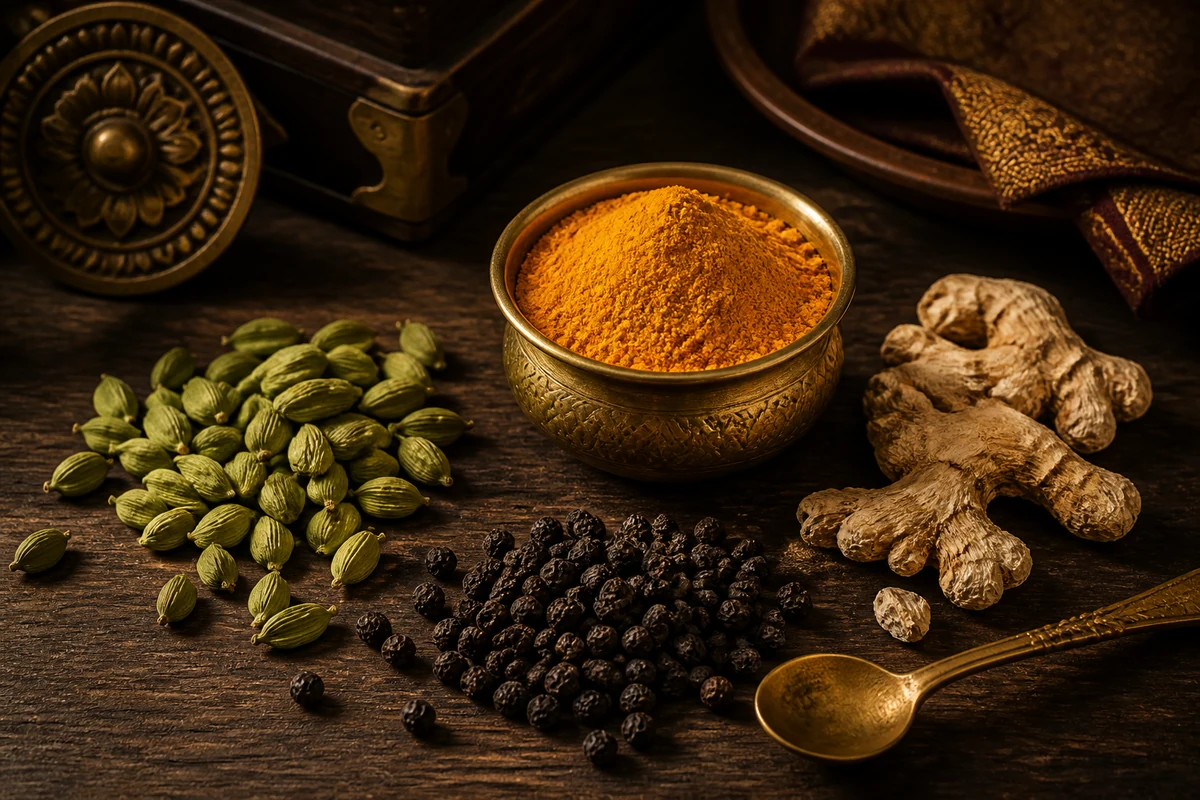
Spices hold their place in Ayurvedic tradition because the classical texts classified them systematically, by taste, by whether they heated or cooled, and by what they did after digestion. That framework is also why cooking and medicine were never separate activities in the tradition.
How did Ayurveda turn spices into a system?
The striking thing about the classical Ayurvedic treatment of spices is how systematic it is.
These are not collections of individual cures. They are attempts at a general pharmacology, in which any substance can be described by the same small set of properties and its effects predicted from them.
The two foundational compendia are the Charaka Samhita and the Sushruta Samhita. The first is concerned chiefly with internal medicine and the second is better known for surgery.
Both took their surviving shape in the early centuries of the common era, while drawing on considerably older material.
A third text, the Ashtanga Hridaya of Vagbhata, was compiled several centuries later and became the most widely used of the three in practice, partly because it is shorter and better organized.
| Text | Roughly when | What it is known for |
|---|---|---|
| Charaka Samhita | Early centuries CE, older layers within it | Internal medicine, diagnosis, diet and drugs |
| Sushruta Samhita | Similar period | Surgery, but also a large materia medica |
| Ashtanga Hridaya | Around the seventh century | A compact synthesis, the one most used later |
Between them these works describe hundreds of plant substances, and a substantial number of them are things you would find in a kitchen.
Dating any of it precisely is not possible. These are layered compilations rather than books with an author and a publication year, and scholars argue over centuries rather than decades.
How did Ayurvedic texts classify a spice?
The framework rests on a handful of properties, and a spice was placed by working through them in order.
Rasa is taste, and there are six rather than the four or five most people expect. Sweet, sour, salty, pungent, bitter and astringent, with the last two being the ones an English-speaking cook tends to run together.
Virya is potency, and it reduces to a single question of whether the substance heats or cools. Ginger heats and coriander cools, in this scheme, regardless of the temperature at which either is served.
Vipaka is the effect after digestion, which may differ from the initial taste. A substance can be pungent going in and sweet in its later effect, and the system treats those as separate facts.
| Property | The question it answers | Example |
|---|---|---|
| Rasa | Which of the six tastes does it carry | Black pepper is pungent |
| Virya | Does it heat or cool | Black pepper heats |
| Vipaka | What is its effect after digestion | Black pepper is pungent again |
| Guna | What qualities does it have, such as light or oily | Black pepper is light and dry |
| Prabhava | Does it do something the above cannot explain | Reserved for the exceptions |
Prabhava is the interesting category, because it is an explicit admission that the model does not account for everything. A substance whose effect could not be derived from its taste and potency was given this label rather than being forced into the scheme.
Those properties were then read against the three doshas, vata, pitta and kapha, which describe tendencies in a person rather than in the spice. The same pepper that suits one constitution is said to aggravate another, which is why the tradition resists giving a single answer about any ingredient.
Why does an Ayurvedic meal include six tastes?
The six tastes are not only a way of describing ingredients, and this is where the theory reaches the plate.
A meal was held to be complete when all six were present, so a properly composed one had to include the bitter and astringent elements that a cook working by appetite alone would probably leave out.
A thali is that principle served on a tray. The sweet, the sour pickle, the salt, the pungent spicing and the bitter vegetable each occupy their own small bowl rather than being blended together.
Read that way, the arrangement is an argument rather than a presentation style, and the small bowls exist so that no taste can be crowded out by another.
What is trikatu, and why did long pepper disappear?
If one formulation shows how this worked in practice, it is trikatu, the three pungents.
It is black pepper, long pepper and ginger, and it appears throughout the classical literature, both on its own and as a component of larger preparations.
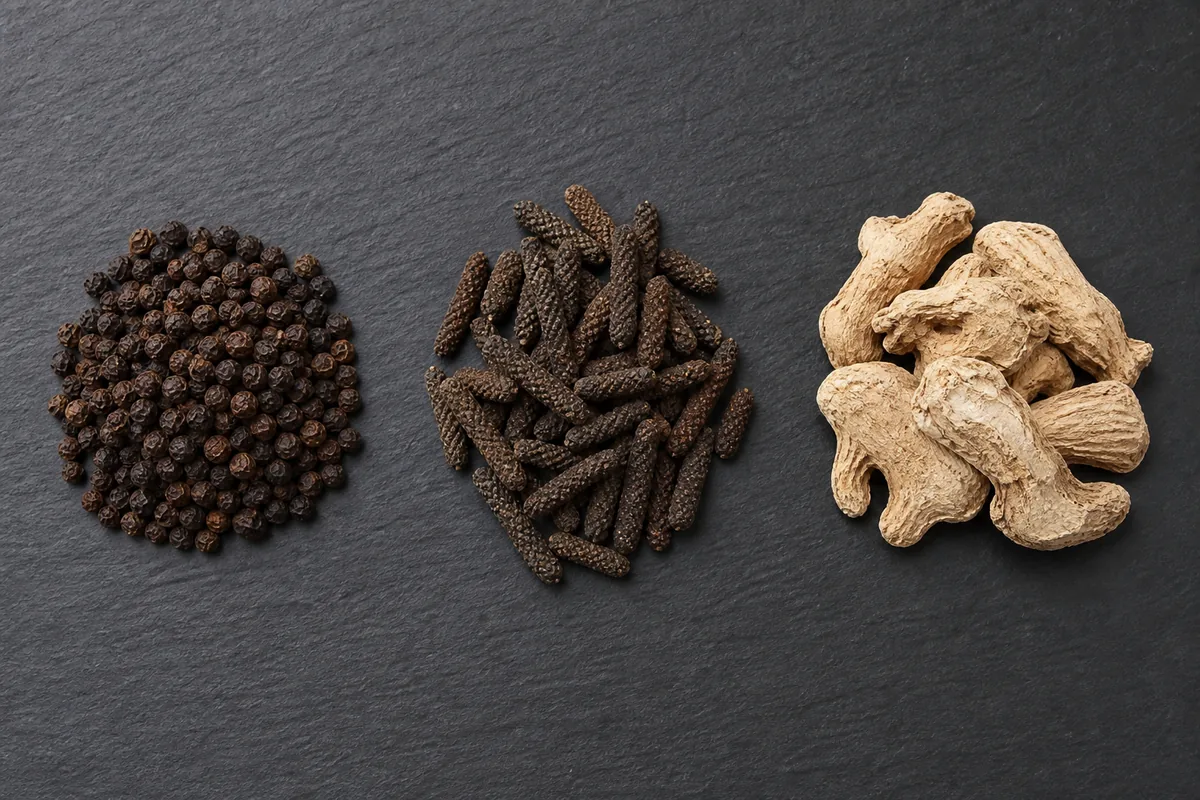
- Black pepper: Piper nigrum, the one that stayed.
- Long pepper: Piper longum, a small dark spike, sweeter and more complex.
- Dried ginger: Sunthi, distinguished in the texts from the fresh root.
Long pepper deserves attention because its fall is so complete. It was traded to the Mediterranean alongside black pepper and valued at least as highly, and it is now rare enough that most cooks have never handled it.
Ginger is treated as two substances rather than one. Fresh and dried are described with different properties, which is a distinction any cook will recognize and which most Western cookery writing has only recently started making.
Trikatu was frequently given with other preparations rather than alone. In the texts' own terms it was thought to make what accompanied it act more effectively, a role the tradition assigns to a class of adjuvants.
Why did the carrier matter as much as the spice?
One idea from this system has no real equivalent in Western cooking, and it explains a great deal about Indian food.
Anupana is the substance a preparation is taken with, and the tradition treats it as changing the effect rather than merely carrying it. Ghee, honey, warm milk and warm water are the common ones.
Whether or not one accepts the pharmacology, the underlying observation is sound. Many of the aromatic compounds in spices dissolve in fat rather than water, so the same spice genuinely does behave differently in ghee than in water.
This continuity is the part that surprises people most. There was no historical moment at which Indian cooking and Indian medicine separated, because the framework never treated them as different activities.
Which Ayurvedic spices were native, imported, or added later?
Not every spice in the tradition is native to India, and the texts record the difference in ways that are historically useful.
Black pepper, long pepper, turmeric, cardamom and ginger are indigenous to the subcontinent and appear from the earliest layers onward.
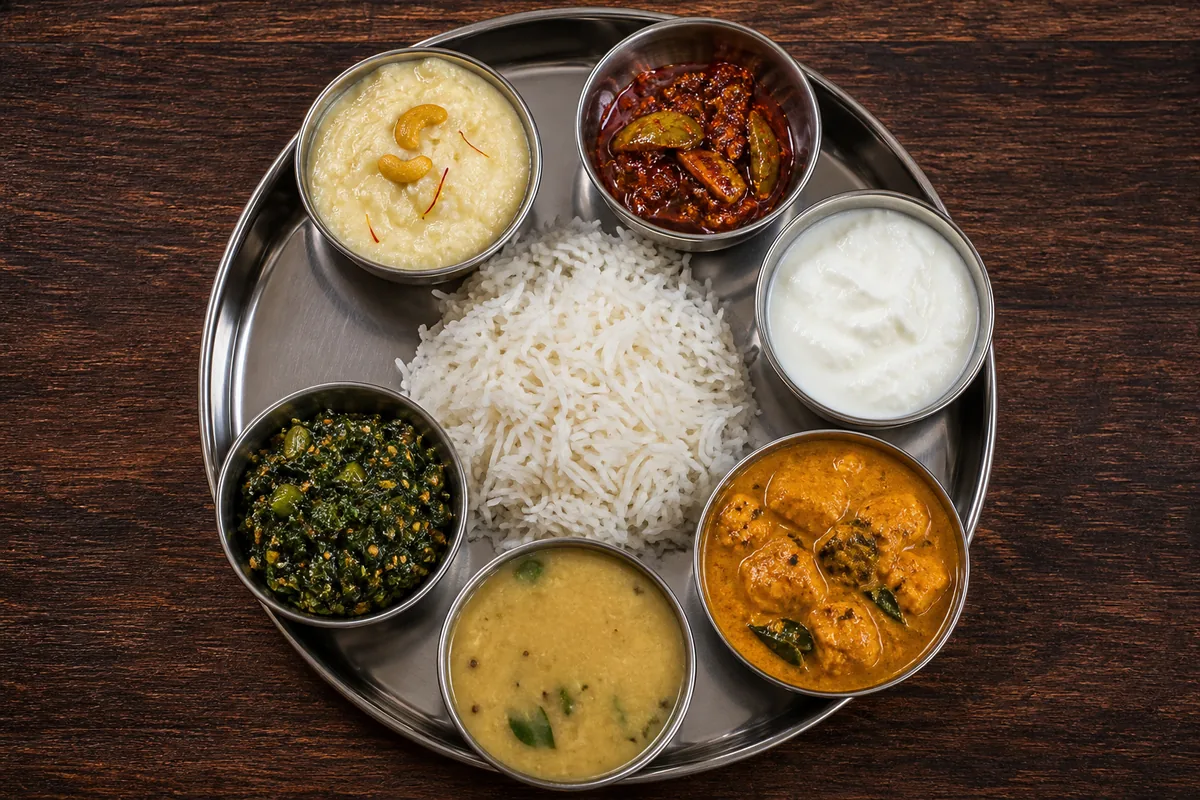
- Why six: A meal was held complete only with all six tastes present.
- The hard ones: Bitter and astringent, which appetite alone would skip.
- The structure: Small bowls rather than one mixed plate.
Asafoetida is the clearest import, since the plant grows in Iran and Afghanistan rather than India and reached the subcontinent through trade.
It became so thoroughly embedded that it now reads as an entirely Indian ingredient.
| Spice | Origin | Note |
|---|---|---|
| Black pepper | The Malabar coast | The basis of the Roman trade |
| Long pepper | India and Southeast Asia | Once as important as black pepper |
| Turmeric | South Asia | Used as dye, ritual material and medicine |
| Cardamom | The Western Ghats | The green kind, distinct from the black |
| Ginger | Cultivated in Asia, wild origin uncertain | Fresh and dried treated separately |
| Asafoetida | Iran and Afghanistan | Adopted through trade and now inseparable from the cuisine |
| Chile | The Americas | Arrived in the sixteenth century, long after the texts |
Chile is the useful test case for how living the tradition is. It reaches India only after Portuguese contact, so no classical text mentions it, yet later practitioners placed it within the same framework by describing its taste, potency and effect.
That is how the system was designed to work. A new substance did not need a new theory, only a position on the existing axes.
How did Indian spices travel beyond the subcontinent?
The spices did not stay where the texts were written, and the pepper trade is the best documented part of the story.
Roman demand for Indian pepper was substantial enough to draw complaint from Roman writers about the outflow of silver, and it ran through ports on the Malabar coast.
The Periplus of the Erythraean Sea, a first-century Greek merchant's handbook, names Indian ports and the goods to be had at them. It is trade documentation rather than medical writing, and it is the more valuable for that.
What travelled with the goods is harder to trace than the goods themselves. Ideas about heating and cooling foods appear across the Greek, Persian, Arabic and Indian medical traditions, and the direction of borrowing between them is a genuinely open question rather than a settled one.
How did Ayurveda move from classical texts to modern institutions?
Ayurveda's survival into the present is not a story of unbroken continuity, and the recent institutional history matters.
Under colonial administration Ayurvedic practice lost official standing to Western medicine, and much of it continued outside state structures rather than within them.
After independence it was progressively formalised. The Indian Medicine Central Council Act of 1970 created a statutory body for education and registration, and in 2014 the relevant departments were consolidated into a dedicated government ministry.
The honest summary is that this is a long and coherent intellectual tradition that took spices seriously as materials with describable effects, several centuries before anyone could say why they had them. Its lasting mark on the kitchen is easier to demonstrate than any of its medical claims.
That mark is everywhere in the way Indian food is built, and garam masala is one place to see the logic still working.