
Herb Companion Planting: Which Pairings Actually Help?
The claims that survive testing, the ones that do not, and the herbs to keep out of the bed.
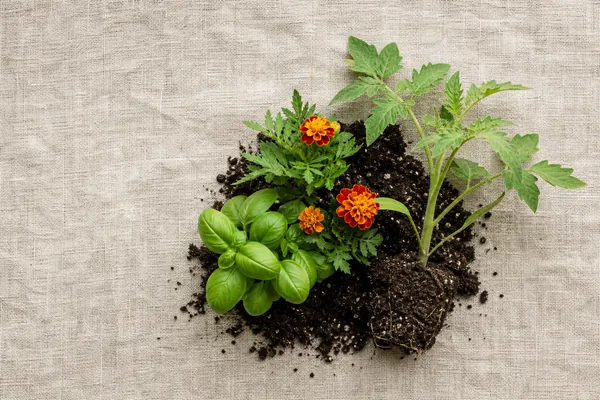
Companion planting is four different claims sharing one name, and they are not equally well supported. Letting herbs flower to feed aphid predators works, breaking crops into mixed patches works, and most named plant pairings are repetition rather than evidence.
What does companion planting actually claim to do?
Companion planting is a bundle of separate claims wearing one name, which is why it is so hard to argue about.
Some of it says a herb repels a pest by smell, and some says a herb attracts an insect that eats the pest.
A third strand says one plant improves another's growth or flavor. A fourth is not about biology at all, and is simply about using space, light and soil well.
Those four claims sit at very different distances from the evidence. Grouping them under one heading is what lets the weakest of them ride along with the strongest.
| The claim | Mechanism | How well it stands up |
|---|---|---|
| Flowering herbs feed pest predators | Nectar for hoverflies, lacewings, parasitic wasps | Well supported, and the reason to do it |
| Mixed planting confuses pests | A pest hunting by sight and smell lands on the wrong plant | Supported, though the mixing matters more than the herb |
| Trap crops draw pests away | The pest prefers a sacrificial plant | Works, and you must accept losing the trap |
| A neighbor improves flavor or growth | Usually unstated | Little support, mostly repetition |
So the useful question is not which herb goes beside which vegetable. It is which of these four you are trying to make happen.
How do flowering herbs help predators and pollinators?
This is the one worth rearranging a bed for.
Aphids, whitefly and caterpillars are eaten by hoverfly larvae, lacewing larvae and the grubs of parasitic wasps. Those predators spend their adult lives feeding on nectar rather than pests.
The flat open flowerheads of the carrot family are the easiest nectar for them to reach, because a hoverfly has a short mouthpart and cannot work a deep tubular flower.
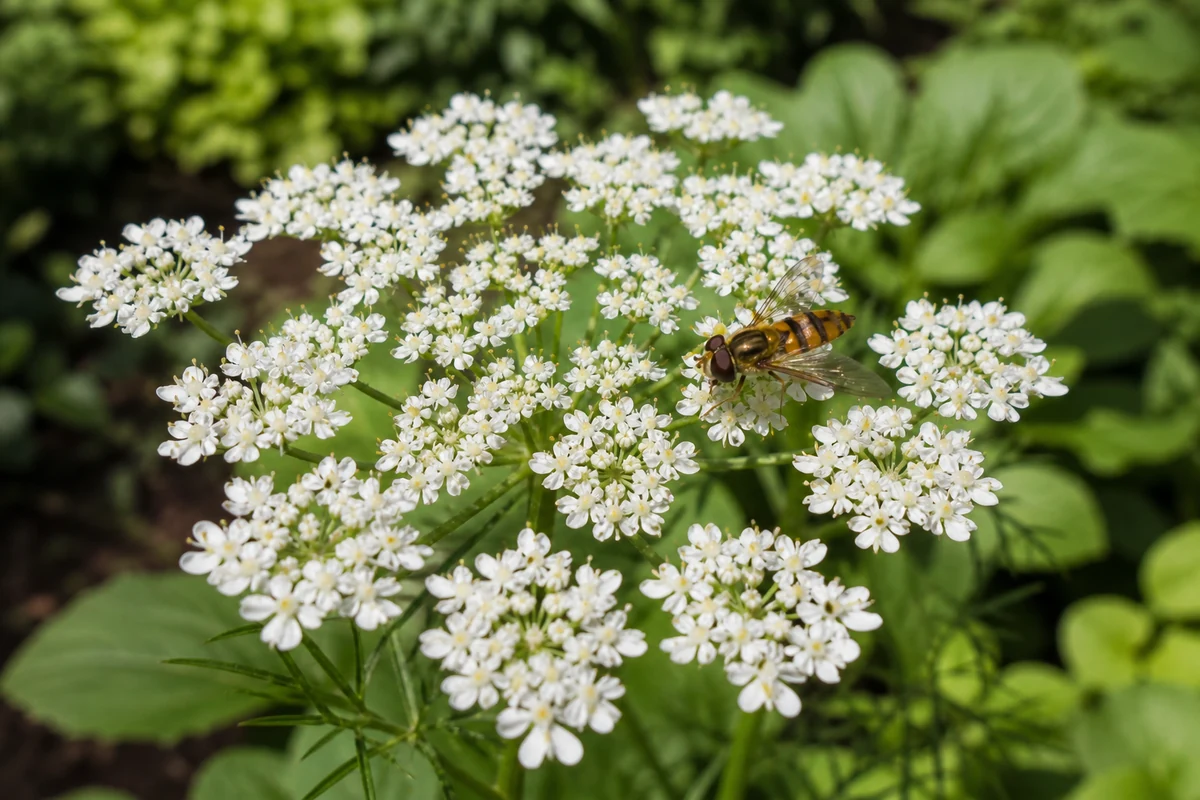
- Flower shape: Flat, open, many tiny florets, easy to walk on.
- Who it feeds: Hoverflies, lacewings, parasitic wasps, all aphid eaters.
- Which herbs: Coriander, dill, fennel, and parsley in its second year, all of which carry this shape.
Coriander and dill are the practical choices because they bolt readily, and bolting is exactly what you want here rather than a failure.
Sow a short row of each in the vegetable bed and let it run to flower rather than pulling it. You lose the leaf and you gain the insects.
Timing matters more than quantity. A few plants flowering continuously from June onwards is worth more than a mass flowering for one fortnight, so sow a little every three weeks.
The predator argument gets all the attention, and the pollination one is easier to measure.
Beans, squash, courgettes and tomatoes all set more fruit when there are more pollinators working the plot. A squash flower that no bee visits drops a small yellow fruit that rots at the tip.
Herbs are unusually good at this because they flower for a long season and they flower when vegetables often do not. Thyme, oregano, marjoram, sage and chives are all heavily worked by bees.
| Herb | Flowers | What it brings |
|---|---|---|
| Chives | Late spring | Early bees, before most vegetables open |
| Sage and thyme | Early summer | Bumblebees in numbers |
| Oregano and marjoram | Mid to late summer | The heaviest bee traffic of the group |
| Coriander and dill | Whenever they bolt | Hoverflies and parasitic wasps |
| Fennel | Late summer | Predators, late in the season when little else feeds them |
Left to flower, a clump of oregano at the corner of a bed is one of the busiest things in a garden, and it costs nothing to leave it.
Do strong-smelling herbs repel garden pests?
The idea that a strong-smelling herb drives pests away is the most repeated claim and the most overstated.
What the field trials generally find is less flattering to the herb. A pest looking for a host plant makes a series of landings, and it needs several correct ones in a row to settle.
Break the block up with anything and the pest keeps landing on the wrong thing, so it leaves or gets eaten before it settles. Non-host plants of almost any kind produce this effect.
So the herb is doing a real job, but the job is being an obstacle rather than being a repellent. That is why a bed of alternating rows outperforms a border of the same herb around the outside.
There is a practical consequence. If interruption is the mechanism, then quantity and placement matter and the choice of herb matters much less, which is the opposite of how the advice is usually given.
| Layout | What a pest meets | Effect |
|---|---|---|
| A neat border of one herb around the bed | An unbroken block of crop inside it | Little, the pest lands and settles |
| Herbs threaded between small crop patches | A wrong landing between every right one | The interruption that actually works |
| One herb repeated down a single row | A clean run of crop either side | Little, the row is the block |
| Two or three herbs scattered irregularly | No reliable pattern to follow | Best of the four |
How do trap crops protect vegetables?
A trap crop is the honest version of the idea, because it names the price.
Nasturtium is the standard example. Blackfly and cabbage white butterflies will settle on it in preference to your beans and brassicas, and the plant is there to be ruined.
- Plant the trap a short distance from the crop, not touching it.
- Get it established first, so it is the larger plant when the pests arrive.
- Check it weekly and squash or remove what has gathered.
- Pull and destroy it once it is covered, before the pests move on.
- Accept that a trap crop you keep tidy is not doing its job.
The failure people report with trap crops is usually neglect. Left alone, a covered nasturtium becomes a nursery that supplies the whole bed rather than draining it.
Which popular companion pairings lack evidence?
Some advice is repeated so often that it sounds like established fact, and two examples are worth naming.
Basil is said to improve the flavor of tomatoes grown beside it. There is no mechanism for this, and the pairing survives because the two are wonderful together on a plate.
That is not an argument against growing them together. They want the same warmth, water and sun, which makes them genuinely good bedfellows, and basil covers what the plant itself needs.
Marigolds are said to repel most garden pests. The narrower claim is the real one: some Tagetes species suppress root-knot nematodes in the soil, which is a soil effect over a season rather than an insect repellent over a bed.
| The advice | The reality | Worth doing anyway |
|---|---|---|
| Basil beside tomatoes | No flavor effect, but identical growing needs | Yes, for the convenience |
| Marigolds repel pests | Some species suppress soil nematodes, slowly | Yes, but not as an insect barrier |
| A border of lavender keeps pests out | Blocks are what pests exploit, borders less so | Grow it for pollinators instead |
| Chives prevent blackspot on roses | Widely repeated, thinly evidenced | Harmless, and chives are useful |
None of these is worth arguing over in a garden. The reason to be clear about them is that a gardener who believes the herb is a barrier stops doing the things that actually work.
Can herbs work as ground cover?
The fourth claim, the one about space rather than biology, is the least discussed and the easiest to act on.
Bare soil between crops dries out, bakes and grows weeds. A low spreading herb covering it keeps the soil cooler and damper and leaves the weeds nowhere to start.
Creeping thyme and low oregano do this well, since they stay short and tolerate being walked past. They ask for the same dry sunny conditions that suit most vegetable beds.
The rule is to keep them out from under the crop itself. Ground cover belongs on the paths and edges where nothing is competing for the same root space.
This one comes with an honest cost that the pest-control advice does not mention. Damp cover at soil level is exactly what slugs shelter under during the day, so a bed edged with creeping thyme gives them somewhere to live next to your lettuces.
It is still worth doing on a dry sunny plot, where slugs are less of a problem anyway. On heavy damp ground, leave the soil bare and mulch it instead.
Which herbs should stay out of a mixed bed?
Some herbs are bad neighbors for reasons that have nothing to do with pests, and this is where real damage happens.
Mint spreads by underground runners and will colonise a vegetable bed within two seasons. Sink it in a buried pot or, better, grow it in a container entirely.
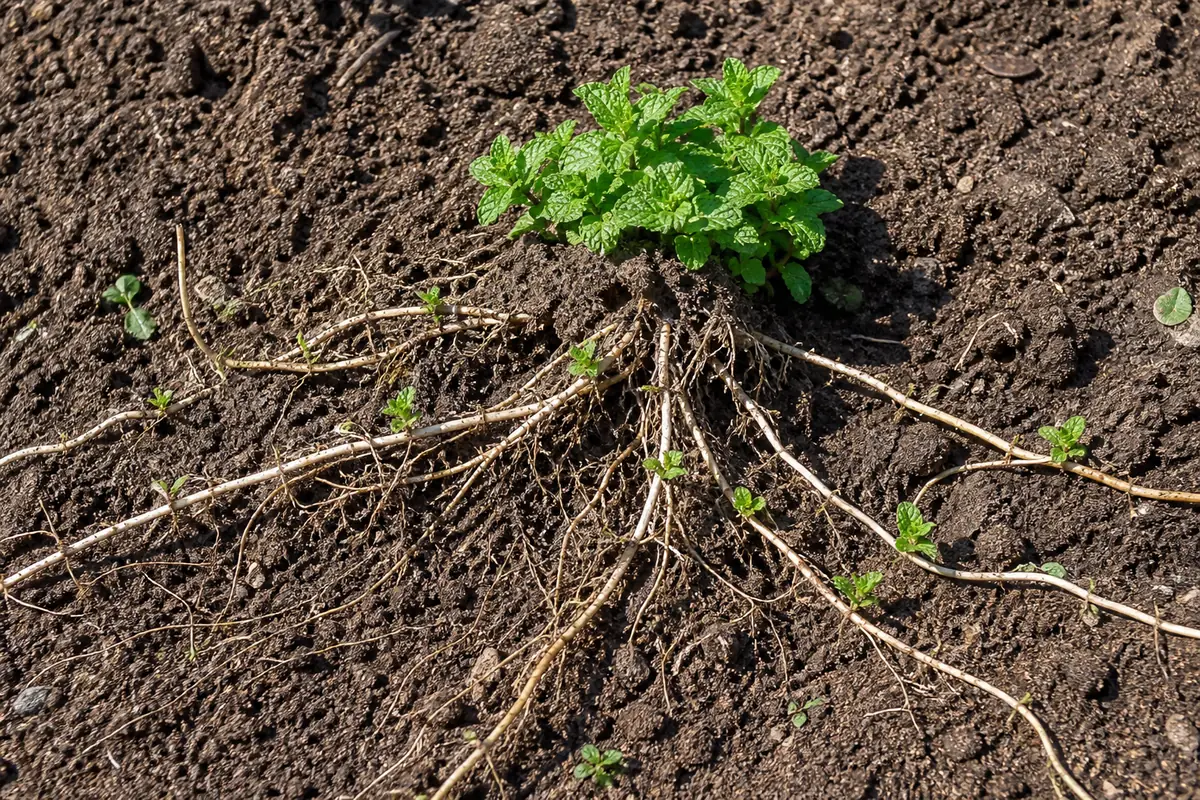
- Above ground: One tidy clump.
- Below ground: Runners heading in every direction.
- The fix: A container, or a bottomless pot sunk with its rim above soil level.
Horseradish is worse and close to permanent. Any fragment of root left in the ground regrows, so a bed that has held it stays a horseradish bed for years.
Lemon balm and some oreganos self-seed heavily. They are not aggressive underground but they arrive everywhere the following spring, so cut them back before the seed sets.
Fennel earns a separate mention because it causes two unrelated problems and gets blamed for the wrong one.
The first is real and chemical. Fennel releases compounds that suppress the germination and growth of several neighbors, so it belongs in its own corner rather than in a mixed bed.
The second is about seed rather than growth. Fennel and dill cross-pollinate readily, and if you are saving seed from either the offspring will be neither one thing nor the other.
Both problems have the same solution, which is distance. Grown at the edge of the plot fennel is an excellent nectar plant, and its flowerheads are among the best of the umbels for feeding predators.
Can one herb plant feed insects and still feed you?
There is a conflict buried in all of this, and most advice steps around it.
A coriander plant that has bolted is finished as a leaf crop. Telling a cook to let it flower is telling them to give up the thing they grew it for.
The resolution is to stop treating each plant as serving both purposes. Sow a separate short strip for flowering and leave it entirely alone, and keep cutting the strip you sow for eating.
For a dedicated flowering strip the variety matters in reverse. Seed sold as slow to bolt is the wrong choice there, and the cheapest whole coriander seed from a spice shelf germinates perfectly well and bolts obligingly.
Dill is easier because the seed is worth having in its own right, so letting it flower costs you nothing.
The insects have already been fed by the time you harvest, and dill covers what to do with the seed afterwards.
How should you lay out a companion-planted bed?
The practical version of all this is short, and it is mostly about pattern rather than pairing.
Break your crops into small patches rather than long single-crop rows, since the interruption is what does the work.
- Split each cropTwo or three small patches beat one long row of the same thing.
- Thread herbs throughCoriander, dill and parsley between the patches, not around the edge.
- Let some boltLeave a few of each to flower, and resow every three weeks.
- Site the thugsMint and horseradish in containers, fennel at the far edge.
- Add a trapNasturtium near the beans and brassicas, and pull it when it is covered.
Do not sacrifice light and airflow to a planting chart. A herb crowded into a bed for a claimed pest benefit competes for exactly the water and sun the crop needed, and a shaded crowded bed brings mildew with it.
Expect a difference over a season rather than a week. Predator populations build slowly, and the second year in a bed run this way is noticeably better than the first.
Part of that second-year gain comes from what you do in autumn. Lacewings and ladybirds overwinter in hollow stems and dead seedheads, so a bed stripped bare in November starts the next spring with no resident predators at all.
Leave the dead umbels of fennel, dill and coriander standing through the winter and cut them down in spring instead. They look untidy for a few months and they hold the insects that arrive before the aphids do.