
Starting an Indoor Herb Garden That Actually Survives
Why light decides everything, which herbs are worth the sill, and how to cut them so they keep going.
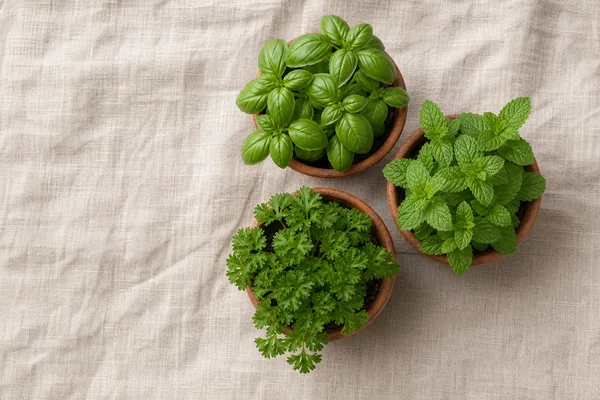
An indoor herb garden lives or dies on light long before care comes into it. A kitchen windowsill gives a fraction of what these plants get outdoors, so the herbs worth growing there are the ones that tolerate the shortfall, and the commonest way to kill the rest is watering them.
How much light does an indoor herb garden need?
Almost every indoor herb that dies was killed by a dark room, whatever the immediate symptom looked like.
Culinary herbs are Mediterranean or near-Mediterranean plants. They evolved in full sun and they expect six to eight hours of it.
A bright windowsill in a normal house delivers a small fraction of outdoor light, and the drop is steeper than anyone expects. Move a pot two feet back from the glass and it loses most of what the sill was giving it.
| Window | What it gives | Verdict |
|---|---|---|
| South-facing | The most direct sun available indoors | The only reliable spot for basil or rosemary |
| West-facing | Strong afternoon sun, warm | Workable for most herbs |
| East-facing | Gentle morning sun | Mint, parsley, chives are fine here |
| North-facing | No direct sun at all | Nothing survives long without a lamp |
A weak plant in low light gets read as thirsty and watered. The wet roots finish it off, and that chain is behind most kitchen herb deaths.
Fix the light first and the rest of this becomes easy.
The same window that gives the light also has the coldest air in the room at night, which catches people out in winter. Glass loses heat, and a pot pressed against it can sit ten degrees below the rest of the kitchen after dark.
Basil suffers most from this. It sulks below about twelve degrees, so a plant that looks fine at teatime and blackens at the leaf edges by morning was chilled rather than underwatered.
Drawing the curtains makes it worse rather than better, since it shuts the pots into the cold gap between fabric and glass. Move them onto the sill's inner edge on cold nights, or lift them off it entirely.
Which herbs are easiest to grow indoors?
Not all of them are, and pretending otherwise is why beginner guides get a bad name.
The plants that cope indoors are the ones with lower light demands and softer growth. The ones that struggle are the woody Mediterranean shrubs that want heat, sun and moving air.
| Herb | Indoors | Why |
|---|---|---|
| Chives | Easy | Tolerates modest light and cool rooms, regrows after cutting |
| Mint | Easy | Almost too vigorous, but grow it in its own pot |
| Parsley | Easy | Slow, steady, forgiving of an east window |
| Oregano and thyme | Workable | Need the brightest sill you have, and dry soil |
| Basil | Hard | Wants warmth and strong light, hates cold glass and wet roots |
| Coriander | Hard | Bolts to seed within weeks whatever you do |
| Rosemary | Hardest | Dies from still air, low humidity and overwatering |
Mint deserves its own pot for the opposite reason to the others. Outdoors it takes over a bed, and in a mixed container it will smother everything beside it within a season.
Coriander is worth treating as a crop rather than a plant. Sow a small batch every three weeks, cut it young, and accept that each sowing has a short life, which is covered under cilantro.
Should you start with seed, a plant, or a supermarket pot?
The pot of basil on the shelf is not one herb that needs looking after. It is thirty or forty seedlings sown into one small pot for volume, and it was grown to be eaten within a fortnight.
Those seedlings are competing for the same thimble of compost, and none of them can develop a proper root system.
So the pot arrives lush, collapses within two weeks, and the buyer concludes they cannot keep herbs alive.
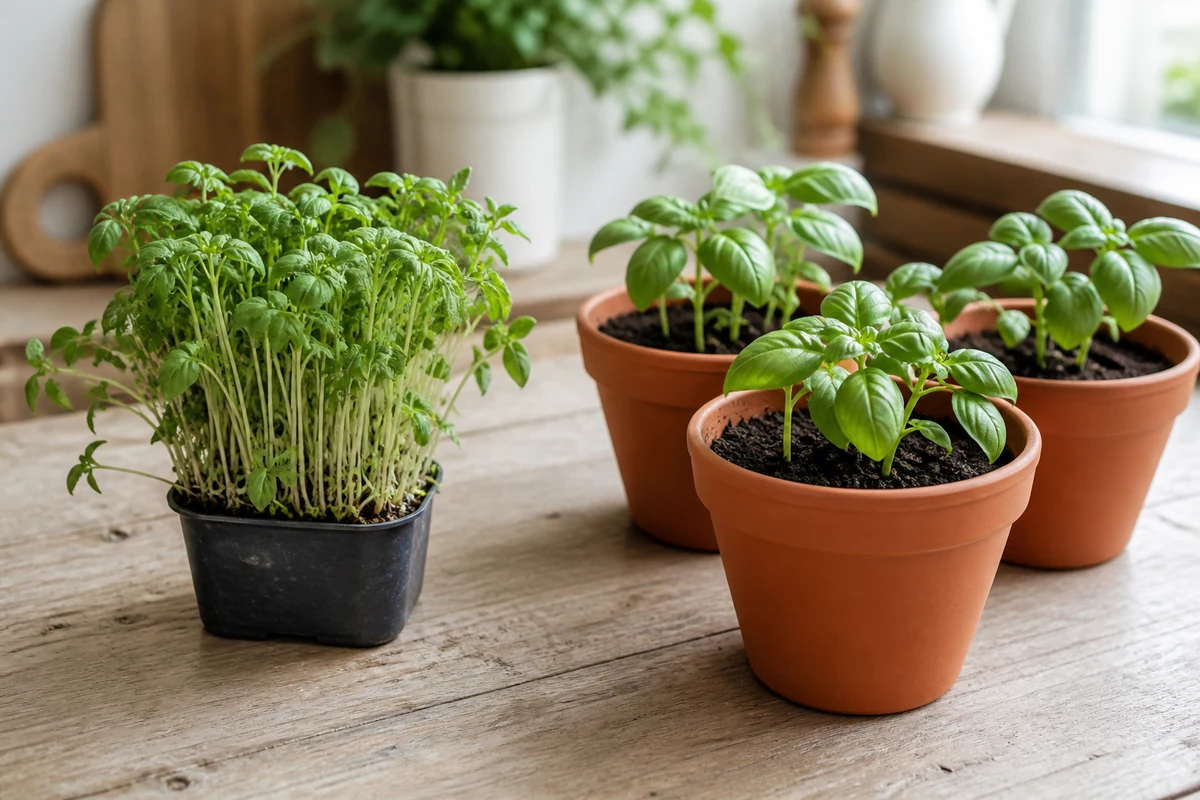
- Before: One pot, thirty-plus stems, roots wound around each other.
- After: Three or four pots with a handful of stems each.
- Timing: Do it the day you buy it, while the roots are still growing.
Splitting one is quick. Soak the rootball, ease it apart into three or four clumps, and pot each clump into fresh compost in a larger pot.
Expect a week of sulking afterwards. What you get in return is a plant that lasts months rather than days, which is the difference between buying herbs and growing them.
Some herbs are cheap and quick from a packet, and some will waste a season of your windowsill.
The fast ones are the soft annuals and the clump-formers. Basil, coriander, chives, dill and parsley all germinate readily on a warm sill, and a packet costs less than a single supermarket pot.
The slow ones are the woody perennials. Rosemary, thyme, oregano and sage germinate unevenly and take a year or more to reach a size worth cutting from, so buying an established plant saves a great deal of waiting.
| Herb | Start from | Note |
|---|---|---|
| Basil | Seed | Germinates in days at room temperature |
| Coriander | Seed | The only sensible way, since it needs constant resowing |
| Chives | Seed or a split clump | A friend's clump divides for nothing |
| Parsley | Seed | Slow to appear, up to three weeks, so do not give up early |
| Thyme, oregano, sage | A bought plant | Seed works but takes a year to be useful |
| Rosemary | A bought plant or a cutting | Seed is slow and unreliable |
| Tarragon | A bought plant only | Seed gives the flavorless Russian species |
Tarragon is the one where the packet is actively a trap, and the reason is covered under tarragon.
Sow thinly whatever you are growing. The instinct to empty the packet produces the same overcrowding that kills a supermarket pot, and thinning the seedlings early is what lets the survivors build roots.
How should you water indoor herbs?
More indoor herbs drown than dry out, and the two look identical from above.
A wilting plant with damp soil is not thirsty. Its roots have already rotted and can no longer take water up, so adding more accelerates the ending.
- Push a finger two centimeters into the compost.
- Damp at that depth: leave it and check tomorrow.
- Dry at that depth: water until it runs from the bottom.
- Empty the saucer twenty minutes later, every time.
- Never water on a schedule, only on the finger test.
Watering thoroughly and then waiting is better than a daily splash. Little and often keeps the surface wet and the deep roots dry, which is the worst of both.
Rosemary and thyme want to dry out almost completely between waterings. Basil and mint want steady moisture without ever sitting in water.
Which pots and soil keep indoor herbs alive?
Drainage holes are not optional, and the pretty ceramic pot without one is a herb killer.
If you love the container, keep the plant in a plastic pot inside it and lift the plastic out to water. Gravel in the bottom of a sealed pot does not work, whatever you have read.
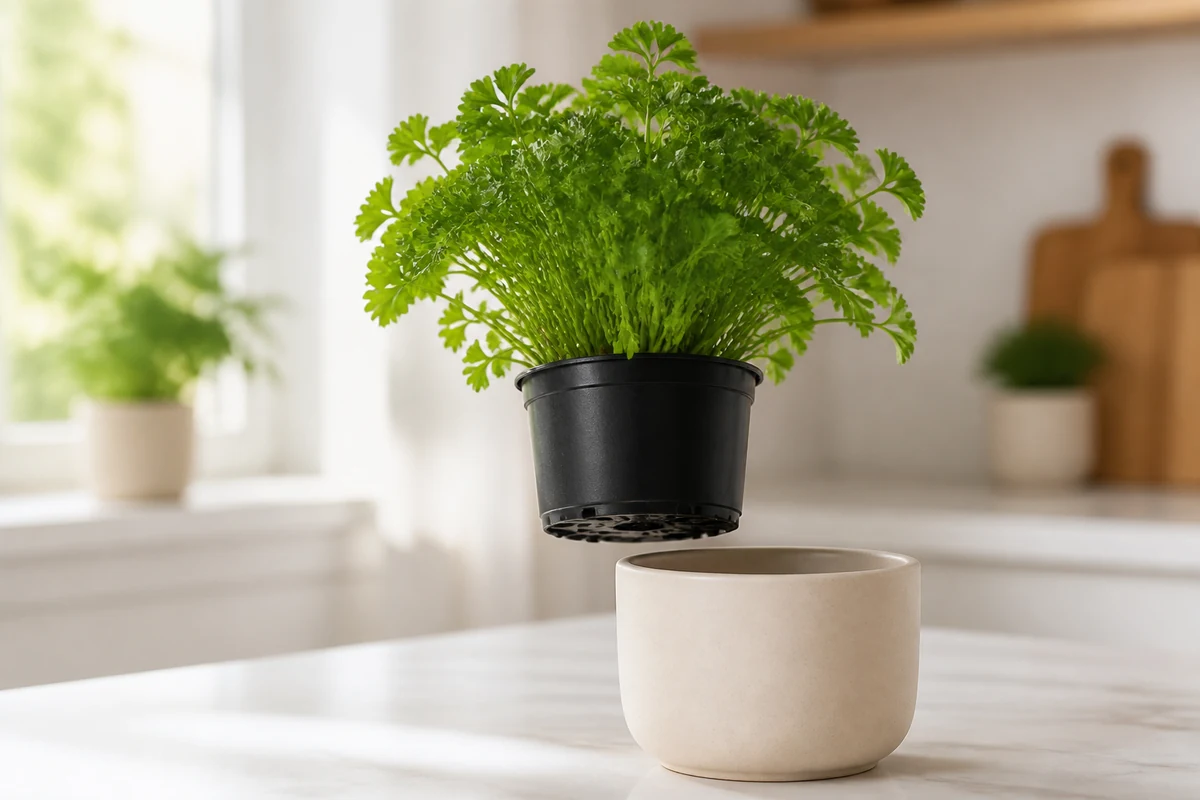
- Inner pot: Plastic, holes in the base, sits loose.
- Outer pot: Decorative, no hole, never left holding water.
- At watering: Lift the inner pot out, water at the sink, let it drain, put it back.
Size matters more than material. A pot at least fifteen centimeters across holds enough compost to buffer your watering mistakes, and a small pot dries and floods within the same day.
Use a peat-free multipurpose compost with some grit or perlite mixed in. Garden soil compacts to a brick in a pot and brings pests indoors with it.
Feed lightly from spring onwards. Compost runs out of nutrients in about six weeks, and a half-strength liquid feed every fortnight is enough for herbs you are cutting regularly.
Do you need a grow light or hydroponic kit?
For a north-facing kitchen a lamp is not an upgrade, it is the only thing that will work.
A modest full-spectrum LED is enough for a few pots. The specification that matters is distance and duration rather than wattage.
Keep it fifteen to thirty centimeters above the leaves and run it twelve to fourteen hours a day on a plug-in timer.
Plants also need the dark. Running a light around the clock does not double the growth and it stresses them, so the timer is doing real work rather than saving electricity.
A lot of people searching for an indoor herb garden mean one of these rather than a pot of compost, and they deserve a straight answer.
They work, and the reason they work is the lamp. The kit solves the one problem that defeats a windowsill, which is why it succeeds where a bare sill fails.
Pros
- The light is built in, so a dark kitchen stops being a barrier.
- Watering is automatic, which removes the commonest cause of death.
- Basil in particular grows fast and well in one.
Cons
- The seed pods are proprietary and the running cost adds up.
- The growing space is small, so the yield is still garnish quantities.
- It does not suit rosemary, thyme or anything woody.
Where they disappoint is volume. A kit holding six pods produces roughly what two good pots on a bright sill produce, so it buys reliability rather than quantity.
The cheaper version of the same idea is a clip-on LED over ordinary pots. It costs a fraction of a kit, takes any compost and any seed, and solves the identical problem.
How do you harvest herbs so they regrow?
How you harvest decides whether a herb thickens up or gives up, and most people cut in the way that guarantees the second.
Stripping the lower leaves and leaving a bare stem with a tuft on top removes the plant's ability to feed itself.
- Find a stem with a pair of small leaves growing where the leaf meets the stem.
- Cut just above that pair, taking the tip and the leaves above it.
- Two new shoots grow from that junction within a week or two.
- Repeat on the new shoots once they have four leaves of their own.
- Pinch out any flower buds the moment you see them.
Chives are different and simpler. Cut a handful of stems right down to two or three centimeters above the compost rather than trimming the tips, and they regrow from the base.
The general limit is a third of the plant at once. Take more than that and the plant spends weeks recovering instead of producing.
Flowering is the end of useful leaf on most soft herbs. Once basil or coriander bolts, the leaves turn bitter and thin, so pinch buds out early.
Which pests attack indoor herbs?
Indoor herbs get a small and predictable set of problems, and two of the three are telling you something about the conditions.
Fungus gnats are the commonest. Small black flies rising off the compost mean the surface has been wet for too long, so they are a watering diagnosis rather than an infestation.
Let the top layer dry properly between waterings and they leave within a fortnight. A centimeter of grit over the compost surface stops the next generation laying.
Aphids cluster on new growth and soft stems, usually on basil first. They arrive on a bought plant more often than through a window.
Spider mites are the serious one, and they are the reason many indoor rosemary plants die. They thrive in hot dry still air, and by the time you see fine webbing between the leaves the plant is well into trouble.
- Check the undersides of leaves on any new plant before it joins the others.
- Keep a new arrival apart for a week if you can.
- Rinse aphids off in the sink rather than spraying anything you plan to eat.
- Raise humidity around rosemary and thyme, and let air move past them.
- Wash and dry any pot you reuse, since eggs survive in old compost.
Nothing here needs a chemical. On plants you are going to eat within days, water, a cloth and better airflow deal with almost everything.
How much can a windowsill herb garden produce?
A realistic indoor setup produces garnish quantities, not the bunches a recipe calls for.
Four pots on a good sill will keep you in chives, mint and parsley for scattering, and give occasional handfuls of basil in summer.
They will not supply the three or four bunches that a herb salad needs, and buying for those dishes while growing for the daily pinch is the sane split.
Herbs also slow to a stop in winter. Growth almost ceases from November to February in a northern climate, so cut less, water far less, and treat the plants as resting rather than failing.
Anything you cannot use fresh is worth drying properly rather than letting it collapse in the fridge, which is a method in itself and is covered in how to dry herbs.