
Chives: The Onion You Never Cook
Why scissors beat a knife, what heat does to them, and how garlic chives differ from the ordinary kind.
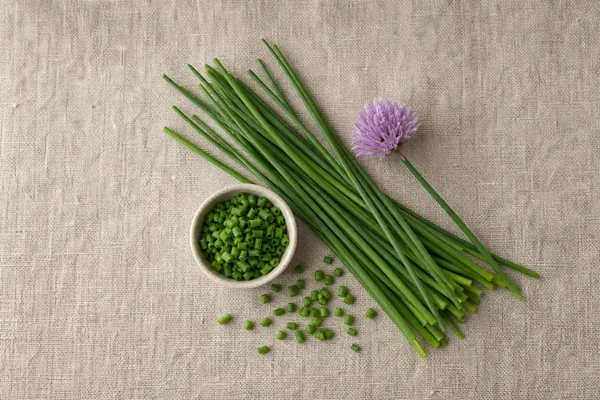
Chives are the mildest onion in the kitchen and the only allium used raw as a finishing herb. The two decisions that change the result are cutting them cleanly rather than crushing them, and keeping them off the heat entirely.
What are chives, and how are they different from other alliums?
Chives sit in the herb section of the shop and belong to the onion family.
They are Allium schoenoprasum, related to onions, garlic, leeks and shallots, and the flavor is unmistakably in that family once you notice it. What separates them is how quietly they do it.
An onion needs cooking before it is pleasant. Chives do not, because they carry a fraction of the sulfur compounds a bulb onion does, and what they have arrives gently rather than as a hit.
That makes them the one allium you can scatter raw over something delicate without taking it over.
The hollow round stem is the giveaway. Roll one between your fingers and it is a tube rather than a blade, which is how you tell true chives from every green look-alike sold beside them.
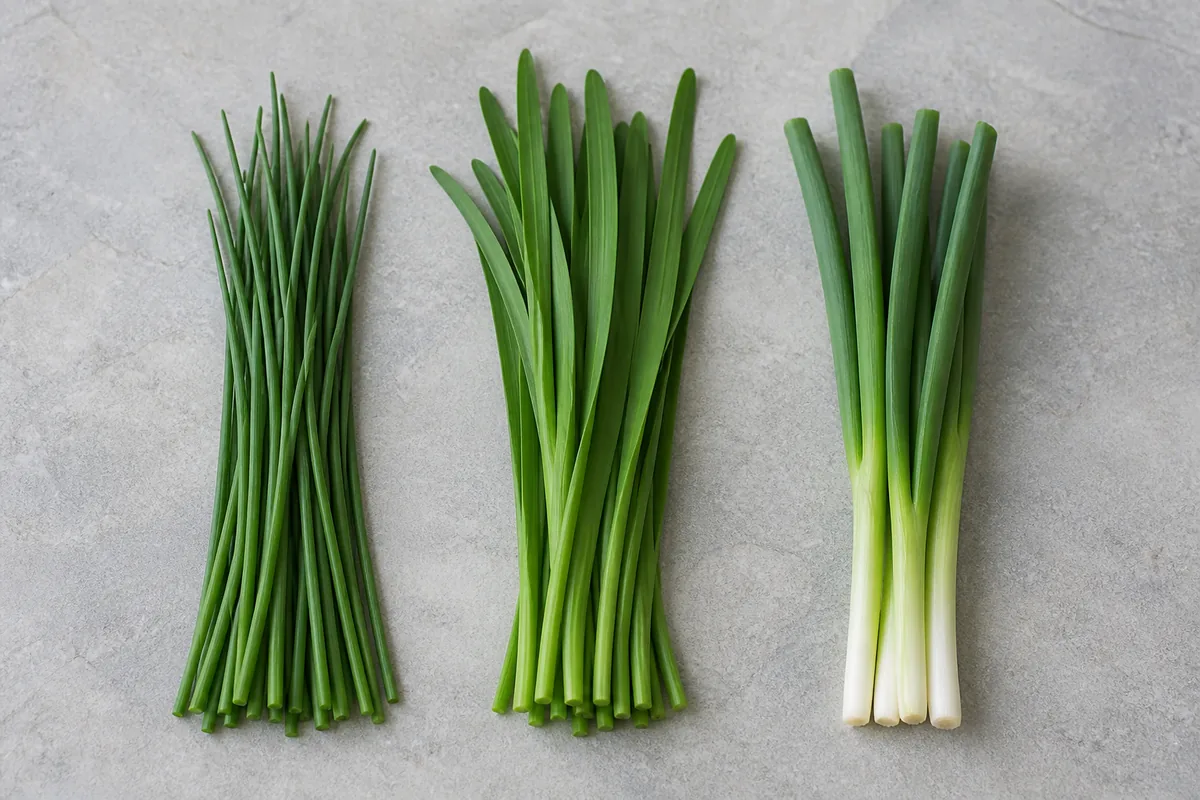
- Chives: Thin, hollow, round in cross-section.
- Garlic chives: Flat, solid, strap-shaped, and they smell of garlic.
- Spring onion tops: Thicker, coarser, and part of a bulb plant.
How should you cut chives without crushing them?
This is the part that separates chives that taste of something from chives that taste of wet grass.
Allium flavor is not sitting in the plant ready to go. It forms when cells rupture and enzymes meet compounds that were kept apart, which is why a whole onion smells of very little and a cut one does not.
A sharp cut ruptures a thin line of cells. A dull knife crushes a wide band of them, and with a stem as fine and hollow as a chive that is most of what you have.
Crushed chives release their water along with everything else. They go limp and dark within a minute, smear on the board, and clump instead of scattering.
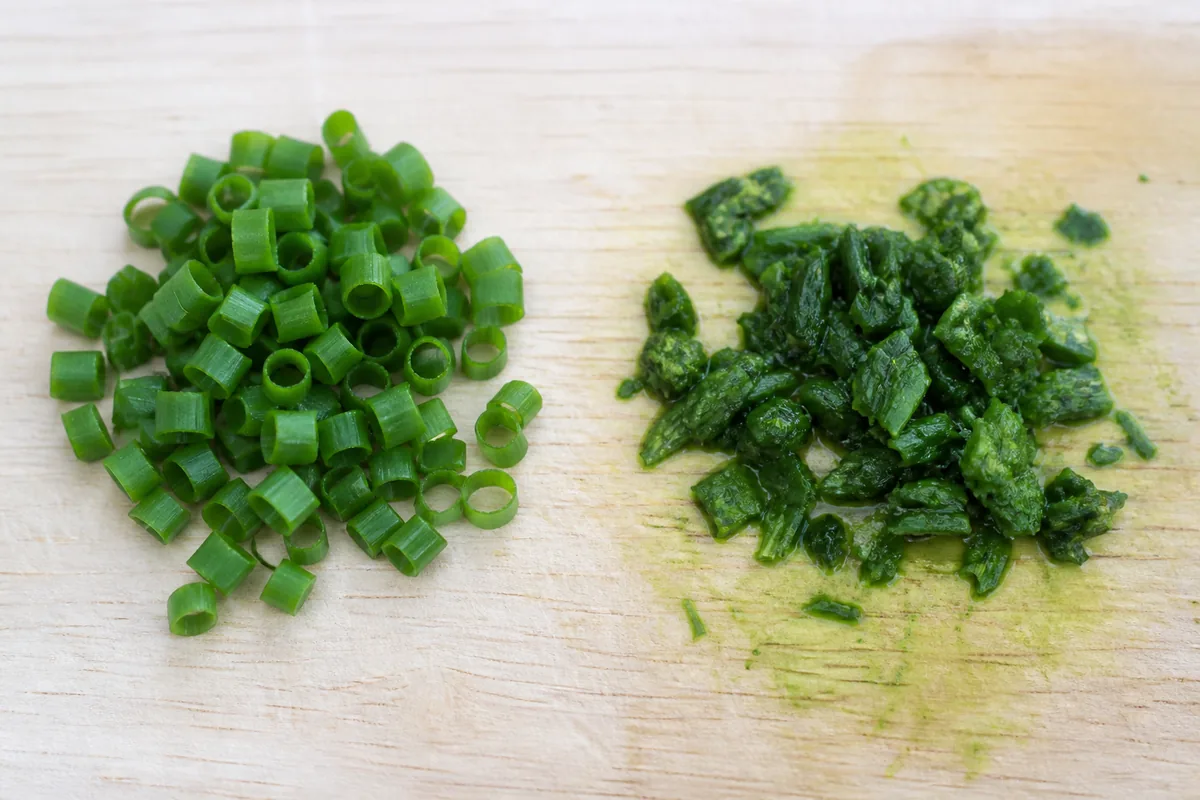
- Left: Snipped with scissors, tubes intact, still bright.
- Right: Chopped with a dull blade, flattened and weeping.
- The tell: Green juice on the board means flavor that left the herb.
Kitchen scissors are genuinely the better tool here, which is unusual advice and worth taking. Hold a small bunch and snip directly over the dish rather than cutting on a board.
If you prefer a knife, make it a sharp one and cut rather than rock. A rocking motion crushes far more than it slices.
Once you are snipping rather than chopping, the remaining decision is how long to leave the pieces.
Fine rings, a couple of millimetres each, are for stirring through. They distribute evenly, catch in soft food and season a whole bowl rather than sitting on top of it.
Long batons, cut into lengths of an inch or two, are for looking at. Laid across a plated dish they read as deliberate, and they hold their shape far longer than rings because there are fewer cut ends losing moisture.
The mistake is using rings where batons belong. A scatter of fine rings on a restaurant-style plate turns to a damp green smudge within a minute of the plate reaching the table.
For anything going into a dip, a dressing or a mash, rings every time.
When should you add chives to a dish?
Chives do not survive cooking, and they fail in a specific way that is worth recognising.
They do not turn bitter. They collapse.
The structure goes within seconds, the bright green dulls to olive, and the fresh oniony note disappears rather than transforming into anything.
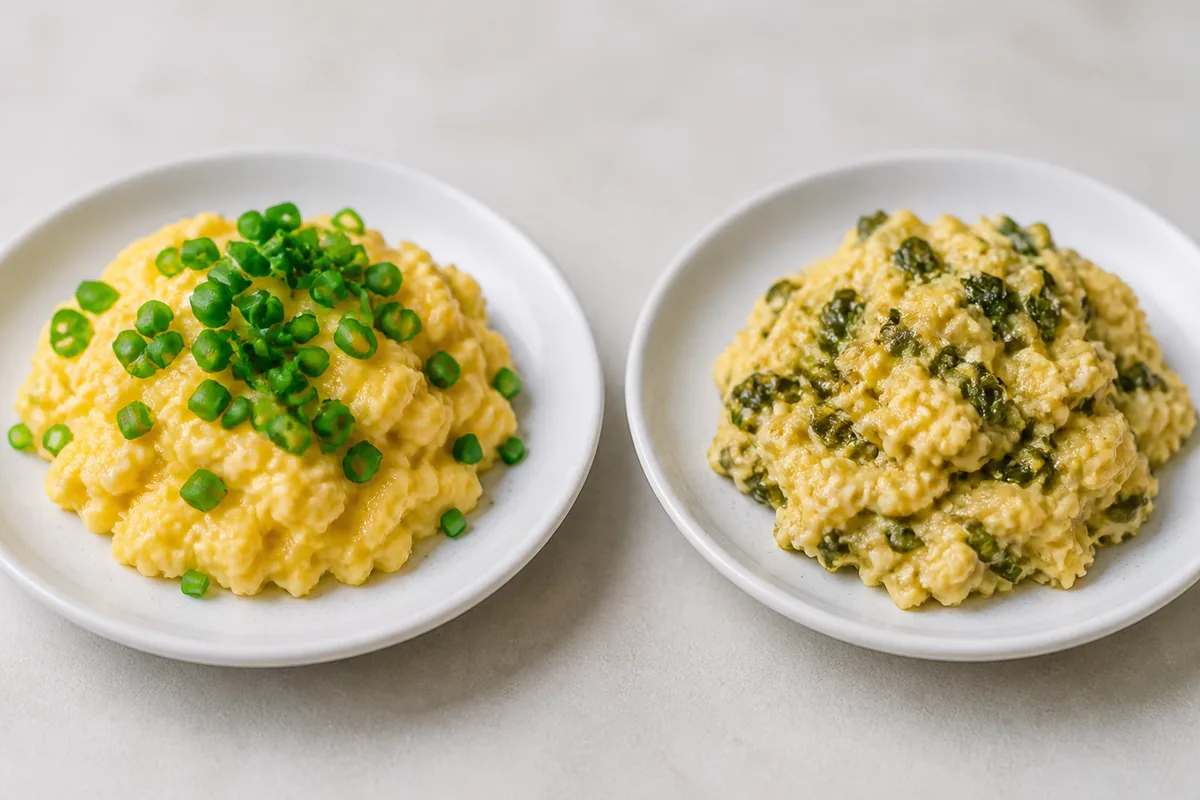
- Left: Scattered off the heat, still bright and distinct.
- Right: Cooked into the dish, collapsed and olive colored.
- Rule: The pan goes off the heat before the chives go on.
So they go on at the very end, or at the table. Scrambled eggs, potatoes, soups, cream cheese and anything with dairy in it are their natural home, because a mild allium is exactly what a rich, soft dish needs to stop it feeling flat.
The one exception is warmth without cooking. Stirring chives through something hot off the heat, or scattering them onto a plate that is still steaming, keeps the color while letting the aroma lift.
Are garlic chives the same as common chives?
Sold beside chives in many shops, and not a substitute for them.
Garlic chives are Allium tuberosum, known as Chinese chives, nira or gau choy. The leaves are flat and solid rather than hollow, wider, and noticeably tougher.
They taste of garlic rather than onion, and they are considerably stronger. A handful will assert itself where the same weight of ordinary chives would whisper.
The most useful difference is that garlic chives are cooked. They go into dumpling fillings, stir-fries and pancakes, and they hold up to the heat that would destroy a regular chive within seconds.
Treat them as a vegetable you cook rather than a herb you sprinkle, and the confusion resolves itself.
How much chive should you use, and where does it work best?
A tablespoon of snipped chives per serving is generous as a finish, and most dishes want less than people put on.
A supermarket bunch runs around 20 to 30 grams, which gives roughly half a cup snipped. That is enough to finish four or five portions rather than one.
The failure mode is not overpowering, since chives are too mild for that.
It is texture. Pile too many on and you get a mat of wet green sitting on the food rather than a seasoning running through it.
For a dip or a soft cheese, where the chives are mixed in rather than scattered, two tablespoons per 200 grams is a reasonable starting point.
| Dish | Amount | When |
|---|---|---|
| Scrambled eggs or omelette | 1 tbsp per portion | Off the heat, at the last second |
| Potato salad or mash | 2 tbsp per 500 g | Stirred in warm, not hot |
| Soft cheese or dip | 2 tbsp per 200 g | Mixed in, then rested an hour |
| Soup, as a finish | A light scatter per bowl | At the table |
| Dressing or vinaigrette | 1 tbsp per 100 ml | Just before serving, they fade in acid |
The classic pairings are not habit. They follow from what a mild allium does next to fat and starch.
Rich, soft food flattens quickly on the palate. Cream, butter, egg and potato all coat the tongue, and after two or three mouthfuls everything tastes the same as it did on the first.
A raw allium cuts through that without adding acid or heat. It gives the mouth something sharp and green to register, which resets the palate between bites.
That is also why chives fail in assertive company. Put them on a curry, a chilli or anything already carrying garlic and heat, and they simply vanish.
Acid is the other place they struggle. A vinaigrette flattens them within minutes, so chives go into a dressing at the very last moment or not at all.
There is one classical mix chives belong to, and knowing it explains a lot of French cooking.
Fines herbes is chives, parsley, tarragon and chervil in roughly equal parts, all fresh, all finely cut and all added at the end.
Every one of the four is heat-fragile, which is the point of the group rather than a coincidence. The mix is designed to go onto omelettes, soft cheeses and delicate fish after the cooking is finished.
Chives supply the allium note in that quartet, and nothing else in it does. Leave them out and the mixture reads as green and grassy without the savoury lift.
Can you use dried chives instead of fresh?
Most herbs lose something when dried. Chives lose nearly everything.
The compounds that carry their flavor are volatile sulfur molecules, and those do not survive drying in any useful quantity. What is left is green confetti with a faint hay note.
Freezing works far better, because it keeps the cell structure intact until you use it. Snip a bunch, spread it on a tray, freeze it loose and bag it once solid.
Frozen chives will not hold their shape well enough for a garnish. They are fine stirred into anything cooked or creamy, which covers most of what chives are used for anyway.
Given how little the dried version carries, it is fair to wonder why it is on the shelf at all.
In packaged food, dried chive is doing a visual job rather than a flavor one. The green flecks in a ranch seasoning, a sour cream and onion crisp or a supermarket herb butter are there so the product looks herby, while the actual taste comes from onion powder and added flavoring.
That is a legitimate use in a factory and a poor one in a kitchen.
If you want the look, use frozen. If you want the taste, there is no shortcut past fresh.
The other route for a glut is fat. Blitz them into softened butter with a little salt, roll it in paper and freeze it, and you have chive butter for months.
How do you buy, store, and grow chives?
Fresh chives wilt quickly once cut, so what you buy matters more than how you store it.
Look for stems that stand up on their own and have squared, clean cut ends. Yellowing tips and any slimy patch mean the bunch has been sitting, and neither improves in the fridge.
Stand the bunch in a glass with a little water, loosely covered, in the door of the fridge. Handled that way a bunch keeps four or five days, which is about as long as chives ever manage.
A living pot is the better buy if you use them often, and chives are one of the few supermarket herb pots that genuinely survives.
They are a perennial that regrows from the base, which is the difference. Most potted herbs sold in shops are annual seedlings crammed together and living on borrowed time, while a chive pot is a clump that will come back for years if you let it.
- Cut low: Take outer stems about an inch above the soil rather than trimming the tips.
- Never shear the top: Cutting across the middle leaves blunt brown ends and weakens the plant.
- Split it: A supermarket pot is several plants crowded together, so divide it into two or three.
- Let it flower once: Then cut the whole clump back hard and it regrows tender.
The purple flowers are edible, and worth more attention than they usually get.
Pull a head apart and it separates into dozens of individual florets, each with a mild onion flavor and enough structure to sit on a salad without wilting. Scattered whole they look like a garnish and taste like a seasoning.
The other use is vinegar. A jar of white wine vinegar packed with flower heads turns a clear pink within a week and carries a gentle allium note, and it makes a vinaigrette that needs almost nothing else.
Flowering does cost you leaf quality. The stems turn tougher and more hollow while the plant is putting energy into the flower, so a plant you rely on for cutting is better kept trimmed before it bolts.
What can you substitute for chives?
The closest stand-in is the green top of a spring onion, sliced very thin.
It is sharper and more assertive than chives, so use around two thirds of the amount and taste before adding more. The color and the raw-allium role are right, which is most of what the dish needs.
Garlic chives work when you want the finishing role but do not mind the flavor changing direction entirely.
| Instead of chives | Use | What changes |
|---|---|---|
| Spring onion greens | Two thirds the amount, sliced thin | Sharper, coarser, less delicate |
| Garlic chives | The same amount | Garlic rather than onion, and stronger |
| Very fine red onion | A scant amount, rinsed first | Much more assertive, no green freshness |
| Wild garlic leaves | A little, shredded | Seasonal, and strongly garlicky |
What does not work is a dried herb of any kind. The whole point of chives is a fresh green allium note, and no dried substitute carries it.
Going the other way is worth a word too, because people try it more often than they should. Chives will not stand in for onion in anything cooked, since there is no body to them and heat removes what little there is.
Where they do replace an onion is in a raw application that has turned out too harsh. A salad, a salsa or a soft cheese carrying too much raw onion can be rescued by leaving the onion out next time and finishing with chives instead, which gives the same direction at a fraction of the bite.