
Which Kitchen Spices Are Chinese Medicine Herbs?
How the tradition classifies ingredients you already own, why fresh and dried ginger count separately, and where the evidence stops.
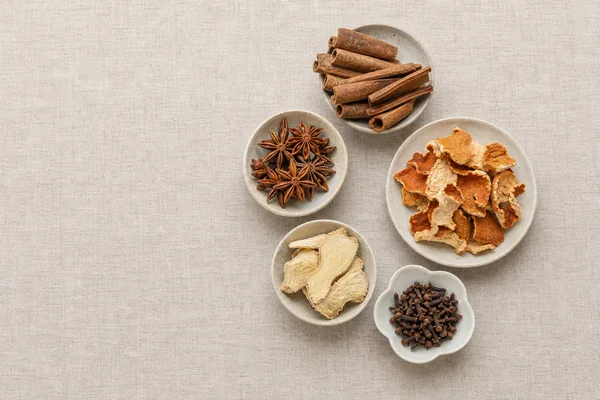
Ginger, cinnamon, star anise, clove and Sichuan pepper all appear in Chinese materia medica as well as in a spice rack. The tradition divides them more finely than a cook does and uses them in far larger amounts, which is why a traditional use does not read across to a recipe.
Which kitchen spices are also Chinese medicine herbs?
Open a drawer of Chinese materia medica and a surprising amount of it is already in your kitchen.
Ginger, cinnamon, star anise, clove, fennel seed, Sichuan pepper, nutmeg and cardamom all appear in both places. So do dried tangerine peel, jujube dates and goji berries, which Western kitchens treat as fruit rather than seasoning.
The overlap is not a coincidence or a marketing move. Both traditions drew on what grew locally and kept well, and aromatic plants that preserve well are exactly the ones that travel into both a cooking pot and a medicine chest.
What differs is not the plant. It is how finely the system divides it, and how much of it gets used.
| In your kitchen | In Chinese materia medica | Roughly what the name means |
|---|---|---|
| Fresh ginger | Sheng jiang | Fresh ginger rhizome |
| Dried ginger | Gan jiang | Dried ginger rhizome |
| Cinnamon bark | Rou gui | Bark of the cassia tree |
| Cinnamon twig | Gui zhi | Young twig of the same tree |
| Star anise | Ba jiao hui xiang | Eight-horned fennel |
| Fennel seed | Xiao hui xiang | Small fennel |
| Clove | Ding xiang | Nail-shaped aromatic |
| Sichuan pepper | Hua jiao | Flower pepper |
| Dried tangerine peel | Chen pi | Aged peel |
How can one plant become several separate medicinals?
This is the part that catches Western cooks out, and it is the most useful thing to understand about the whole system.
Fresh ginger and dried ginger are not two forms of one item here. They are two different medicinals with different names, different classifications and different uses.
Sheng jiang, the fresh root, is described as acting on the exterior of the body and is the one associated with nausea and with easing the harshness of other ingredients in a formula.
Gan jiang, the dried root, is classified as working deeper and more warmly, and is used for entirely different complaints.
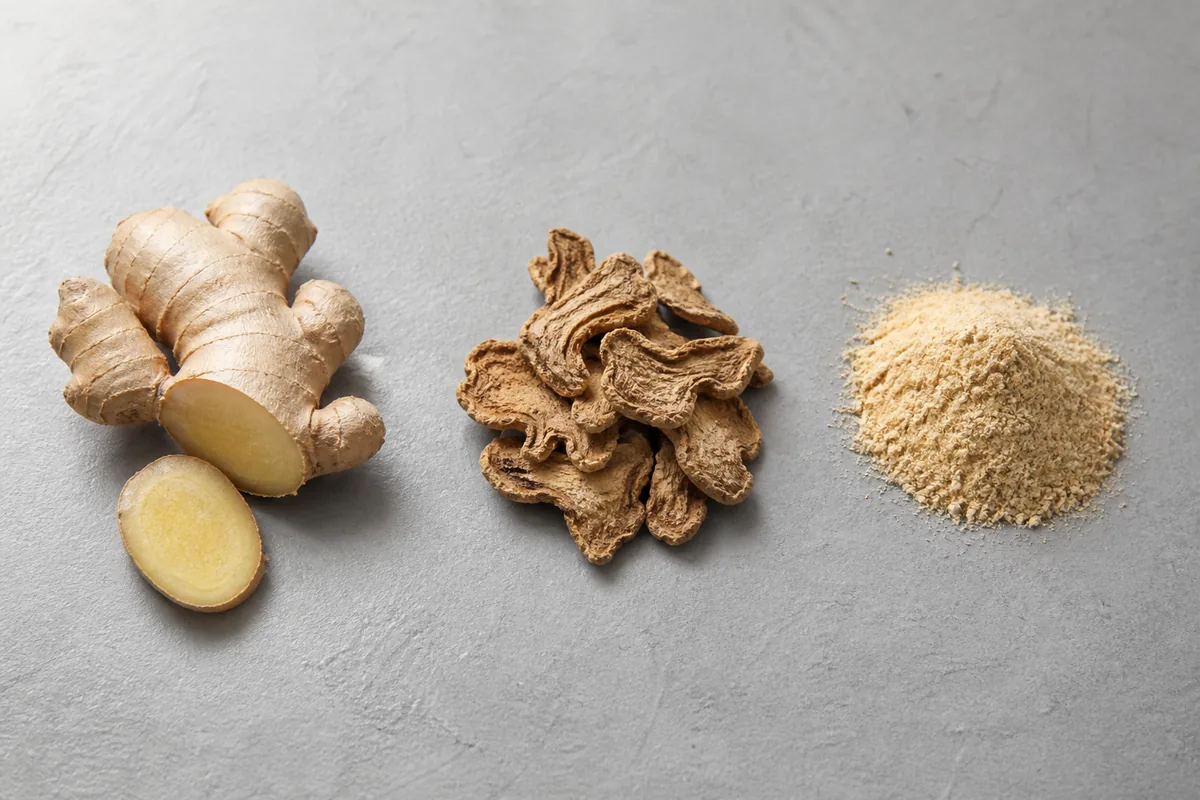
- Fresh: Sheng jiang, the form associated with the surface and with nausea.
- Dried: Gan jiang, classified as deeper and warmer in action.
- Ground: A kitchen convenience rather than a category in the system.
Cinnamon splits the same way, but by plant part rather than by drying. Rou gui is the thick bark and gui zhi is the young twig, and the two are treated as distinct medicinals from the same tree.
Your jar of cinnamon sticks is closer to the bark. The twig has no real culinary equivalent in a Western kitchen, which is why the distinction is invisible from the spice aisle.
The underlying logic will be familiar if you cook seriously. Drying converts gingerols into shogaols, so the two forms genuinely do taste and behave differently.
That is a chemical fact rather than a traditional claim, and the ginger page reaches the same split for entirely culinary reasons.
Are medicinal spice amounts the same as cooking amounts?
A great deal of confusion comes from reading a traditional use and then reaching for the spice jar.
Medicinal preparations are usually decoctions, meaning the material is simmered in water for a long time and drunk as a liquid. The quantities are weighed in grams and a single dose commonly runs from about three to ten grams of one ingredient.
Cooking amounts sit well below that. A pinch of ground clove in a braise is a fraction of a gram, and even a heavily spiced dish spreads its spice across several servings.
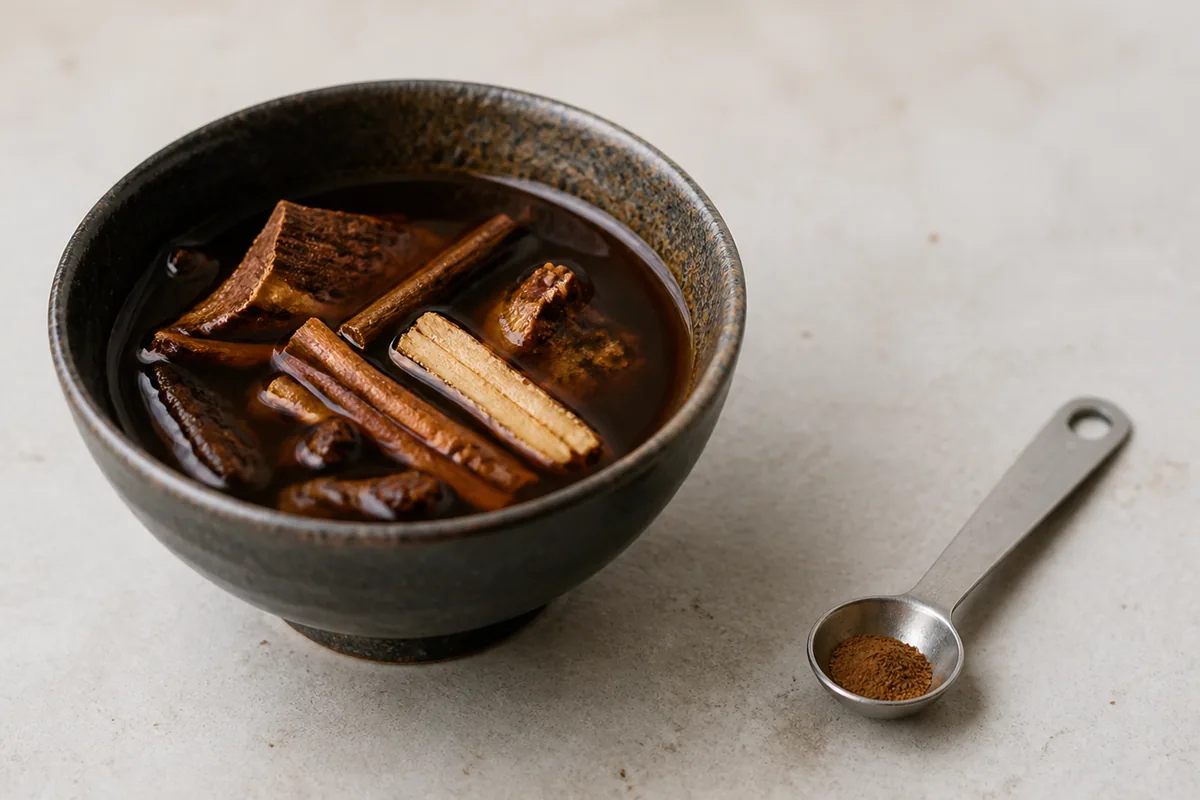
- Left: A single dose, weighed in grams and simmered for a long time.
- Right: A culinary pinch, a fraction of that, spread across a whole dish.
- The point: Same plant, quantities an order apart.
That gap runs in both directions. It means a bowl of ginger and jujube tea is not a prescription, and it also means a traditional caution about a large medicinal dose does not automatically apply to seasoning food.
What do warming, cooling, and five flavors mean?
Every ingredient in the system carries a thermal classification, running from hot through warm and neutral to cool and cold.
The labels do not describe the temperature you serve something at. They describe an effect the tradition attributes to the ingredient, and they are used to match ingredients to a person and a season rather than to a dish.
Most kitchen spices sit on the warm end. Ginger, cinnamon, clove, star anise and Sichuan pepper are all classified as warming, which is part of why they cluster in cold weather cooking in both traditions.
Mint, chrysanthemum and some fruit peels sit on the cool end, and are used differently.
A second axis runs alongside it. The five flavors, pungent, sweet, sour, bitter and salty, are each associated with particular actions, so an ingredient is classified by both its nature and its flavor.
Pungent covers most of the aromatic spice rack, which is why a Chinese pharmacy and a spice drawer overlap so heavily in the first place.
| Axis | The range | Where kitchen spices mostly sit |
|---|---|---|
| Nature | Hot, warm, neutral, cool, cold | Warm, with ginger, cinnamon, clove and star anise together at that end |
| Flavor | Pungent, sweet, sour, bitter, salty | Pungent, which is the category most aromatics fall into |
Reading a classification is not the same as reading an instruction. It tells you where the tradition files an ingredient, not what will happen to you when you eat it.
If this framework sounds familiar, it should. Ayurveda organises food along its own comparable axes, and that system is set out separately under Ayurvedic spices rather than repeated here.
How do these spices appear in everyday Chinese cooking?
In everyday use this rarely looks like medicine at all. It looks like food.
Ginger and jujube tea, congee cooked with dried tangerine peel, chicken simmered with goji and astragalus, a pot of soup carrying a small muslin bag of aromatics: these are the ordinary form the tradition takes in a home kitchen.
That style has a name, shi liao, usually translated as food therapy, and it sits between cooking and medicine rather than firmly in either.
The amounts in home food therapy are much closer to cooking than to a clinical decoction, which is worth knowing before assuming a family soup carries a medicinal dose of anything.
| Ingredient | Everyday culinary use | Everyday food-therapy use |
|---|---|---|
| Fresh ginger | Stir-fries, steamed fish, braises | Simmered with jujube as a hot drink |
| Dried tangerine peel | Slow-braised meat, some sauces | Cooked into congee and soups |
| Star anise | Red-braised pork, master stock | Rare on its own, usually in a mix |
| Jujube | Occasional in desserts | Very common, in teas and soups |
| Goji berries | Almost none in Western cooking | Scattered into soups and rice near the end |
If you want to see these ingredients doing a job in ordinary cooking rather than in a formula, look at a master stock.
Lu shui is a braising liquid built on soy, rock sugar and rice wine, carrying star anise, cassia bark, ginger, dried tangerine peel, fennel seed and often liquorice root. Meat is poached in it, the stock is strained, and it is kept and used again.
Good ones are kept going for years, topped up rather than replaced, and a restaurant stock with decades behind it is a genuine asset rather than a boast.
What makes it relevant here is the ingredient list. It is almost exactly the overlap set from the top of this page, used in culinary quantities and treated purely as flavor.
Nobody eating a bowl of red-braised pork is taking a remedy. The same aromatics that a pharmacy weighs in grams are doing an entirely ordinary job in the pot, which is the clearest answer to whether these two worlds are really the same thing.
Keeping one alive safely is its own discipline, and it is the step most write-ups skip over.
Why is aged tangerine peel an exception to freshness advice?
Almost everything written about buying spice, here included, comes down to buying it fresh and using it before the aroma fades.
Chen pi breaks that rule on purpose. It is tangerine peel that has been dried and then aged, and older peel is more valued rather than less, with well-aged stock sold at a considerable premium.
The reasoning is specific rather than mystical. Fresh citrus peel is dominated by sharp volatile top notes, and those fade first, leaving the deeper and more bitter compounds behind in a higher proportion.
So the ingredient people want is the one that has lost something. That is the exact opposite of what you want from a jar of ground coriander, where the volatile top notes are the whole point.
Jujube and some other dried fruits are treated similarly, though less dramatically.
| What you have | What you want | Why |
|---|---|---|
| Ground coriander, cumin, paprika | The freshest you can get | Volatile top notes are the entire product |
| Whole peppercorns, cloves, star anise | Fresh, though they hold for years | Intact husks slow the same loss down |
| Chen pi, aged tangerine peel | The oldest you can afford | The sharp top notes fading is the intended change |
It is worth holding both ideas at once. For nearly everything on your rack the usual freshness checks apply, and chen pi is a genuine exception rather than a reason to doubt the rule.
Which familiar spices are absent from classical Chinese medicine?
The absences say as much about the system as the overlaps do.
Cumin, oregano, paprika, allspice and vanilla barely feature, and chile arrived late, since it reached China only after the Columbian exchange and is not part of the older materia medica.
That is a geography story rather than a judgement. The classical texts catalogue what grew in or reached China, and a plant from Mexico or the Mediterranean had no way of appearing in a Tang dynasty compendium.
It matters practically when you read a modern list that assigns Chinese classifications to every spice in a Western rack. Some of those assignments are recent extrapolations rather than traditional ones, and the two are worth telling apart.
What does the evidence support?
This is where care matters, because the two systems answer different questions and the answers do not translate cleanly.
Traditional classification is a framework built over centuries of observation and use. It is not the same thing as a controlled trial, and it does not become one by being old or widely practised.
Some individual ingredients have been studied in modern terms, and where that work exists it lives on its own page. Ginger and nausea is the best supported of them and is set out under ginger for digestion, while turmeric, cinnamon and black pepper each have their own evidence pages.
Most traditional pairings and formulas have not been tested that way at all. Absence of a trial is not evidence that something fails, but it is also not permission to describe it as proven.
When does a kitchen spice become a medical decision?
Cooking with these spices is ordinary and safe for most people. Taking them at medicinal doses is a different activity and deserves different care.
Concentrated preparations and supplements are where the risks concentrate. Interactions with prescription medication are real and documented for several common spices, and those are listed under spice and drug interactions.
Sourcing is the other practical concern. Material sold as a herbal medicine is regulated differently from food in most countries, and adulteration and heavy metal contamination have both been documented in imported herbal products.
If you are cooking, buy from a food supplier and treat it as food. If you are being treated, that should be through a practitioner who knows what else you are taking.