
What Is Dukkah, and Why Should It Stay Coarse?
Toast each component at its own speed, then stop crushing before the nut oils turn the mixture pasty.
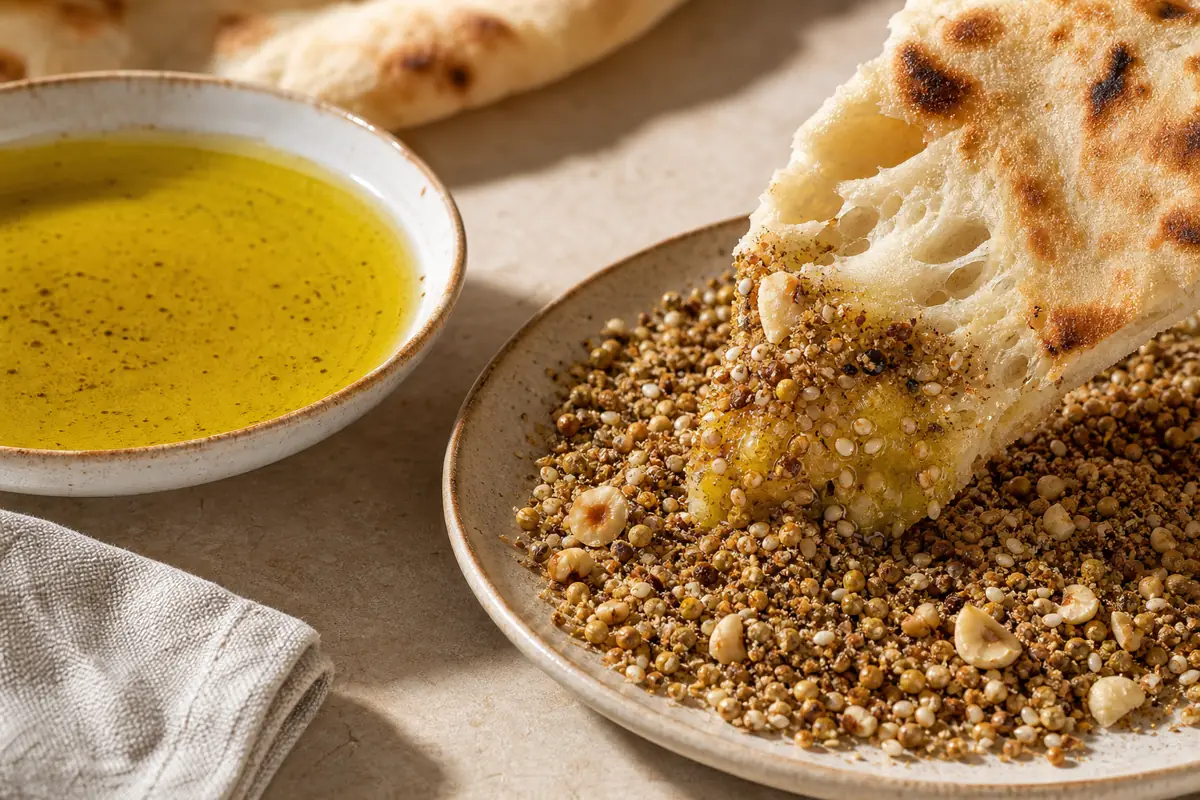
Dukkah is an Egyptian mixture of toasted nuts, sesame, coriander, cumin, pepper, and salt. Toast the components separately, cool them fully, and crush them into uneven crumbs so the blend stays dry and crunchy.
What is dukkah made of?
Dukkah is an Egyptian mixture of toasted nuts, sesame seeds, whole spices, salt, and pepper crushed into dry, uneven crumbs.
Hazelnuts are common, but almonds, pistachios, peanuts, and mixed nuts also appear. The nut supplies most of the crunch and richness.
Sesame fills the gaps with smaller crisp seeds and a roasted aroma. Many useful mixtures leave some seeds completely whole.
Whole coriander seeds bring citrus and a light floral note that lifts the heavier toasted nuts.
Cumin gives an earthy, savory base, while black pepper provides dry heat. Salt makes the mixture work as a finishing condiment.
| Component | Common choices | What it contributes | Main risk |
|---|---|---|---|
| Nuts | Hazelnut, almond, pistachio | Large crunchy pieces and richness | Turning oily in the processor |
| Small seeds | Sesame | Fine crisp texture and roasted aroma | Burning before nuts toast |
| Fragrant seeds | Coriander, cumin, fennel | Citrus, earth, and sweetness | Grinding into stale powder |
| Seasoning | Salt and black pepper | Savory finish and dry heat | Hiding nut flavor |
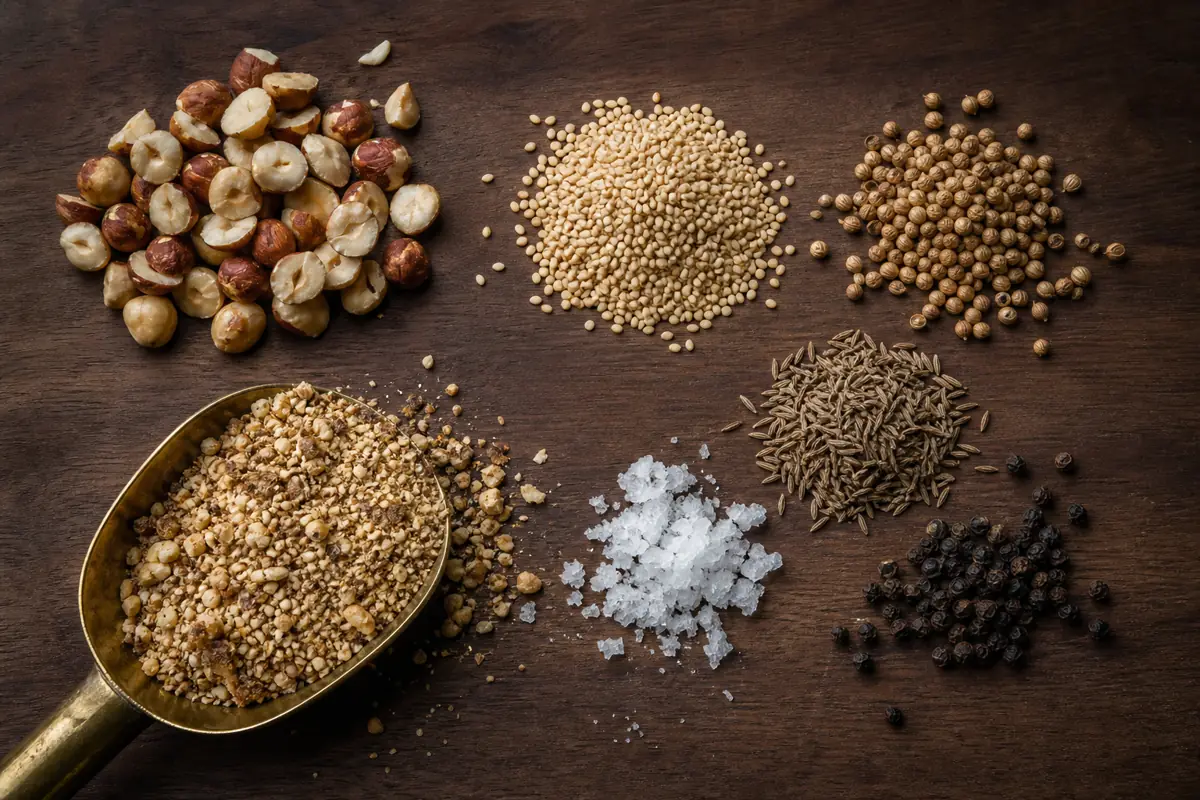
- Nuts form the largest pieces.
- Sesame stays partly whole between the nut crumbs.
- Coriander and cumin can be finer because they season every bite.
Dukkah formulas vary across families and vendors, so no single nut is mandatory. The stable identity comes from toasted crunch and crushed spice.
A practical starting structure uses about half nuts, one quarter sesame, and one quarter fragrant spices plus seasoning.
That proportion is a testing frame rather than a rule. More sesame makes finer crunch, while more nuts make larger, richer crumbs.
That structure separates it from za'atar seasoning, where dried herbs, sumac, and sesame lead without a nutty crumb base.
What does dukkah taste like?
Toasted nuts first, then sesame, then a warm spice edge that arrives last. It reads as savoury and nutty rather than hot, and most versions carry no chilli at all.
The texture is half the flavor.
Coarse fragments give small bursts of sesame and coriander instead of the even seasoning a powder would deliver, which is why grinding dukkah too far ruins it.
Salt sits further forward than in most spice blends.
A good dukkah tastes seasoned on its own, because it was built to be eaten straight from the bowl on oiled bread rather than stirred into something already salted.
The spice side is usually coriander and cumin, with the coriander leading. That combination reads as citrus over earth, which keeps a bowl of toasted nuts from tasting heavy.
Freshness shows up as smell rather than taste.
A stale jar still tastes of salt and crunch while the aroma has quietly gone, and that is the point at which most people decide dukkah is boring.
- First: Toasted nuts, usually hazelnut or almond.
- Then: Sesame, which carries most of the aroma.
- Behind them: Coriander leading and cumin underneath, reading as citrus over earth.
- Throughout: Salt, further forward than in most blends.
- Not present: Heat. A standard dukkah has little or no chilli.
Why should you toast dukkah ingredients separately?
Toast dukkah ingredients separately because nuts, sesame, and whole spices reach their fragrant stopping points at different speeds.
Nuts usually need several minutes in a dry pan or oven. They are ready when their aroma strengthens and their surfaces deepen slightly.
Sesame seeds can turn from pale to bitter very quickly. Move them constantly and remove them when they become lightly golden.
Coriander and whole cumin seeds often need about a minute in a warm pan. Stop when they smell distinct.
Residual heat keeps browning small ingredients after the burner stops. Tip every finished batch onto a cool plate rather than leaving it in the pan.
An oven gives nuts even heat, while a skillet makes sesame easier to watch. Use the tool that exposes the stopping cue.
- Nuts: Toast until fragrant and lightly colored, then check the center of one before stopping.
- Sesame: Stir constantly and remove at pale gold because the seeds continue darkening off heat.
- Whole spices: Warm only until aroma rises clearly; smoke means the pan is too hot.
- Cool fully: Keep every component spread out until no warmth remains before grinding.
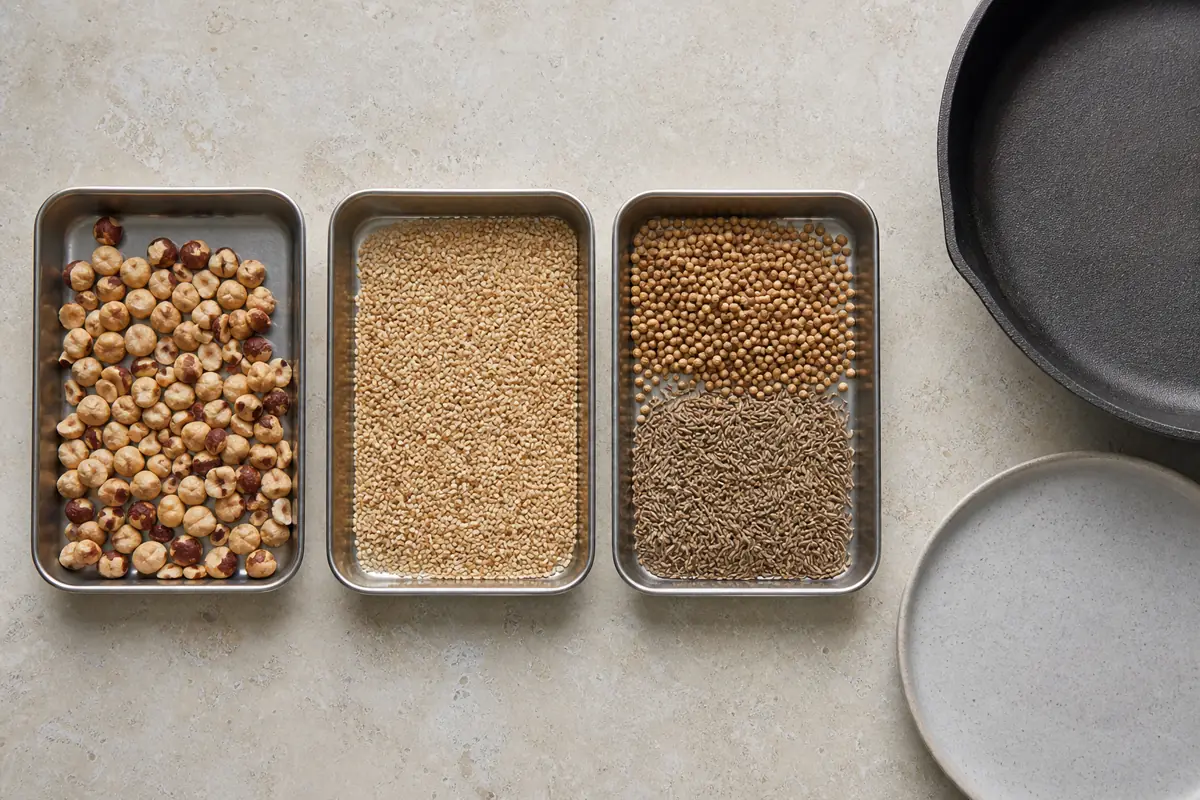
- Nuts need color through their thicker centers.
- Sesame needs constant movement and an early exit.
- Whole spices need fragrance rather than deep browning.
The same dry-toasting method applies to many spices, but dukkah adds a fat-rich nut that needs a longer, gentler stage.
Discard scorched sesame or blackened cumin. Mixing a burned component into fresh nuts spreads bitterness through the entire batch.
How coarse should dukkah be?
Dukkah should resemble coarse sand mixed with small nut pebbles, not flour and not nut butter.
Cool every ingredient first. Warm nuts release oil faster and can smear against the processor bowl before they break cleanly.
Grind the coriander, cumin, pepper, and salt relatively fine because their job is to season the larger pieces evenly.
Chop or pulse the nuts separately until most pieces are between sesame-seed size and small lentil size.
Add sesame near the end so many seeds survive whole. Their tiny crackle helps dukkah feel crisp rather than sandy.
| Texture | Visible cue | Best use | Problem |
|---|---|---|---|
| Coarse crumbs | Uneven nuts and whole sesame | Bread dipping and finishing | Can fall from very smooth food |
| Medium crush | Mostly sesame-sized pieces | Crusting fish and vegetables | Loses some dramatic crunch |
| Fine powder | No clear nut pieces | Mixing into dough or batter | Tastes dry when sprinkled |
| Oily paste | Clumps and smears | Not a useful dukkah texture | Nut oils have released |
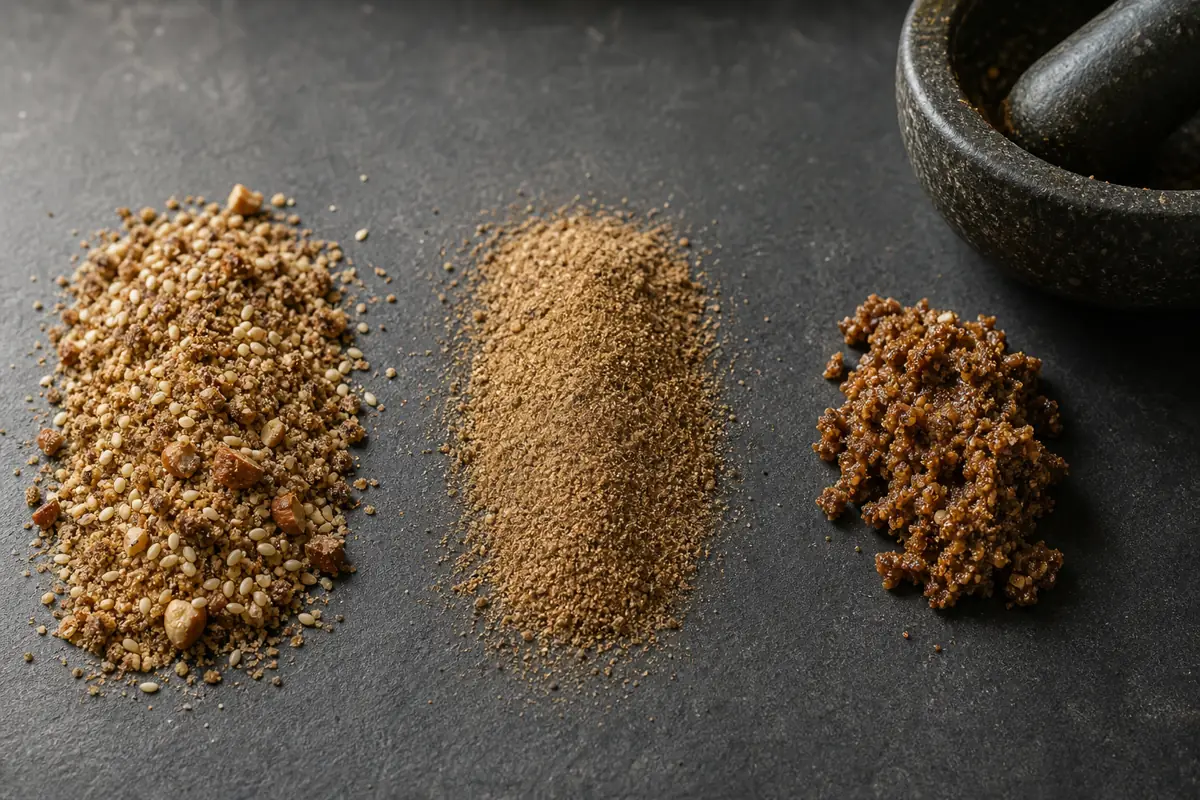
- Spices may be finer than nuts.
- Sesame stays partly whole.
- The mixture pours freely rather than sticking to the bowl.
Short pulses provide more control than a continuous run. Shake the bowl between pulses so large pieces reach the blade.
A mortar gives excellent control for a small batch. Crush spices first, then pound nuts lightly and fold in sesame.
If the blend starts clumping, stop immediately and fold in more separately chopped nuts and sesame. Do not process the repair again.
Choosing whole spices before grinding also protects aroma until the moment you build the mixture.
How do you eat dukkah with bread and olive oil?
Eat dukkah by dipping bread into olive oil first, then pressing the oiled surface into a separate dish of the dry mixture.
Warm flatbread or crusty bread works because its torn surface catches oil and crumbs. A smooth sealed crust holds less.
Use enough oil to make the bread tacky without saturating it. Excess oil fills the gaps and makes dukkah slide off.
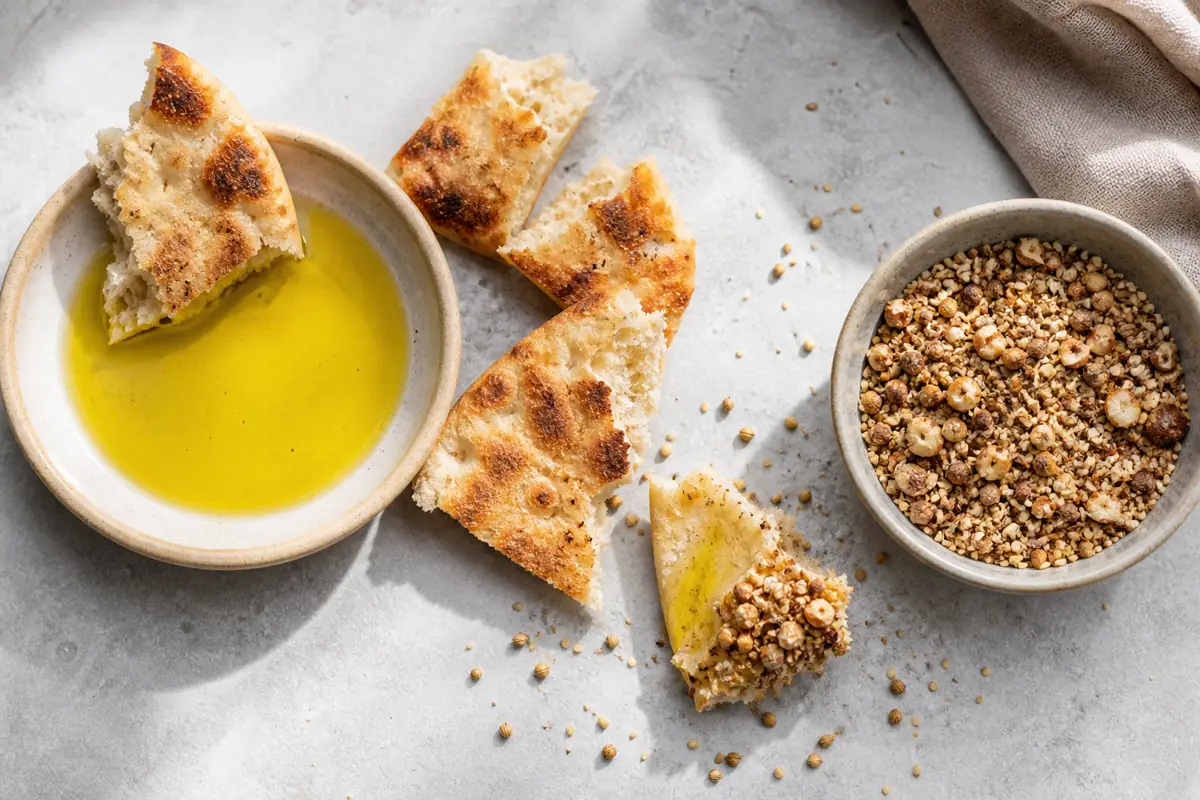
- Tear bread to expose a rough surface.
- Touch the bread lightly to oil.
- Press the coated edge into dukkah and eat immediately.
Separate dishes keep the jar's contents dry and let each person control the ratio. Premixing a large bowl softens the nuts.
Choose an olive oil you enjoy tasting plainly. Dukkah supplies roasted aroma, salt, and texture rather than hiding stale oil.
A small pinch of tart sumac can brighten a heavy nut mixture, but it changes the classic coriander-cumin balance.
Is dukkah the same as zaatar?
Both are dry blends eaten with oiled bread, and they taste nothing alike. Confusing them at the shop is easy and confusing them in a dish is obvious.
Dukkah is Egyptian and built on toasted nuts.
Hazelnut or almond carries it, sesame and coriander fill it out, and the whole thing is dry and crunchy by design.
Zaatar is Levantine and built on dried herb and sumac.
The sourness of sumac is its defining note. A traditional mix contains no nuts at all, which matters for anyone cooking around an allergy.
The textures differ as much as the flavors.
Dukkah stays coarse and separate so it clings to oil, while zaatar is finer and turns to a paste when it meets olive oil.
Neither one substitutes for the other. Reaching for zaatar when a recipe asks for dukkah gives sourness where crunch was wanted, and the reverse gives nuts where acidity was the point.
| Dukkah | Zaatar | |
|---|---|---|
| Origin | Egypt | The Levant |
| Built on | Toasted nuts and sesame | Dried herb and sumac |
| Defining note | Nutty and warm | Sour and herbal |
| Texture | Coarse, stays separate | Finer, turns to paste in oil |
| Nuts | Yes, usually hazelnut or almond | No, in a traditional mix |
What foods can you use dukkah on?
Use dukkah where a soft, moist, or creamy food needs toasted crunch at the final moment.
Sprinkle it over eggs after cooking so steam does not soften the crumbs. Soft yolk holds the mixture especially well.
Roasted carrots, squash, cauliflower, and beets give dukkah a sweet browned base. Add the blend after the tray leaves the oven.
Press a medium grind onto fish or chicken before searing, but watch the heat. Exposed sesame and nuts can scorch.
Yogurt, hummus, and thick bean purées catch coarse crumbs without needing extra oil. Soup needs dukkah only at serving.
- Eggs: Add after cooking so yolk catches the crunchy mixture.
- Roasted vegetables: Sprinkle after browning to preserve the toasted nuts.
- Fish or chicken: Use a medium crush and moderate pan heat to protect sesame.
- Yogurt and hummus: Finish each portion separately so leftover dukkah stays dry.
- Soup and grains: Add at the table after hard steam settles.
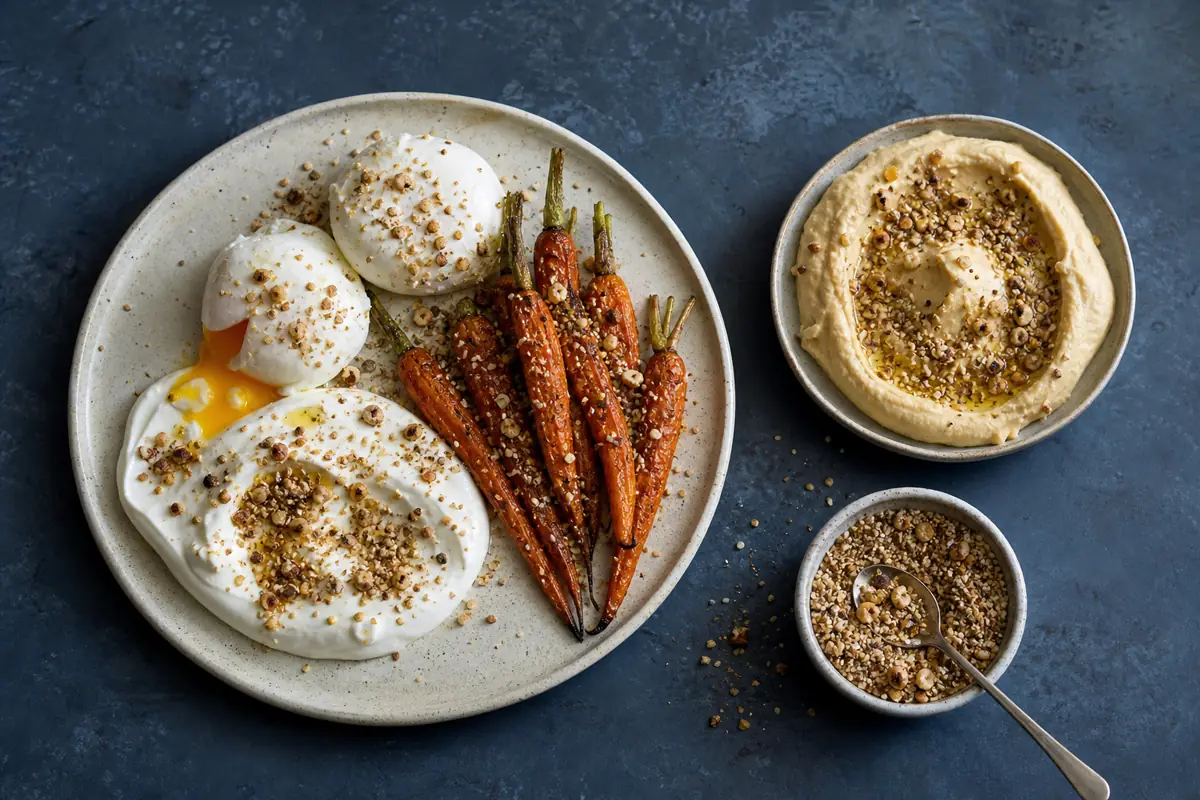
- Add dukkah after wet cooking finishes.
- Use a medium crush for a cooked crust.
- Keep the serving jar away from steam.
Dukkah belongs in a broader Middle Eastern pantry, yet its texture makes it behave more like a finishing condiment.
Add it late. Extended simmering gives away the quality that makes dukkah distinct from an ordinary ground spice blend.
Can you cook with dukkah, or only sprinkle it?
Dukkah is a finishing blend, and heat undoes most of what it is for. The nuts were already toasted once, so a second round in a hot pan takes them past fragrant and into bitter.
That rules out stirring it into a sauce.
Simmering softens the fragments until the crunch disappears, and crunch is the reason dukkah exists rather than a nice extra it happens to have.
There is one heat it survives.
A short spell under a grill or in a hot oven on top of something already cooked works, because the blend browns on the surface without sitting in liquid. Roasted carrots finished with dukkah for the last three minutes come out well.
Use it as a crust rather than as a seasoning.
Press it onto oiled fish or chicken before a short bake and it holds together as a coating, which is a different job from dissolving into the dish.
Add it after the plate is dressed, not before.
Dukkah clings to oil and goes soggy in water, so it belongs on top of the dressing rather than tossed through a wet salad and left to sit.
- Sprinkle: On oiled bread, hummus, eggs, roasted vegetables, and yoghurt. Its natural home.
- Short grill or bake: Fine on top of food that is already cooked.
- As a crust: Pressed onto oiled fish or chicken before a short bake.
- Not in a sauce: Simmering destroys the crunch that is the whole point.
- Not in advance: It goes soggy once it sits in anything wet.
Can dukkah be nut free?
Dukkah can be nut free when pumpkin and sunflower seeds replace the large nut pieces, but sesame may still create an allergy concern.
Pumpkin seeds provide broad crunchy pieces and a green, savory flavor. Sunflower seeds give a smaller, milder crumb.
Keep sesame only when every diner can eat it. A nut-free label does not mean the mixture is safe for someone with sesame allergy.
| Replacement | Texture | Flavor change | Starting share |
|---|---|---|---|
| Pumpkin seeds | Large firm crunch | Green and savory | About half the mixture |
| Sunflower seeds | Small tender crunch | Mild and roasty | About one quarter |
| Sesame seeds | Tiny crisp pieces | Deep toasted aroma | About one quarter |
| No sesame | Less fine crackle | Cleaner seed flavor | Split between pumpkin and sunflower |
Toast each seed separately just as you would nuts. Pumpkin seeds need longer, while sesame can darken in seconds.
Use a clean pan, processor, and storage jar when allergy safety matters. A shared grinder can transfer invisible nut residue.
Commercial seed blends also need label checks because factories may process tree nuts, peanuts, and sesame on shared equipment.
State the full ingredient list when serving. Dukkah varies enough that the name alone never proves whether nuts or sesame are present.
Gluten is a separate question from the nuts, and the answer is usually no.
Nuts, sesame, coriander, cumin, and salt contain none of it.
Some commercial blends stretch the mix with breadcrumbs or wheat rusk. That is cheap bulk rather than tradition, so the ingredient panel stays the only reliable check on any jar you did not toast and mix yourself at home.
How long does dukkah last?
Dukkah tastes best within several weeks because crushed nuts and seeds expose oils that oxidize faster than whole spices.
Cool every toasted component before sealing the jar. Trapped warmth creates condensation that softens crumbs and encourages spoilage.
Keep a small working jar airtight in a cool cupboard when you will finish it quickly. Refrigerate larger or slower batches.
Freezing protects extra mixture for longer storage. Divide it into small dry containers so only one portion warms at a time.
- Fresh aroma: Toasted nuts and coriander should smell clear immediately after the jar opens.
- Good texture: The mixture should pour freely without damp clumps.
- Rancid warning: Paint-like, waxy, or stale-oil odor means the nuts have oxidized.
- Moisture warning: Mold or persistent damp clumps require discarding the whole batch.
Use a dry spoon and keep the jar away from steam. One wet utensil can ruin crunch before the oils become stale.
General spice storage guidance still matters, but dukkah's crushed nuts make its useful life shorter than cumin or coriander.
Make smaller batches if you use dukkah only for occasional bread service. Freshly toasted crumbs justify the extra preparation.