
Spice Measurement Conversions: When Does Volume Fail?
Grams per teaspoon, whole against ground, fresh against dried, and where the error actually matters.
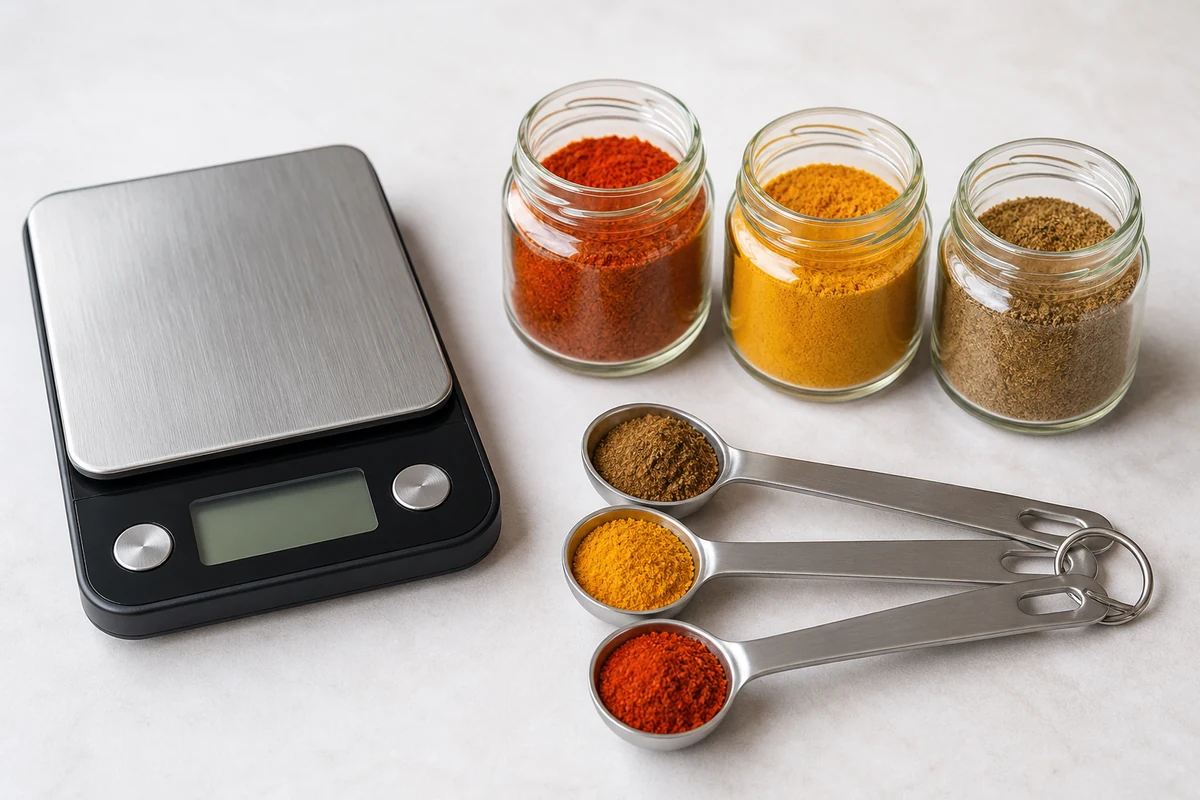
A teaspoon measures space, not weight, and a teaspoon of ground cinnamon holds roughly a third of the mass that a teaspoon of fine salt does. That is why conversions between spices only work in grams, and why a few volume rules are still worth keeping.
Why does a teaspoon of each spice weigh differently?
Every volume measurement answers the same question, which is how much room something takes up.
That works for water, where a milliliter and a gram are effectively the same thing. It stops working the moment the ingredient is a powder, because powders differ in how densely they pack.
Ground spices sit at the extreme end of that problem. They are light, fluffy and full of air, and how hard they were pressed into the spoon changes the answer.
- A level teaspoon
- About 5 milliliters of space, whatever is in it
- Ground cinnamon
- Roughly 2.5 grams in that space
- Fine table salt
- Roughly 6 grams in the same space
- The gap
- The same spoon, more than twice the weight
So two recipes that both say one teaspoon can be asking for very different amounts of material. The spoon was never the variable.
How many grams are in a teaspoon of spice, and when does the error matter?
The table below is a working guide rather than a specification, and it is worth understanding why no such table can be exact.
Grind size changes density, so a coarse home grind and a fine commercial powder do not weigh the same.
Moisture changes it too, and so does whether the spoon was leveled, heaped, or dipped into the jar and shaken.
| Spice | Roughly, in grams | Notes |
|---|---|---|
| Fine table salt | 6 | The heaviest thing in most spice racks |
| Coarse sea salt | 4 to 5 | Larger crystals leave more air |
| Ground black pepper | 2.5 | Coarser grinds weigh less |
| Ground cinnamon | 2.5 | Light and very compressible |
| Ground cumin | 2 | One of the lightest |
| Paprika | 2.5 | Packs down easily, so level it |
| Ground ginger | 2 | Fluffy and prone to lumping |
| Whole cumin seed | 3 | Seeds pack more tightly than powder |
| Whole black peppercorns | 3.5 | Hard, dense, consistent |
Treat those as within about twenty per cent rather than exact. If a difference of twenty per cent would ruin your dish, the answer is a scale rather than a better table.
The practical reading is the ranking rather than the numbers. Salt is heavy, seeds are middling, ground spices are light, and any conversion that ignores this will be wrong in a predictable direction.
Not every recipe cares, and knowing which ones do is more useful than weighing everything.
A stew taking two teaspoons of cumin is forgiving, since a twenty per cent error there is not detectable. Baking, curing and anything involving salt is not forgiving at all.
| What you are making | Volume is fine | Weigh it |
|---|---|---|
| A stew, soup or braise | Yes | Only if you are scaling it up a lot |
| A spice blend to keep | No | Yes, or the next batch differs |
| Curing or brining | No | Always, salt errors are not recoverable |
| Baking with spice | Usually | If the spice is also a drying agent |
| A single portion | Yes | No |
| Ten portions | No | Yes, errors multiply |
Salt deserves its own warning because the same word covers products that differ by nearly half.
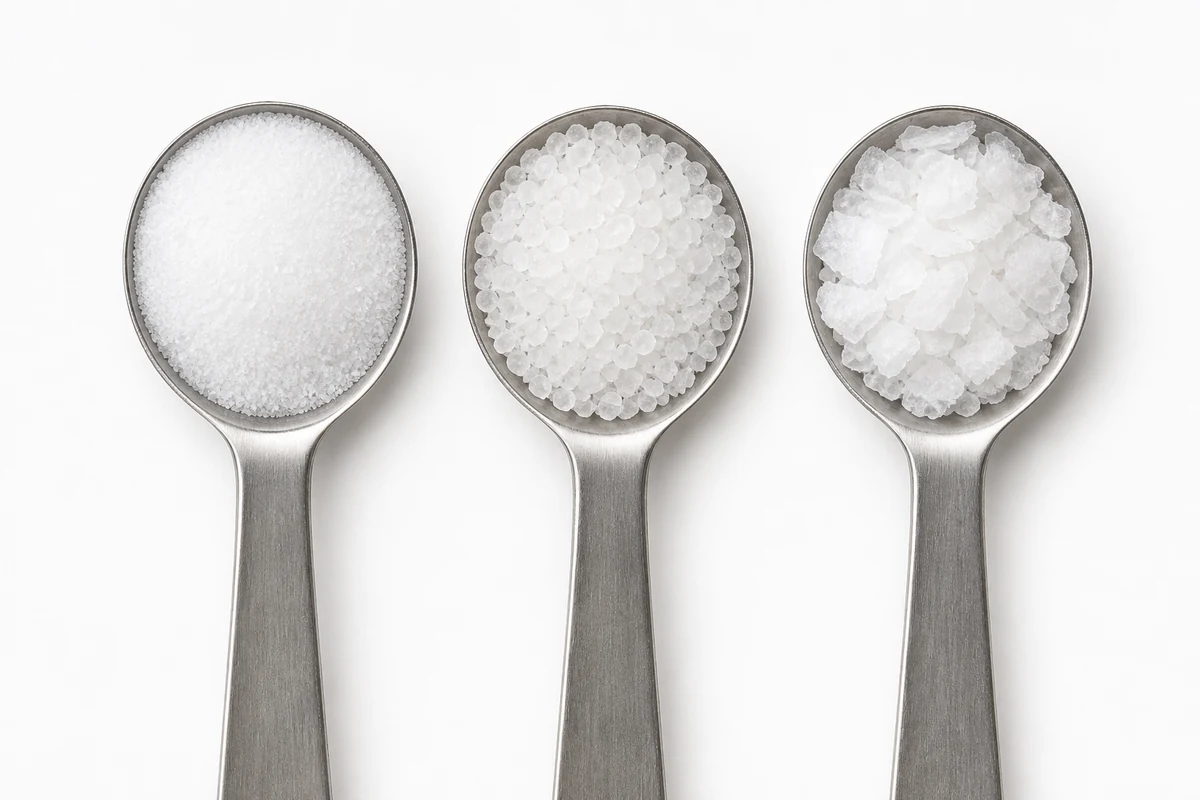
- Fine table salt: Small dense crystals, the heaviest spoonful.
- Coarse kosher salt: Larger crystals, noticeably lighter.
- Flaky sea salt: Hollow flakes, the lightest of the three by some margin.
How do you convert whole spices to ground?
This is the conversion people most often need and most often guess at.
Grinding does not change the mass of a spice, but it changes the volume considerably. Whole seeds have gaps between them, and grinding fills those gaps with the seed itself.
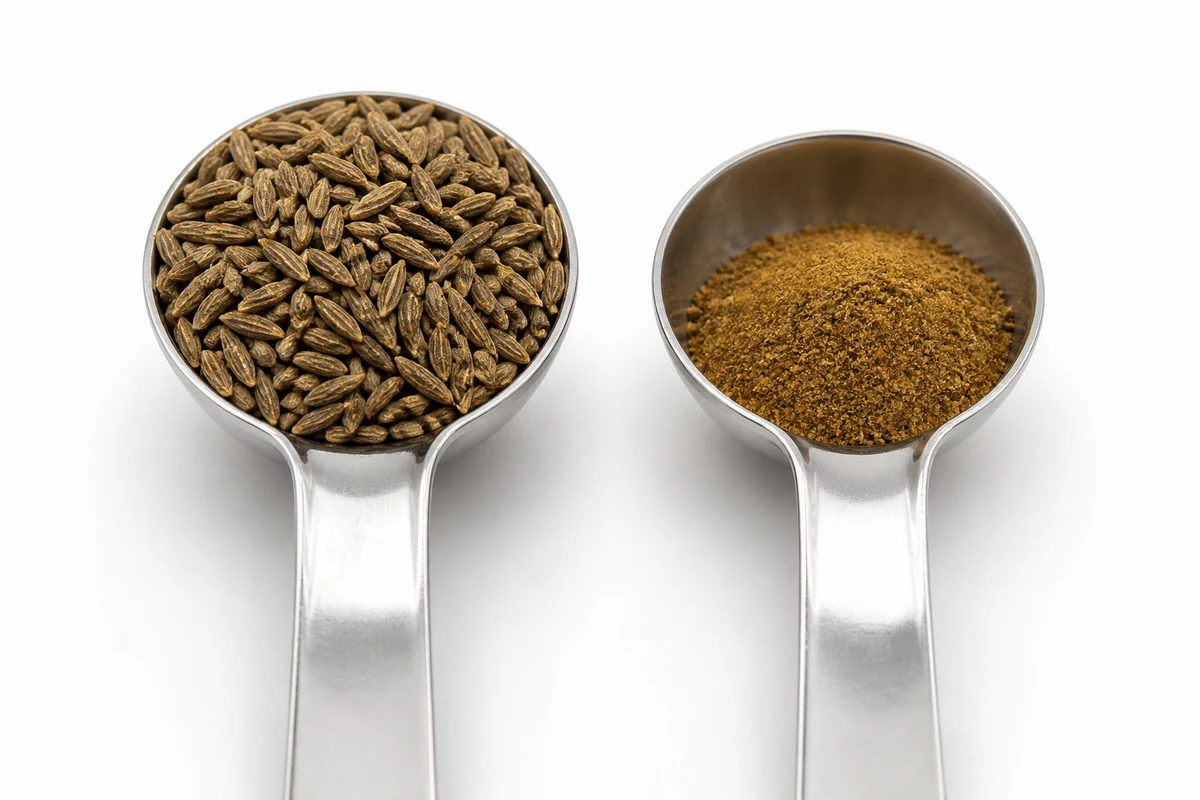
- Left: One teaspoon of whole seed, with air between the seeds.
- Right: The same seed ground, taking up less space.
- The rule: Ground is stronger by volume, so use a little less of it.
For seeds, a teaspoon of whole spice grinds down to somewhat less than a teaspoon of powder, which means ground is more concentrated spoon for spoon.
| Whole | Gives roughly | Note |
|---|---|---|
| 1 tsp cumin or coriander seed | A scant 1 tsp ground | Ground is slightly stronger by volume |
| 1 tsp black peppercorns | About 1.5 tsp ground | Cracking opens the corn up considerably |
| 1 cinnamon stick, 8 cm | About half a teaspoon ground | Varies with the thickness of the quill |
| 1 whole nutmeg | About 2 to 3 tsp grated | Grate what you need and keep the rest whole |
| 6 cardamom pods | About half a teaspoon of ground seed | The husk is discarded, so the loss is large |
| 1 tsp whole cloves | About 3/4 tsp ground | Cloves are dense and grind fine |
Aroma complicates the arithmetic in the right direction. Freshly ground spice is stronger than an old jar of the same powder regardless of what the scale says, so a conversion that is technically correct may still overshoot.
How do you convert fresh herbs to dried?
Drying removes water and concentrates everything else, and the ratio is more consistent than most kitchen rules.
Three to one is the working figure. A tablespoon of chopped fresh herb is roughly a teaspoon of the dried equivalent.
That holds well for the sturdy herbs. Oregano, thyme, rosemary and sage all dry successfully, and the substitution behaves.
It fails for the soft ones, and not because of the ratio. Dried basil, parsley, chives and coriander leaf lose the aromatics that made them worth using in the first place.
No quantity of the dried version reproduces the fresh one, and how to dry herbs covers which herbs are worth drying at all.
- Sturdy herbs: use one third the volume when swapping fresh for dried.
- Add dried early, since it needs liquid and time to open up.
- Add fresh late, since heat destroys what you wanted from it.
- Crush dried leaves between your fingers as they go in.
- For soft herbs, change the plan rather than the quantity.
How much error comes from the spoon and the way you fill it?
Two cooks can measure the same teaspoon from the same jar and be a fifth apart, before any conversion is involved.
Dipping the spoon into the jar and lifting it out compacts the powder, especially if the jar has been sitting and the contents have settled.
Spooning the powder in loosely and levelling it with a knife gives a lighter, more repeatable measure. That is the method any published gram figure assumes.
- Loosen it firstStir or shake the jar, since settled powder packs denser.
- Spoon it inLift powder into the measure rather than scooping through it.
- Level itSweep across the top with the back of a knife.
- Do it the same way every timeConsistency matters more than which method.
- For sticky spicesGinger and paprika lump, so break them up before measuring.
None of this makes volume accurate. It makes it repeatable, which for a recipe you cook often is most of what you needed.
This one catches people who cook from recipes written abroad, and there is no way to detect it from the recipe.
A metric teaspoon is 5 milliliters and a United States teaspoon is 4.93, which is close enough to ignore. The tablespoon is where it goes wrong.
An Australian tablespoon is 20 milliliters, while the British and American ones are 15. A recipe written in Sydney and cooked in London is out by a third on every tablespoon in it.
| Where the recipe is from | One tablespoon | Effect on a British spoon |
|---|---|---|
| United States | 14.8 ml | None worth noticing |
| United Kingdom and Europe | 15 ml | The baseline |
| Australia and New Zealand | 20 ml | A third more than you intended |
| An old British recipe | Sometimes 17.7 ml | Rare, but it exists in older books |
For a stew this is invisible. For a spice blend you are making in quantity, or for anything salted, it is the difference between the recipe you meant to follow and another one.
Cup measures carry the same problem at a larger scale, and the gap is wider. An American cup is 237 milliliters against 250 in Australia and much of Europe, so a cup of anything is out by around five per cent before the ingredient is considered.
How many teaspoons are in a spice jar?
Buying decisions need a different conversion, which is between the jar on the shelf and the number of times you will cook with it.
Supermarket spice jars are small, and they are sold by weight rather than volume.
That makes the arithmetic easy once you know roughly what a teaspoon of the thing weighs.
| Jar size | Ground spice, roughly | Whole spice, roughly |
|---|---|---|
| 30 g | 12 to 15 teaspoons | 10 teaspoons |
| 50 g | 20 to 25 teaspoons | 16 teaspoons |
| 100 g | 40 to 50 teaspoons | 33 teaspoons |
| Large bag, 500 g | Around 200 teaspoons | Around 165 teaspoons |
That last row is why the bulk bag is a trap for anything ground. Two hundred teaspoons is several years of ordinary cooking, and ground spice does not keep for several years.
The useful calculation runs the other way. Work out how often you actually use a spice, multiply by the amount per use, and buy roughly six months of it.
A spice you use twice a month at a teaspoon a time needs about 30 grams a year. A 100 gram jar of it is not a saving, whatever the price per gram says, and this is the arithmetic behind buying guides.
What do pinch, dash, and to taste mean?
Recipes fall back on these when precision is not the point, and they are more consistent than they look.
A pinch is what you can pick up between thumb and forefinger, which lands at around an eighth of a teaspoon for most powders.
A dash is a touch more, roughly a sixteenth to an eighth for liquids and about the same for powders, and the word survives mainly in old cookbooks and cocktail recipes.
| What the recipe says | Roughly | When it is used |
|---|---|---|
| A pinch | 1/8 tsp | Salt, chile, anything easy to overdo |
| A dash | 1/8 tsp, less for liquids | Mostly older recipes |
| A knob or a nut | Around a tablespoon | Butter and fresh ginger |
| To taste | Start at half what you think | Salt, acid, heat |
| A generous teaspoon | A heaped one, so about 1.5 | Mild bulk spices only |
To taste is the one that carries real information. It is telling you that the correct amount depends on your ingredients rather than on the recipe, and that the author expected you to check.
Can a scale account for spice freshness?
There is one thing no conversion on this page can capture, and it undoes all of them.
Two grams of cumin ground this morning and two grams from a jar opened three years ago weigh exactly the same and do not taste remotely the same.
Volatile aromatic compounds are a tiny fraction of a spice by mass, so losing nearly all of them barely registers on a scale. The powder that is left is mostly the parts that carry no aroma.
This is why an experienced cook increases the amount of an old spice rather than trusting the recipe. It is also why the best measurement improvement available is usually a fresher jar rather than a better spoon.
Should you multiply every spice when scaling a recipe?
Doubling a recipe does not mean doubling every spice, and this is where careful measuring still produces a bad dish.
The mild bulk spices scale straight. Cumin, coriander, paprika and turmeric can be multiplied by whatever factor you like.
The assertive ones do not. Clove, bay, cinnamon, star anise, chile and anything bitter build faster than the volume of the dish, so doubling them tips a balanced pot into medicinal.
| Spice group | Scale it by | Why |
|---|---|---|
| Cumin, coriander, paprika, turmeric | The full factor | Mild, and they carry bulk flavor |
| Black pepper, ginger, mustard | The full factor, then taste | Heat builds slightly |
| Clove, star anise, bay, cinnamon | About one and a half times | Assertive and quick to dominate |
| Chile of any kind | One and a half, then adjust at the end | Heat is easy to add and impossible to remove |
| Salt | Weigh it, do not multiply spoons | Errors compound and cannot be reversed |
Cooking time is the hidden reason. A doubled pot takes longer, and a longer cook extracts more from every whole spice in it, so the same quantity produces a stronger result.
When should you stop converting and use a scale?
A cheap digital scale reading to one gram removes almost everything on this page.
It also solves the problem that no conversion table can, which is that your grind, your jar and your spoon are not the ones the table was built from.
Keep the spoons for cooking that adjusts as it goes. A stew you taste four times does not need a scale, and reaching for one there is precision spent where it changes nothing.
Every gram figure on this page was measured from somebody else's jar, with their grind and their packing, and yours will differ.
Fixing that takes about ten minutes and once. Put a bowl on the scale, zero it, level one teaspoon of a spice into it, and write the number on the jar label.
Do that for the eight or ten spices you actually cook with and the guesswork ends. A recipe calling for two teaspoons becomes a number you can weigh, in your kitchen, from the jar you own.
Redo it when you change supplier or start grinding your own, since both of those change the density more than any rounding on this page did.
It is a small piece of work that removes the need for every table above, which is the honest end point for a page about conversions.