
Which Spices Did Ancient Egyptians Actually Use?
Separate kitchen condiments from incense, embalming materials, elite imports, and modern reconstruction.
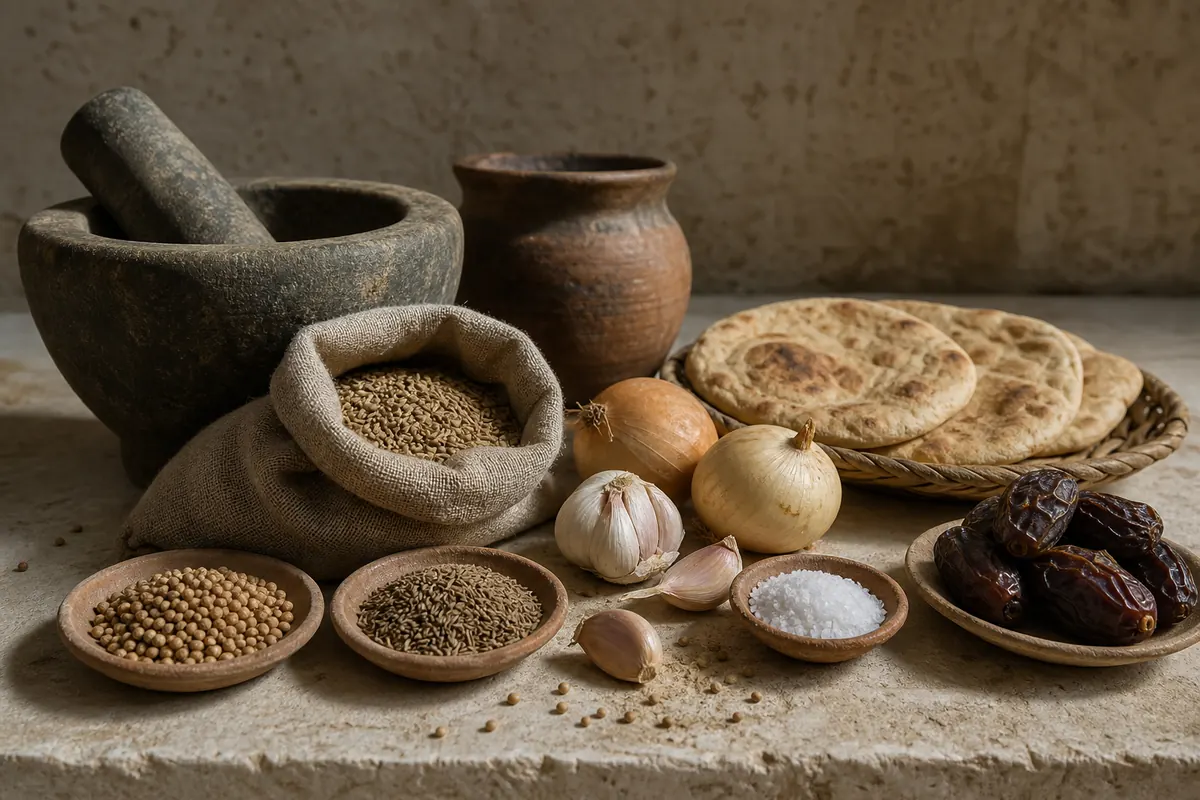
Cumin, coriander, garlic, onion, salt, and herbs have stronger food evidence than many famous imported aromatics. Judge each claim by date and context because incense, medicine, funerary materials, and later trade do not automatically prove a recipe.
What can we prove was seasoned in ancient Egypt?
Spices in ancient Egypt appear through plant remains, written lists, tomb scenes, vessel residues, and later classical accounts.
No single source describes every kitchen.
Cumin and coriander have strong evidence as condiments. Garlic, onion, salt, lettuce, dill-like herbs, and other plants also shaped daily food.
Evidence must carry a date. Predynastic, New Kingdom, Ptolemaic, Roman, and Late Antique Egypt did not share one fixed ingredient supply.
| Evidence | What it supports | Main limit |
|---|---|---|
| Seed or plant remains | The plant was present at a site | Use may still be uncertain |
| Food or ration text | An ingredient entered an economic or meal system | Names can be hard to identify |
| Kitchen vessel residue | A substance contacted a container | Contamination and reuse matter |
| Tomb painting or model | A valued activity or offering was represented | Images can be symbolic |
| Later writer | A practice was known in that later period | It may not describe earlier Egypt |
A written list also reflects the institution that made it. Temple, tax, medical, and ration records preserve different parts of food life.
The UCL Digital Egypt record guide stresses that surviving texts have gaps and changing purposes. Silence in one record type is not proof that a household never used an ingredient.
The safest statement names the plant, period, place, and evidence. A long list without those details usually mixes food, medicine, perfume, and ritual.
This method keeps history useful. It also stops modern spice blends from being presented as an unchanged ancient recipe.
Cumin and coriander belong to food, not only tomb lore
Cumin and coriander seeds are among the clearest culinary condiments connected with Egypt.
Both store well and release aroma after crushing or grinding.
The British Museum linen bag EA53928 from Antinoupolis contains both seeds. The museum dates the object broadly from the first to eighth centuries CE.
That late object cannot stand as a New Kingdom meal by itself. Its curator notes instead point to specialist research documenting earlier Egyptian use.
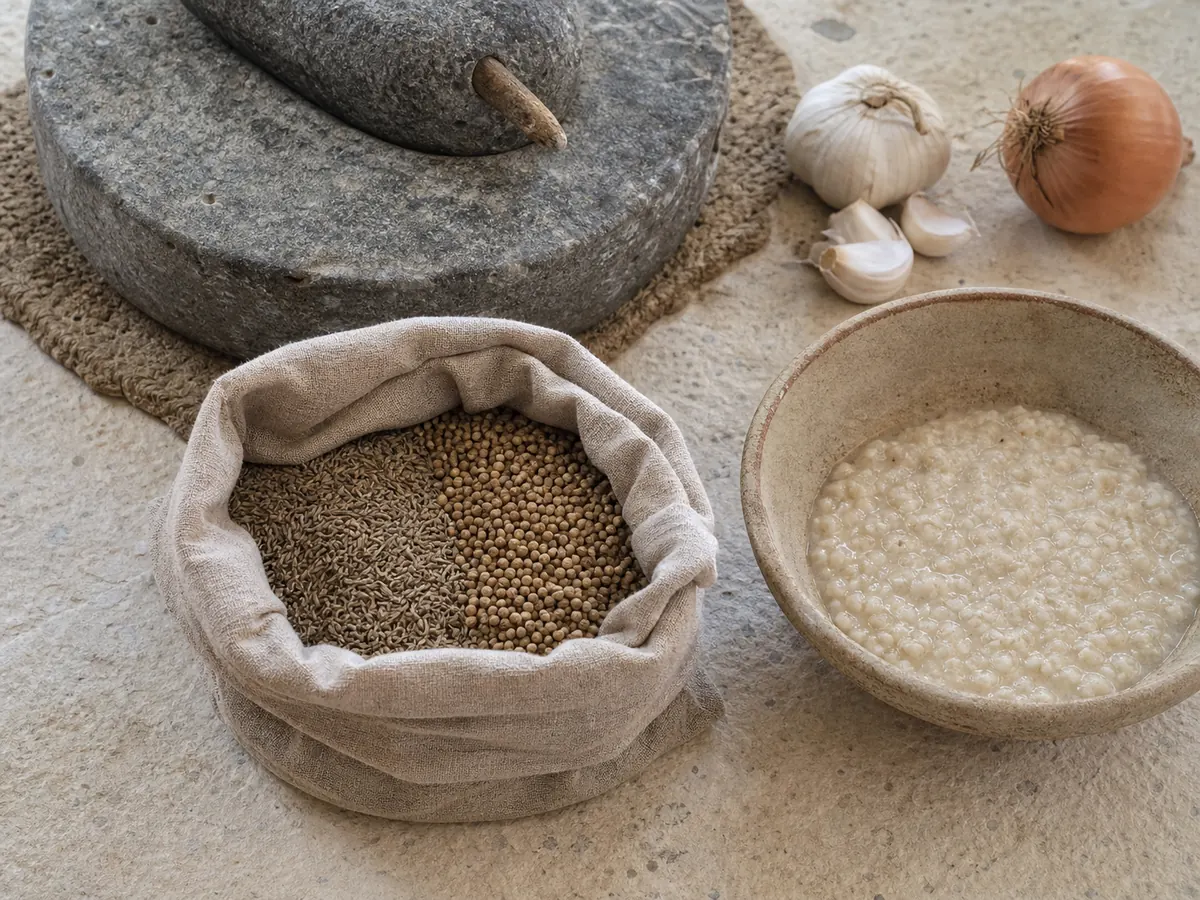
- Seed shape: Whole remains can support botanical identification.
- Grinding: A stone tool makes hard seeds usable in food.
- Meal context: Bread, porridge, vegetables, or meat explain a culinary job.
- Date: The object and the practice may come from different periods.
Cumin adds earthy bitterness and warmth, while coriander seed brings citrus lift. The pairing still works because the seeds pull in different directions.
Whole seeds also survive transport and storage better than fresh leaves. Their physical durability helps explain why archaeology can see them.
Grinding marks or a kitchen findspot strengthen a food interpretation. A seed in a burial can also be an offering rather than a dinner trace.
Modern cooks should not infer a fixed cumin-to-coriander ratio. The evidence supports ingredients more securely than exact recipes.
Garlic, onion, herbs, and salt mattered more than exotic lists
Daily Egyptian food centered on bread, beer, onions, garlic, legumes, vegetables, dates, and available fish or meat. Seasoning worked inside that staple system.
Onion and garlic supplied sharp sulfur aroma and sweetness after cooking. Salt preserved food and changed taste, while fresh or dried herbs added local green notes.
Imported exotica attracts more attention because rarity leaves dramatic stories. Everyday aromatics likely affected more meals.
The Nile flood shaped planting toward cool-season crops after inundation. Grain storage and predictable staples mattered before a cook chose any rare aromatic.
Bread and beer dominate many records because institutions could count, move, and distribute cereal. A condiment changed those staples without replacing their economic importance.
- Bread and porridge: Grain foods provided the base that salt, seeds, onions, or dates could change.
- Beer: Brewing created daily nourishment and ceremonial drink, with flavor varying by context and period.
- Legumes and vegetables: Garlic, onion, herbs, and salt made modest plant foods more satisfying.
- Fish and meat: Salting, drying, and aromatic seasoning helped with flavor and keeping quality.
- Dates and honey: Sweetness belonged to food and drink without making every preparation a dessert.
Black pepper, cinnamon, and other distant aromatics reached Egypt through changing networks, especially later. Their presence cannot be projected back into every dynasty.
The broader spice trade history explains why ports and political control changed access. Egypt sat between African, Mediterranean, and Red Sea systems.
A realistic pantry begins with staples and local aromatics. Rare imports should remain the exception unless evidence places them in a specific setting.
Incense was not dinner seasoning
Ancient Egyptian temples burned incense during purification and offerings. Fragrant resins also entered perfume, ointment, medicine, and funerary preparation.
Even a translated name such as cinnamon bark needs caution. Ancient plant terms and modern botanical species do not always align.
Those uses matter, but they do not automatically make frankincense, myrrh, or every aromatic resin a common cooking ingredient.
| Context | Aromatic job | Evidence needed |
|---|---|---|
| Kitchen or meal | Seasoning, preservation, or drink flavor | Food vessel, ration text, or plant remains |
| Temple | Offering and purification | Burner, inscription, or ritual scene |
| Workshop | Perfume, oil, or ointment | Vessel residue and production tools |
| Medical text | Remedy ingredient | Named preparation and application |
| Burial | Embalming, offering, or symbolism | Body treatment or funerary context |
The same plant can cross categories. Honey can sweeten food and bind medicine, while oil can cook, perfume, or carry a remedy.
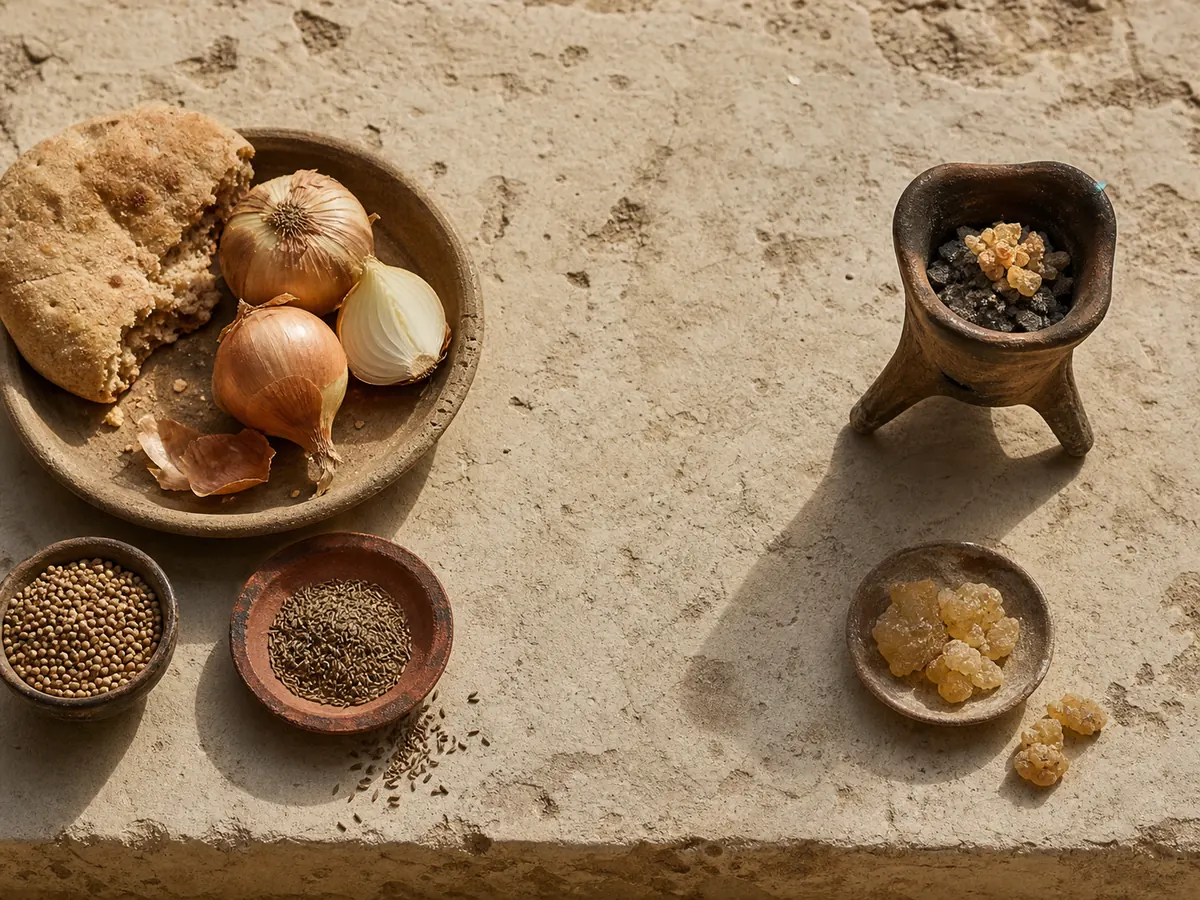
- Food side: Seeds sit with bread, onions, and meal preparation.
- Ritual side: Resin sits with a burner and fragrance use.
- Empty space: Context keeps one aromatic claim from becoming another.
Context decides the claim. A resin beside a burner means something different from coriander in a seed bag near food remains.
Modern categories are cleaner than ancient practice, but historians still need boundaries. Overlap does not justify turning ritual ingredients into recipes.
Trade changed the pantry unevenly across periods
Egypt's Nile, desert routes, Mediterranean ports, and Red Sea links moved plants and aromatics. Access expanded, contracted, and shifted with political power.
New Kingdom evidence supports established use of cumin and coriander, while expeditions and tribute brought resins and luxury goods from farther south and east.
Hellenistic and Roman rule connected Egypt more tightly to Mediterranean and Indian Ocean trade. Pepper and other imports became easier to document in later contexts.
Roman Egypt belonged to a wider classical market, and Mediterranean imports appear more broadly in excavated contexts. That change cannot be projected backward into Old Kingdom kitchens.
Ports reveal availability before they reveal frequency. Household deposits, price evidence, and repeated food contexts are needed to move from arrival to ordinary use.
High-value aromatics such as clove buds traveled well because tiny amounts carried strong aroma. Later access still does not prove common household use.
| Period lens | Safer claim | Claim to avoid |
|---|---|---|
| Pharaonic Egypt | Local staples plus documented condiments | Every later import was common |
| New Kingdom | Cumin, coriander, and major resin exchange | One standard royal spice blend |
| Ptolemaic Egypt | Growing Mediterranean exchange | Classical texts describe all earlier periods |
| Roman Egypt | Stronger Red Sea and Indian Ocean links | Roman imports were everyday for everyone |
| Late Antique Egypt | Mixed local and long-distance plant evidence | Late finds prove Old Kingdom recipes |
Price and status controlled who encountered distant aromatics. An elite offering, military supply, port market, and village meal cannot stand for one another.
Whole seeds and bark travel better than fresh herbs. The same storage advantage still explains why whole spices last longer.
Trade adds possibility, not proof of use. A route can deliver an ingredient without showing how often cooks used it.
Worker rations and elite offerings tell different food stories
Ration records emphasize bread and beer because institutions measured staples. Tomb offerings display abundance, status, and provision for the dead.
Neither source is a complete household menu. Workers could gather, trade, cook, and share foods that formal records did not count.
Deliveries in kind made cereal unusually visible to administrators. River transport and storage connected harvest assessment with institutional bread and beer production.
Tomb offerings solve a different problem by showing desired abundance for the dead. Their display choices can magnify elite foods and ritual ideals.
Archaeobotany helps fill the gap by identifying seeds, fruits, grains, and weeds from settlements. Preservation still favors some plants over others.
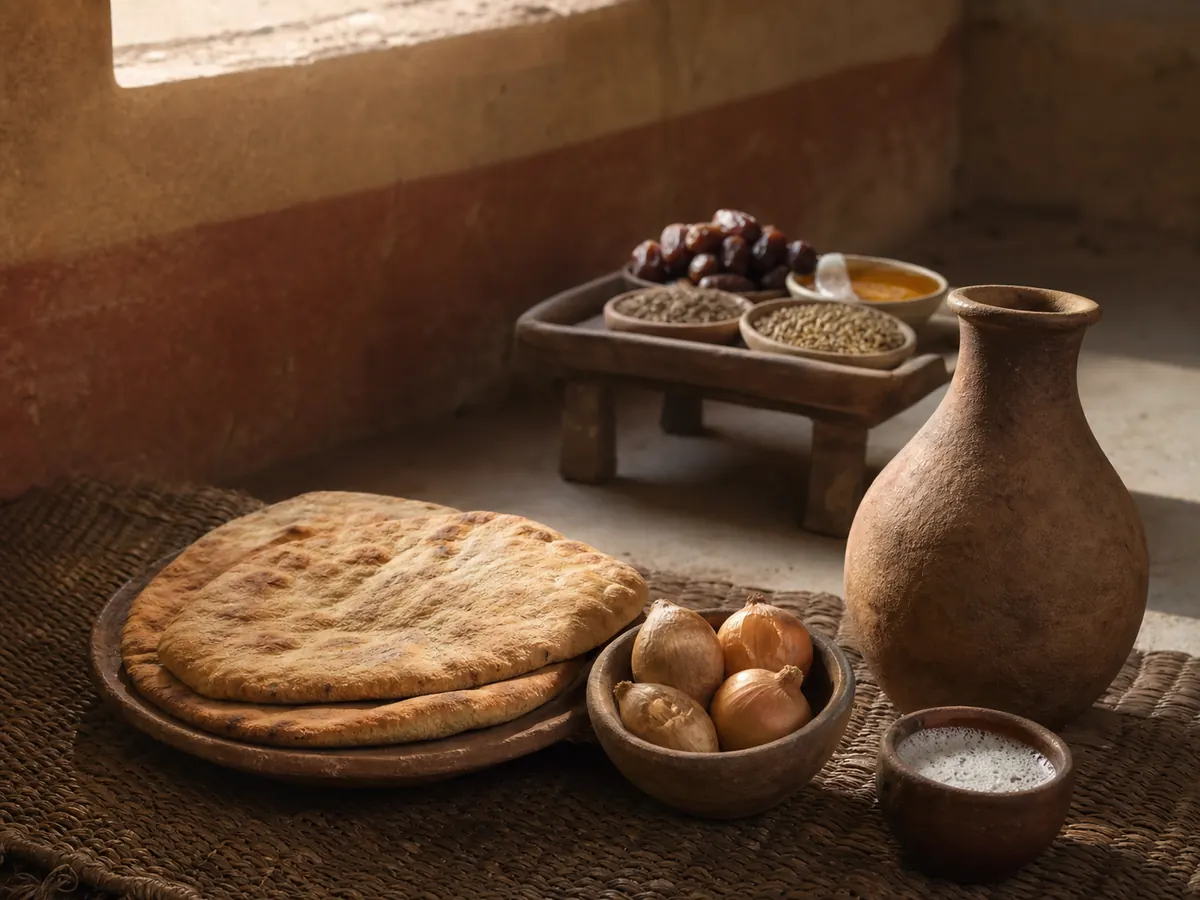
- Rations: Records favor foods measured for labor and institutions.
- Offerings: Images and objects can express abundance or ritual duty.
- Households: Daily combinations remain harder to reconstruct.
- Elite imports: Presence does not prove broad access.
Soft leaves decay more easily than hard coriander or cumin seeds. Absence of an herb is therefore weaker evidence than a well-identified seed find.
Social position also changes interpretation. A rare aromatic in a palace store says little about a laborer's dinner.
The most responsible reconstruction labels its evidence and uncertainty. It can be plausible without pretending to be a recovered recipe.
Why modern Egyptian spice-blend claims go wrong
Modern Egyptian cooking has its own living traditions, including dukkah and other seasoning mixtures. These should not be renamed unchanged pharaonic recipes without evidence.
- Check the date: A Roman-period find cannot prove an Old Kingdom meal.
- Check the context: Incense, medicine, and embalming do not automatically describe food.
- Check the ingredient name: Ancient plant terms may have several modern candidates.
- Check the ratio: Ingredient evidence rarely preserves a measured blend formula.
- Check the label: Plausible reconstruction is honest language when exact recipes are missing.
A reconstruction may combine documented ingredients for education. It becomes misleading when the recipe is sold as exact, universal, or thousands of years unchanged.
A useful reconstruction names its period and marks every inferred step. It should distinguish an attested ingredient from a modern ratio, cooking time, or serving choice.
Use historical grinding methods as a practical clue, not proof of a ratio. Stone tools show capability more clearly than a finished flavor balance.
History becomes richer when uncertainty stays visible. Cumin, coriander, garlic, onion, salt, dates, bread, and beer already tell a substantial food story.
The final lesson is simple. Ancient Egypt had changing kitchens, not one mystical spice cabinet.