
Which Gochugaru Substitute Fits Kimchi, Stews, or Sauces?
Gochugaru Has Four Jobs to Replace
Aleppo pepper is the closest single-jar gochugaru substitute for most cooked dishes.
Start with the same volume, then adjust after tasting because both products vary in heat.
That answer changes for kimchi. A large amount of chile remains visible and only lightly transformed during fermentation, so fruitiness and particle size matter as much as heat.
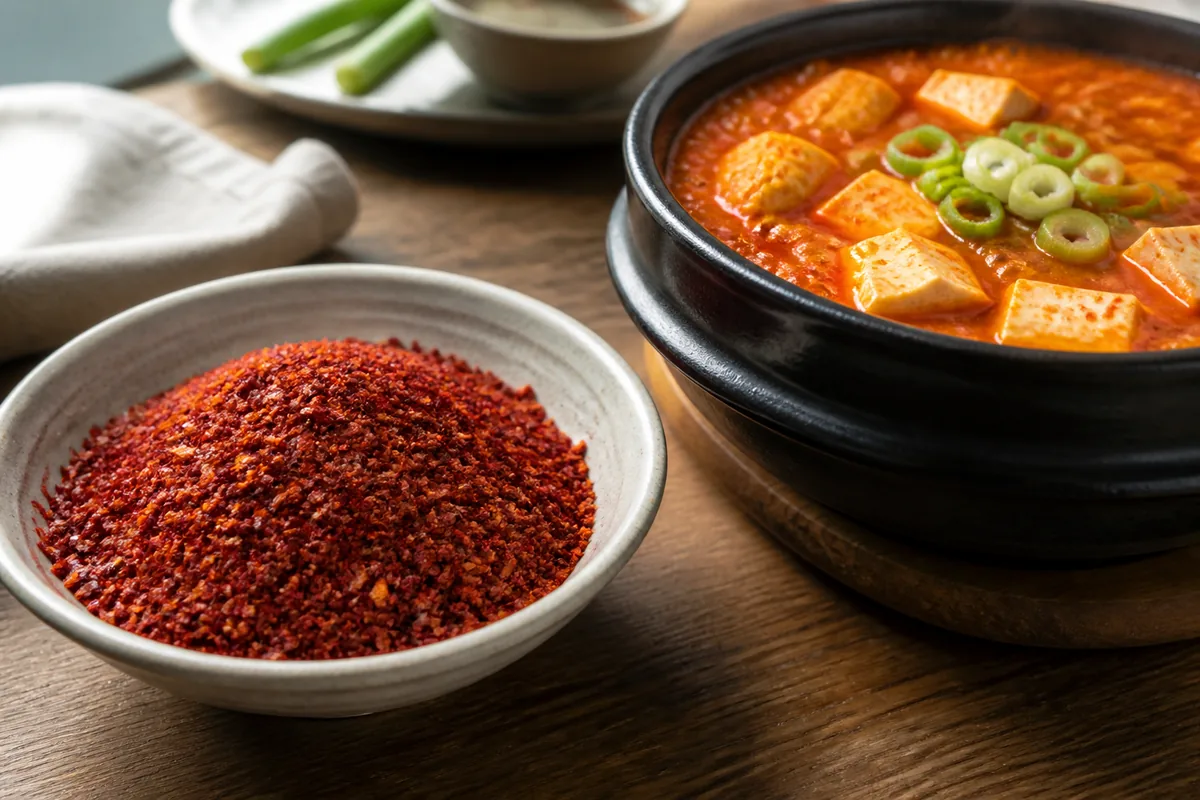
Gochugaru gives food a deep red color, a rounded chile flavor, moderate warmth, and particles that cling to vegetables or remain visible in broth.
Most pantry chiles reproduce one or two of those properties rather than all four.
- Flavor
- Look for fruity or gently sweet chile rather than sharp heat or heavy smoke.
- Heat
- Choose mild or medium when possible because equal volumes of cayenne can overwhelm the dish.
- Color
- A bright or deep red chile keeps sauces and cabbage from turning brown.
- Grind
- Coarse flakes stay visible, while fine powder disperses quickly and thickens wet seasoning.
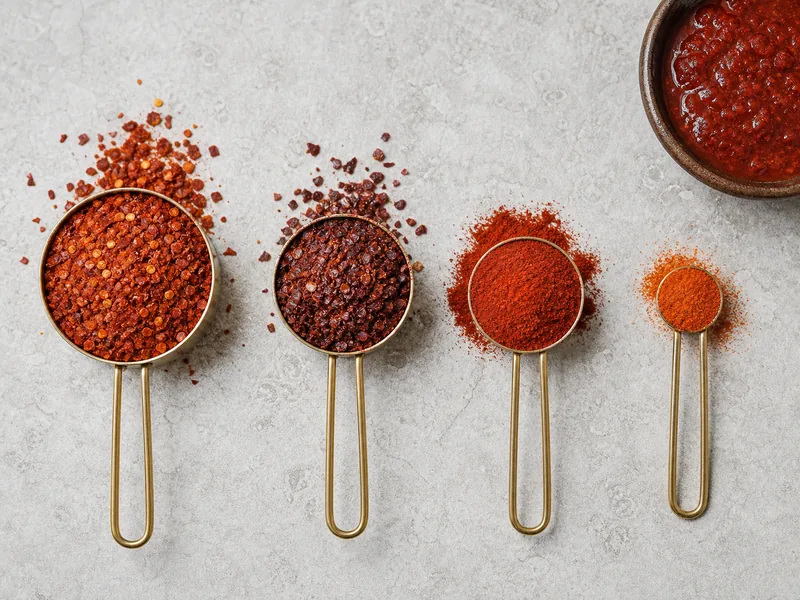
- Coarse flakes: Gochugaru and Aleppo remain visibly textured.
- Smooth powder: Paprika supplies red body without the same particles.
- Tiny measure: Cayenne contributes concentrated heat.
Korean red pepper is sold in coarse, medium, and fine grinds for different jobs. Coarse material is commonly used for cabbage kimchi, while finer products disappear more readily into sauces and pastes.
Seeds and the pale inner tissue of a chile affect the finished heat and color.
A seed-heavy crushed pepper may look similar in the jar but taste sharper and produce a paler, speckled result.
Read the ingredient line before measuring. Salt, oil, smoke flavor, or another chile changes both the ratio and the stage when you should taste.
Five Gochugaru Substitutes with Different Limits
No replacement is neutral.
The useful choice is the one whose main difference the dish can absorb.
Aleppo pepper comes closest on particle size and fruitiness. Sweet paprika mixed with a very small cayenne dose separates color from heat, while smoked paprika and chipotle deliberately move the dish toward smoke.
| Number | Substitute | Starting amount | Best use | Main difference |
|---|---|---|---|---|
| 1 | Aleppo pepper | 1 tablespoon | Stew, sauce, marinade, finishing | Different fruitiness and possible salt or oil |
| 2 | Sweet paprika plus cayenne | 1 tablespoon paprika plus 1/4 teaspoon cayenne | Wet sauce, stew, marinade | Smooth texture |
| 3 | Smoked paprika | 1/2 tablespoon | Grilled meat, roasted mushrooms, smoky marinade | Obvious smoke |
| 4 | Chipotle powder | 1/4 tablespoon | Dark braise, barbecue-style marinade | Smoke, darker color, stronger chile flavor |
| 5 | Cayenne | 1/8 to 1/4 tablespoon | Wet cooked sauce or stew | Sharp heat without red body or flakes |
1. Aleppo Pepper
Use one tablespoon Aleppo pepper for one tablespoon gochugaru in a cooked stew, sauce, or marinade.
Its coarse flakes, moderate heat, and fruity character make it the closest practical match among the options on this page.
Aleppo pepper often feels softer than ordinary crushed red pepper because it has fewer hard seeds and a rounded flavor. The exact heat still changes by producer and harvest.
Some packaged Aleppo pepper contains salt or a small amount of oil. Taste a pinch before reducing the recipe's salt, and loosen oily flakes with a fork so the measure is not packed.
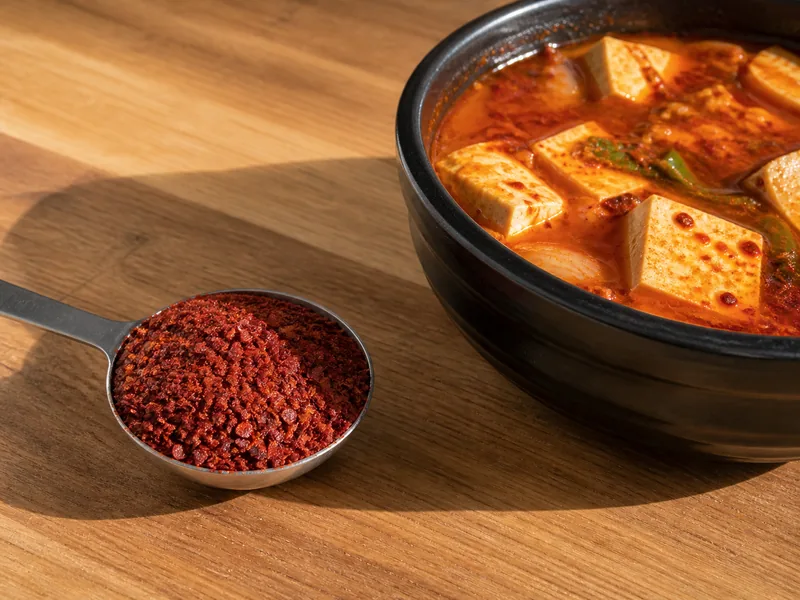
- Level spoon: Begin at the same volume as gochugaru.
- Wet stew: Broth lets the flakes soften and disperse.
- Exposed texture: The substitution remains visible at the surface.
In sundubu jjigae or a moist stir-fry sauce, add it where the recipe calls for gochugaru and let the flakes hydrate.
For a finishing sprinkle, use less at first because the substitute remains exposed on the surface.
A small kimchi test can be acceptable when the product is unsmoked and not salty. It is still a different pepper, so do not season a full cabbage batch before tasting a spoonful of the mixed paste.
2. Sweet Paprika and Cayenne
Combine one tablespoon sweet paprika with one-quarter teaspoon cayenne as a starting replacement for one tablespoon gochugaru.
Sweet paprika supplies red body and mild fruitiness, while the much smaller cayenne measure supplies heat.
Use sweet paprika that is explicitly unsmoked. Hot paprika makes the final strength harder to predict because its heat overlaps the cayenne.
- Measure the color basePut one tablespoon sweet paprika in a small bowl.
- Add the heatMix in one-quarter teaspoon cayenne until no orange streaks remain.
- Season part of the foodAdd three-quarters of the mixture to a wet sauce, stew, or marinade.
- Wait for dispersionStir over gentle heat or let the wet seasoning stand for two minutes.
- Taste before increasingAdd the remainder only if the dish needs both more color and more heat.
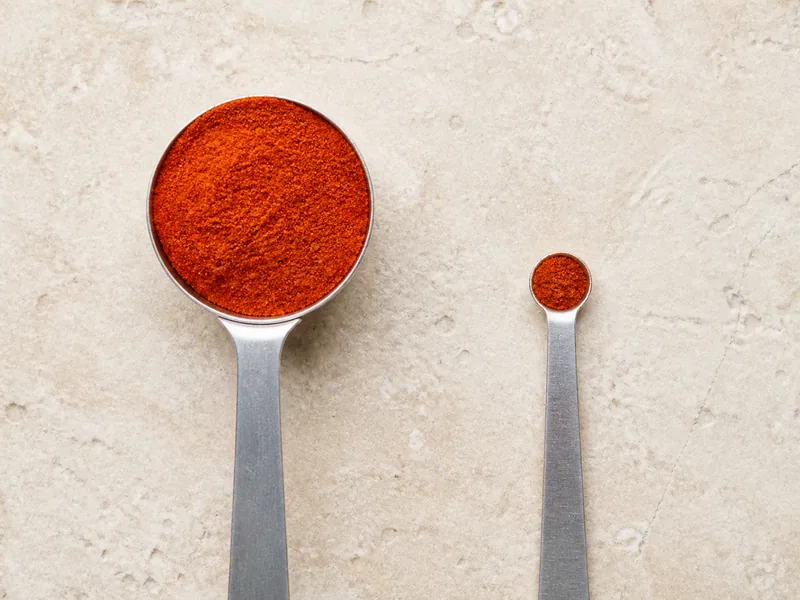
- Large measure: Sweet paprika supplies red color and mild chile body.
- Small measure: Cayenne restores only part of the missing heat.
- Before mixing: The ratio remains easy to verify.
The powders distribute more evenly than coarse gochugaru. That smoothness can be useful in a sauce, but it creates a denser paste on cabbage and removes the visible red flecks.
Do not increase cayenne merely because the food looks pale.
Add more sweet paprika for color, then judge the heat in a separate bite.
3. Smoked Paprika
Smoked paprika works only when smoke already belongs in the dish.
Start with one-half tablespoon for each tablespoon gochugaru, then add a small cayenne pinch if the food needs more heat.
The powder brings strong red color and a softer heat than cayenne. Its smoke remains recognizable after simmering, so a larger dose makes the food taste intentionally different rather than closer to gochugaru.
A browned surface can integrate that change because char and rendered fat already support smoke.
A pale tofu stew exposes it immediately.
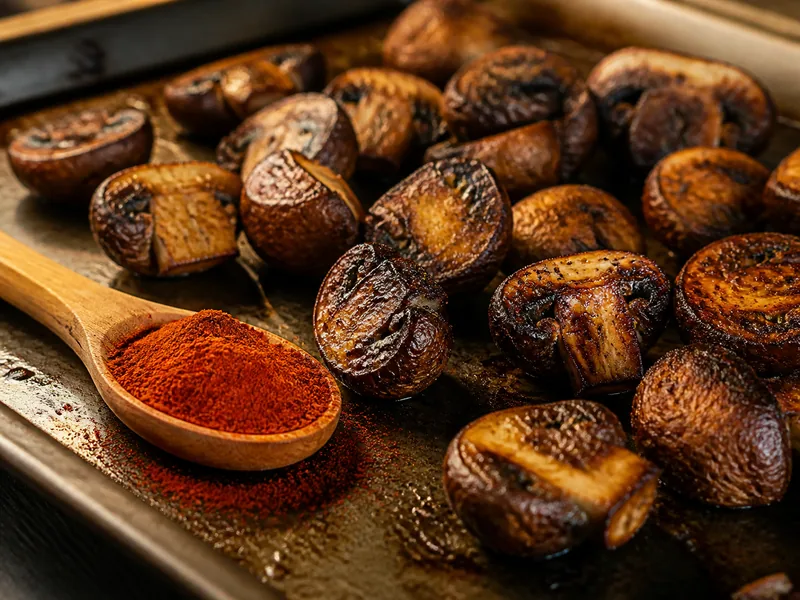
- Charred surface: Roasting already supplies smoky cues.
- Brick-red powder: Smoked paprika adds color with smooth texture.
- Narrow use: Keep it away from kimchi and clear broth.
Taste the finished food before adding more. If color is the only missing property, use a little sweet paprika instead of another smoked dose.
4. Chipotle
Use one-quarter tablespoon chipotle powder for one tablespoon gochugaru in a dark braise or barbecue-style marinade. Chipotle supplies more smoke, a darker red-brown color, and a deeper dried-chile flavor.
That smaller measure protects the dish from both smoke and heat.
It does not rebuild the bright coarse flakes that make gochugaru distinctive.
The sauce can accept a deeper color and long smoke.
Browning supports the chipotle direction when the recipe already has sweetness or soy.
A small dose can disappear into a thick cooked sauce.
Reject it because the smoke and dark powder dominate a high-volume raw paste.
Reject it because the flavor and texture remain exposed.
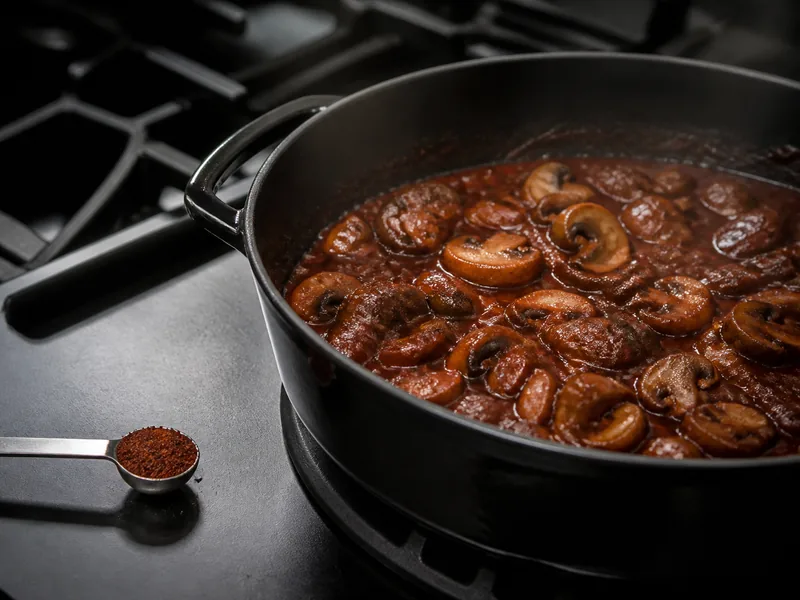
- Quarter dose: Begin well below equal volume.
- Wet sauce: The powder disperses through a dark base.
- Smoke accepted: The finished dish already welcomes a deeper direction.
If the braise needs more red body after the chipotle is mixed in, add unsmoked paprika rather than more chipotle. This keeps the smoke from growing with the color.
Do not use canned chipotle in adobo at the same ratio.
The sauce adds liquid, salt, acidity, and sweetness that a dry chile measure does not contain.
5. Cayenne
Cayenne is a heat correction rather than a complete gochugaru replacement. Start with one-eighth to one-quarter tablespoon for every tablespoon gochugaru, and use the lower end when the package gives no heat indication.
Its fine particles expose a great deal of surface area.
They spread quickly through liquid, but a dry spoonful can create a concentrated hot spot on food.
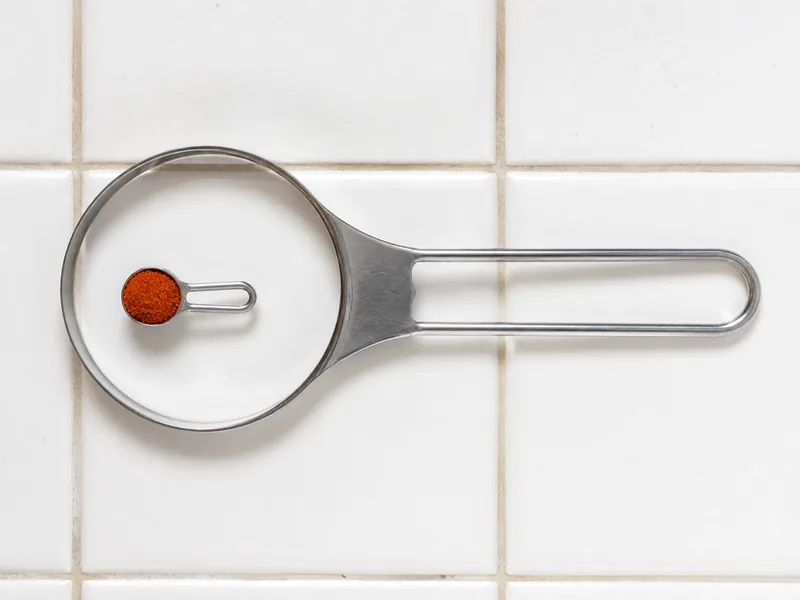
- Tiny inner spoon: Cayenne supplies concentrated heat.
- Large outline: Gochugaru may be measured by the tablespoon.
- Empty space: The missing volume must not be filled with cayenne.
Cayenne works best when another ingredient already supplies color and body. A tomato-red stew or a paprika-based marinade may need only the missing heat.
It is a poor finishing garnish and a poor kimchi choice because it supplies neither coarse texture nor rounded fruitiness. If cayenne is the only red chile available, a less spicy dish is safer than an equal-volume swap.
Kimchi Is the Strictest Test
Kimchi exposes a weak substitute because gochugaru is used by the spoonful or cup rather than as a background pinch.
The chile helps form the visible seasoning paste around the cabbage.
Coarse flakes absorb moisture and cling as separate particles. Fine paprika or cayenne makes a smoother, denser coating, and a smoked chile keeps its smoke through the finished batch.
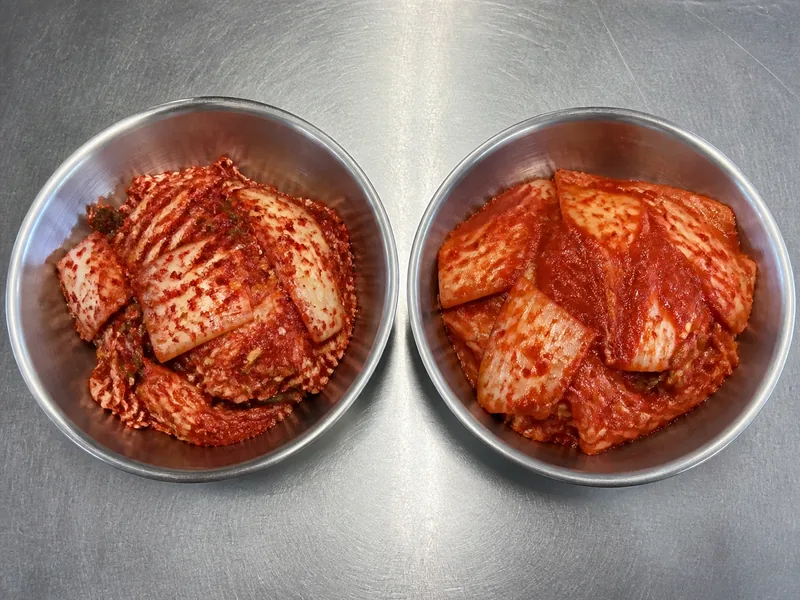
- Flecked bowl: Coarse particles remain visible and cling separately.
- Smooth bowl: Fine powder creates a denser uniform coating.
- Small test: Compare one portion before scaling the recipe.
A substitute does not determine fermentation safety by itself.
Salt level, temperature, vegetable preparation, cleanliness, and the recipe's process still require the same attention.
- Mix a small pasteCombine the substitute with one spoonful of the recipe's wet seasoning.
- Coat one leafRub it onto a small piece of brined cabbage.
- Wait five minutesLet powder hydrate and let coarse flakes soften.
- Taste the full biteJudge heat, fruitiness, salt, smoke, and how the paste clings.
- Choose the batch directionScale up only when the difference is acceptable, or make a chile-free white kimchi recipe instead.
Aleppo pepper deserves the first trial because its particle size is closest. The paprika and cayenne mixture can season a small quick preparation, but its smooth paste will not reproduce the same appearance or mouthfeel.
Smoked paprika and chipotle should not enter this test.
Their main difference becomes a defining flavor when the chile is used at kimchi volume.
Waiting for gochugaru is a reasonable cooking decision. White kimchi is another deliberate direction, while a full batch made with an unsuitable smoked or very hot powder is difficult to correct after fermentation begins.
Match the Replacement to the Cooking Method
Wet cooking gives imperfect substitutes the most room. Broth, sauce, and tofu distribute fine particles, while simmering integrates a slightly different fruitiness.
A dry garnish gives them the least room because the eater meets the chile directly.
Particle size, seeds, salt, and smoke stay obvious on noodles, rice, or a finished pancake.
Use Aleppo pepper first, or the paprika and cayenne mixture when smooth dispersion is acceptable.
Use Aleppo for a brighter result, or a small chipotle dose when the marinade already welcomes smoke.
Add Aleppo or the paprika mixture after liquid enters so fine powder does not scorch.
Smoked paprika can fit an existing charred direction.
Use Aleppo sparingly because its coarse texture is the closest of these options.
Test Aleppo in a small portion, otherwise wait for gochugaru or choose a chile-free recipe.
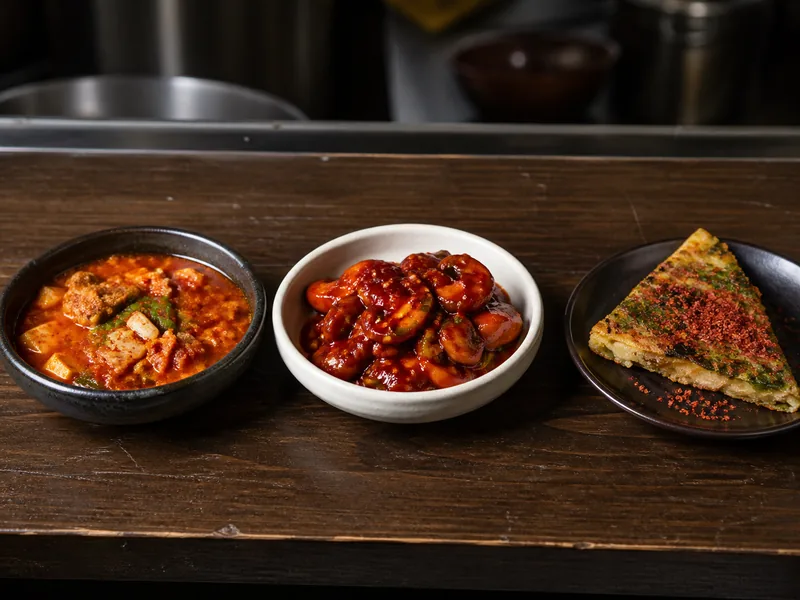
- Stew: Broth integrates fine particles.
- Marinade: A glossy coating can carry a darker chile.
- Garnish: Coarse texture stays exposed on the finished food.
Oil changes the timing. Fine paprika and cayenne can darken quickly in a hot dry pan, so mix them into a wet sauce or lower-temperature oil rather than leaving the powder on bare heat.
Coarse Aleppo flakes tolerate brief blooming but still burn.
Add them after aromatics begin releasing moisture, or stir them into broth where they can hydrate evenly.
A marinade can carry a darker substitute because sugar, soy, garlic, and browning share the surface. Keep the first dose small since cooking concentrates a thin coating.
Powder and Flakes Do Not Measure the Same in Food
Equal spoon volumes do not guarantee equal results.
Fine powder packs tightly and disperses fast, while irregular flakes trap air and remain visible after hydration.
That difference explains why the starting ratios here are practical tasting points rather than exact conversions. Brand heat, grind, seed content, oil, and salt can move the useful amount.
- Very fine powderStart below the listed amount and disperse it in liquid before judging.
- Large dry flakesLet them hydrate for several minutes before deciding that the dish needs more.
- Oily Aleppo flakesFluff before measuring and check whether the package contains salt.
- Seed-heavy crushed chileExpect sharper heat and a paler speckled appearance.
- Smoked productTreat smoke as a permanent flavor choice rather than a small package detail.
A scale can improve repeatability when a recipe uses a large chile quantity, but it cannot make two different products taste the same. Record the brand and amount if you plan to repeat the adjusted recipe.
For a single pot, measuring low and tasting after hydration is more useful than chasing a theoretical conversion.
Increase one property at a time whenever possible.
Correct Heat, Smoke, Color, and Texture Separately
Name the error before adding anything else.
A second random chile often increases heat while leaving the original color or texture problem untouched.
- Too hotAdd more unsalted broth, tofu, vegetables, or sauce base. Do not rely on sugar to remove capsaicin.
- Too smokyDilute with the unseasoned base and stop adding smoked chile. The smoke cannot be strained out.
- Too paleAdd a small amount of sweet paprika when the dish can accept smooth powder without more heat.
- Too darkIncrease the unseasoned base because the dissolved pigment cannot be removed.
- Too smoothAdd coarse Aleppo only when more chile flavor is still welcome. Texture lost to dissolved powder cannot be fully restored.
- Too saltyCheck seasoned or oily Aleppo products, then dilute before adding any more salt.
Dairy and fat can soften the perception of heat in dishes that already allow them, but they also change the recipe. Broth or unseasoned sauce is the cleaner correction in most Korean stews.
Smoke and smooth texture are the least reversible changes on this list.
The best correction may be to redirect the dish toward a smoky braise rather than keep adding ingredients in search of gochugaru.
Omission is sensible when the recipe asks for only a small finishing pinch and every available option is harsh or smoked. The food will be milder, but its other flavors can remain clear.